
Cat and cow is a gentle yoga movement on hands and knees where you move between arching and rounding your back with your breath. Do six to ten slow rounds, keep the range small if anything hurts and use a chair version if the floor is hard.
This is general education, not medical advice. If you have wrist, neck or shoulder injuries, osteoporosis, severe back pain or are pregnant, check with your doctor before practising.
What is cat and cow?
Cat and cow is a gentle yoga movement where you move between rounding and arching your back on hands and knees, linking each movement with your breath. It is also called marjaryasana and bitilasana, from the Sanskrit names for cat pose and cow pose. It is one of the first things many teachers show beginners because it warms the spine and is easy to learn. It is often used as a warm-up before the sequences in our guide to sun salutations.
How do you do cat and cow step by step?
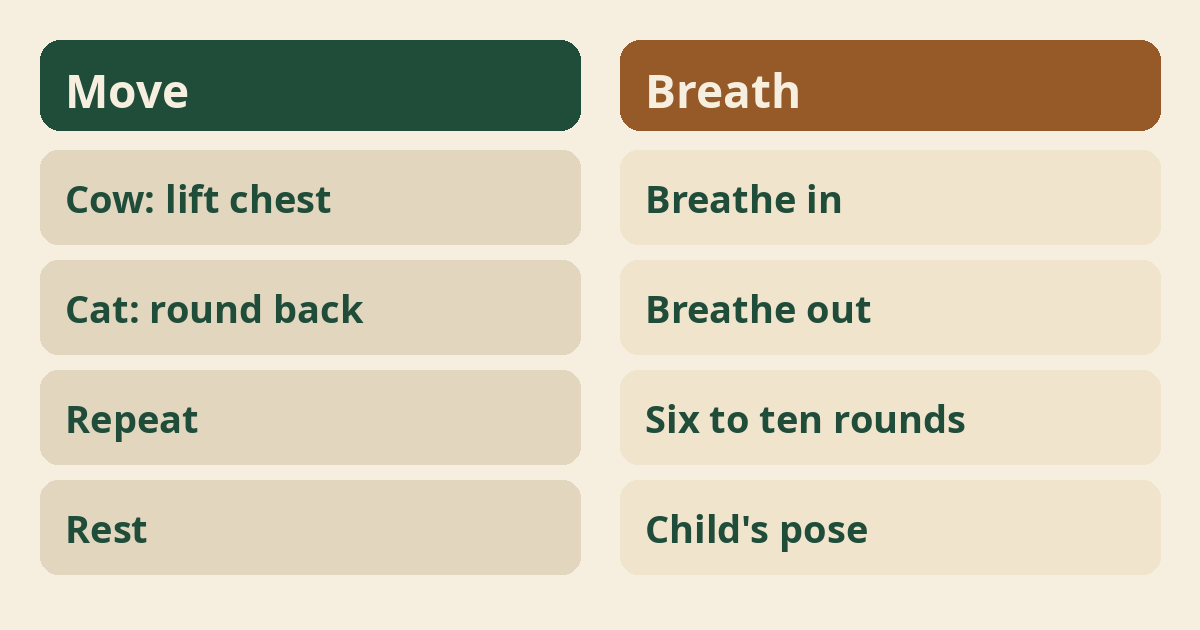
Start on hands and knees, breathe in as you lift your chest and tailbone, and breathe out as you round your back and tuck your chin. Move slowly, and let each movement follow the breath.
- Come onto hands and knees with wrists under shoulders and knees under hips.
- Spread your fingers and keep your neck long.
- Breathe in and gently lift your tailbone and chest, letting the belly soften toward the floor, for cow.
- Breathe out and round your back toward the ceiling, tucking your chin and tailbone, for cat.
- Move back and forth for six to ten slow rounds.
- Keep the movement small if your back or neck feels strained.
- Return to a neutral spine and rest in child’s pose.
What should you feel?
You should feel a gentle stretch along the spine and perhaps the front of the chest and the back of the shoulders, with no pain. If you feel pinching in the lower back or neck, reduce the range. The movement should feel smooth and easy. Keep your arms strong without locking the elbows. Let the breath guide the pace.
Why do people like this movement?
It warms the spine, links breath with movement and is a gentle way to notice how your back feels. The National Center for Complementary and Integrative Health describes yoga as a mind and body practice that includes poses and breathing. Cat and cow fits well as a start. Many people use it as a short break after sitting. It is not a treatment for back pain, but it often feels pleasant.
How should you place your hands and knees?
Place your hands under your shoulders and your knees under your hips, with your fingers spread wide. If your wrists feel uncomfortable, move your hands slightly forward or make fists. If your knees hurt, place a folded blanket under them. Keep your toes tucked or untucked, whichever feels better.
How should you breathe?
Breathe in as you open the chest for cow and breathe out as you round for cat. Keep the breath slow and through the nose. Do not hold your breath. If the pattern feels confusing, simply move in the way that feels good with your natural breathing. Our guide to pranayama explains more about gentle breathing.
How many rounds should you do?
Six to ten slow rounds are plenty for a beginner, and you can do more if it feels good. Slow and smooth is better than quick and big. Pause between rounds if you feel tired. You can repeat the sequence several times a day, for example during breaks.
What are common mistakes?
Common mistakes include moving too fast, going too deep, locking the elbows, scrunching the neck and holding the breath. Another is dropping the head too far. Keep your neck long and in line with your spine. Spread your weight over your hands and knees. Stay comfortable.
What are easy variations?
You can do it seated in a chair, standing with hands on thighs or against a wall if kneeling is uncomfortable. In a chair, place your hands on your knees and arch and round your spine as you breathe. This is a good choice if getting onto the floor is hard. See our guide to chair yoga for more seated ideas.
Is it good for your back?
It can feel good for a stiff back, but it is not a treatment for back pain. If you have back pain, ask your doctor first. Our guides to yoga for back pain and yoga with a bad back explain how to be careful. Move within a pain-free range and stop if anything hurts.
When can you use it?
Use it as a warm-up, a break at your desk or at home, or between other poses. It pairs well with child’s pose and downward dog. It is also a nice way to start the morning yoga routine. A minute or two is enough.
What if your wrists hurt?
Use fists, padding, a wall version or a chair version. Wrist pain is common. Move your hands a little forward, spread your fingers and press through the whole hand. If pain continues, stop and speak with a doctor or physiotherapist.
What if your knees hurt?
Place a folded blanket under your knees or use a cushion, or switch to a standing or chair version. Do not kneel on a hard floor. A softer surface can help. If you have a knee injury, speak with a doctor first. Our chair yoga guide offers easy alternatives.
Can you do it when pregnant?
Many people find it comfortable in pregnancy, but ask your doctor first and keep movements gentle. Cat and cow is often taught in prenatal classes. Keep your belly relaxed and avoid deep arching. Our guide to prenatal yoga explains more.
Who should be careful?
People with wrist, neck or shoulder injuries, osteoporosis or severe back pain should check with a doctor first. This guide is general education and not medical advice. Stop if you feel pain, numbness or dizziness. A qualified teacher can adapt the movement for your body.
How can you add awareness?
Notice each part of the spine moving, from the tailbone up to the neck, and let the breath lead. Try closing your eyes for a few rounds. Notice where the spine moves easily and where it feels stiff. This simple attention is a gentle introduction to mindfulness. Our guide to mindfulness and meditation explains more.
How can you build it into a routine?
Do a few rounds each morning or between tasks, and pair it with a habit you already have. Keep a note of how you feel. Our guide to starting a home yoga practice shows how to build a small routine. Small, steady habits work best.
What should you expect over time?
You may find your spine feels looser and your breath smoother, but results vary, and it is not a cure for any condition. Be patient and kind to yourself. If you have ongoing stiffness or pain, speak with a doctor or physiotherapist. Enjoy the simple movement.
What should you wear and use?
Wear comfortable, stretchy clothes and use a non-slip mat with a folded blanket under the knees. Avoid anything that restricts your waist or makes you slip. A soft mat protects your knees and wrists. If you are practising at your desk or in a chair, wear shoes with good grip. A quiet space helps you focus on the breath. Keep water nearby.
How does it connect to other poses?
Cat and cow leads naturally into child’s pose, downward dog, table pose and many standing poses. Because it warms the spine, teachers often use it at the start of class. You can follow it with a gentle twist such as thread the needle. If you practise alone, you can create a short sequence of cat and cow, child’s pose and downward dog. Keep the breath smooth between moves.
How can you tell if you are doing too much?
If you feel pinching, pain, dizziness or a strong strain in the neck or back, you are doing too much. Reduce the range of motion and slow down. You should feel comfortable throughout. A good rule is that you should be able to breathe easily. If symptoms continue, stop and speak with a professional. Gentle and steady wins over big and fast.
Where to read next
For a calm, beginner-friendly start, Ranjana Sinha’s Begin Where You Are is written for people who want simple steps. Our guide to starting a home yoga practice adds a gentle routine you can follow at home.
Frequently asked questions
How many cat and cow rounds should I do?
Six to ten slow rounds is a good start.
Is cat and cow good for back pain?
It may feel good for some, but it is not a treatment. Ask your doctor if you have back pain.
What if my wrists hurt?
Use fists, padding or a chair version. Speak with a doctor if pain continues.
Can I do it in a chair?
Yes. Place your hands on your knees and arch and round your spine.
When should I do cat and cow?
Any time, such as a warm-up, a morning stretch or a break from sitting.
The bottom line
Cat and cow is a simple way to wake up the spine. Move slowly, breathe easily and keep it comfortable.

