
Yes, you can meditate with your eyes open. Rest a soft, unfocused gaze on a plain spot a little way ahead of you, breathe naturally and return to your breath whenever your mind wanders. It is a normal practice in many traditions.
This is general education, not medical advice. If you have an eye condition or feel distressed during meditation, speak with a doctor or qualified teacher first.
Can you meditate with your eyes open?
Yes, many traditions teach meditation with open eyes, and it is a perfectly valid way to practise. Closing the eyes is common, but it is not required. In several traditions, including some forms of Zen and Tibetan practice, students sit with eyes open or half open. The National Center for Complementary and Integrative Health describes meditation as a group of practices that train attention and awareness, and it does not say that the eyes must be closed.
Why would you keep your eyes open?
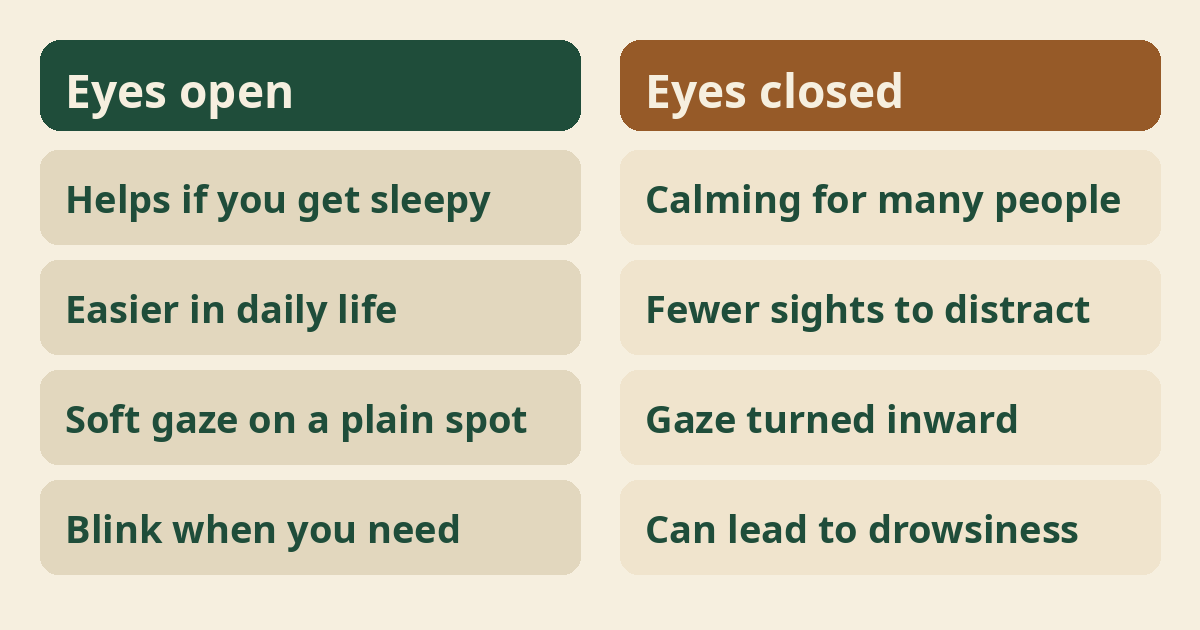
Open eyes help if you feel sleepy, dizzy, or uneasy with closed eyes, and they make it easier to carry the practice into daily life. Some people drift off or fall into daydreams when they close their eyes. Others feel anxious in the dark behind the eyelids. With open eyes, you stay grounded in the room. It can also help you practise in places where closing your eyes is not suitable, such as on a bus or at your desk.
How do you do it step by step?
Soften your gaze, rest it a short distance ahead and breathe naturally while you follow your breath. Keep your head level and your shoulders relaxed.
- Sit comfortably with a tall, easy spine.
- Lower your gaze to a spot on the floor about an arm’s length or two ahead.
- Let your eyes go soft, as if you were not looking at anything in particular.
- Breathe naturally and rest attention on the breath.
- When you notice thoughts or sights pulling you away, return to the breath.
- Blink whenever you need to. Do not stare.
- End by lifting your gaze and noticing the room.
Where should you rest your gaze?
A calm spot on the floor, a blank wall or a candle flame at a comfortable distance works well. Avoid screens, moving objects and bright lights. A plain surface gives the eyes little to do. If you wear glasses, keep them on if they help you feel settled. Avoid straining to keep one point in focus. A relaxed, slightly unfocused gaze is better.
What is a soft gaze?
A soft gaze means your eyes are open but not locked onto anything, like looking through a window rather than at it. Let the muscles around your eyes relax. If your eyes feel tired or dry, blink, close them for a moment or look at something farther away. Eye comfort is a part of good practice. If you have an eye condition, check with your eye doctor about long periods of fixed gazing.
Is it harder than closing your eyes?
It can be at first, because sights and movement pull at your attention. Choose a quiet spot facing a plain wall, and keep sessions short. Many people find that after a week or two, open eyes become easy and even preferred. Our guide on common obstacles to meditation covers wandering attention in more detail.
How long should you practise?
Start with five to ten minutes, and build up slowly if it feels comfortable. Open-eye meditation can be tiring for the eyes, so short sessions are wise. Alternate with closed-eye sessions if you like. Our guide on how long you should meditate has a simple plan for increasing time.
Can you combine it with breath practice?
Yes, open-eye meditation pairs well with gentle breath awareness. Rest your attention on the breath at the nostrils, chest or belly, while your eyes stay softly open. Keep the breath natural. Do not hold or force it. Our guide to pranayama for beginners has simple breathing practices to try separately.
How does it relate to yoga traditions?
Yoga traditions describe turning the senses inward, and some practices use a steady gaze, called drishti, to hold attention. Drishti is used in postures and in some forms of seated practice. A steady, soft focus helps the mind settle. Our guide on the eight limbs of yoga explains where concentration and meditation fit in the wider path.
When is it a good choice?
Open-eye practice suits people who get sleepy, who feel uneasy in the dark, or who want to practise in daily settings. It is also a helpful way to bridge formal sitting and everyday awareness. For example, you can practise a few mindful breaths with your eyes open while you wait for a lift or sit at your desk. If you are meditating before sleep, closed eyes may suit you better. See our guide on morning meditation for ideas on timing.
What should you be careful about?
Avoid staring, bright lights and strain, and stop if your eyes feel sore or you feel dizzy. If you have an eye condition, a migraine tendency or a mental health condition, check with a professional first. If meditation brings up distress, pause and seek guidance from a trained teacher or health professional. This guide is general education only.
What posture and setting help most?
Sit upright on a chair or cushion, face a plain wall and keep the light soft and even. A cluttered view pulls attention, so tidy the space in front of you. Natural daylight is pleasant, but avoid strong glare. Keep your phone out of sight and switch it to silent. Sit so that your back is supported and your neck is relaxed, with your chin slightly down. A steady seat makes a steady gaze much easier.
What if you start to feel spaced out?
Blink, widen your view slightly and feel your feet or hands on the ground. Staring too long at one point can make the mind feel foggy. A soft gaze with awareness of the whole room is more grounded. If the fogginess continues or you feel unwell, end the session and rest. Short, regular sittings are better than long, forced ones.
How do you handle distractions in the room?
Notice them, label them silently as seeing or hearing, and return to your breath. A passing person, a flicker of light or a sound is part of the experience, not a failure. Over time, you learn to let sights come and go without chasing them. If the room is too busy, turn your seat toward a quieter corner or close your eyes for a short while.
Can you meditate with open eyes outdoors?
Yes, a quiet park or garden is a pleasant place, as long as you are safe and the setting is calm. Choose a bench or a flat spot where you will not be disturbed. Rest your gaze on grass or a tree trunk, and let sounds and breeze be part of the practice.
Common myths about open-eye meditation
Some beliefs keep people from trying it. Here are a few of the most common.
- Myth: meditation requires closed eyes. It does not.
- Myth: open eyes mean you are distracted. A soft gaze can be very steady.
- Myth: only advanced practitioners do it. Beginners can too.
- Myth: it is the same as staring. Staring is tense, a soft gaze is relaxed.
How can you switch between open and closed eyes?
Start with open eyes, close them briefly if you feel scattered and open them again when you feel steady. There is no rule against switching. Some people keep eyes open for the first minutes and then close them for stillness. Try both over a week and notice which helps you stay present. Keep the choice that feels comfortable and honest.
What can you notice during practice?
You may notice sights, sounds, thoughts, the breath and the feeling of sitting, all coming and going. The practice is not to block these out but to let them pass while you stay with the breath. This is a skill that builds slowly. A short note after each sitting can help you see change over time.
Where to read next
For a calm, beginner-friendly start, Ranjana Sinha’s Begin Where You Are is written for people who want simple steps. Our guide to starting a home yoga practice adds a gentle routine you can follow at home.
Frequently asked questions
Can you meditate with your eyes open?
Yes. Many traditions teach it. Use a soft, unfocused gaze and rest it a short distance ahead.
Is it better to meditate with eyes closed or open?
Neither is better for everyone. Choose what helps you stay present and comfortable.
Where should I look when meditating with eyes open?
At a plain spot on the floor or wall, about an arm’s length or two ahead, with a soft gaze.
Will my eyes get tired?
They can at first. Blink, rest them or close them briefly. Keep sessions short.
Can beginners meditate with eyes open?
Yes. Start with five to ten minutes.
Is it okay to blink?
Yes. Blink whenever you need. Staring is not the aim.
The bottom line
Meditating with your eyes open is a valid and useful way to practise. Use a soft gaze, keep sessions short and do whatever helps you stay calm and present.

