
Raja yoga is the broad path of mental discipline described in Patanjali’s Yoga Sutras, often called the eight-limbed path. Kriya yoga is a smaller set of practices, and in the Sutras it is a short, practical preparation for that path. So Kriya yoga can be seen as one doorway into raja yoga, not a rival to it. This guide explains the two terms in plain words and shows where they meet.
This is general education, not medical advice. If you have a health condition, are pregnant, or feel unsure, speak with your doctor before trying any breathing or meditation practice.
What is raja yoga?
Raja yoga is the yoga of mastering the mind, usually presented through the eight limbs taught in the Yoga Sutras. The word “raja” means royal or chief, which is why it is sometimes called the royal path. It includes ethical living, simple observances, posture, breath regulation, withdrawing the senses, concentration, meditation and absorption.
Many people first meet these ideas through the limbs themselves. If you want the full list in order, read our guide to the eight limbs of yoga. In everyday speech, “raja yoga” and “classical yoga” or “the eight-limbed path” often point to the same body of ideas.
What is Kriya yoga?
Kriya yoga is a group of yoga practices aimed at settling the mind, and the word “kriya” means action or practice. In the Yoga Sutras, kriya yoga is described as three habits: self-discipline, self-study and surrender to something greater than the self. In some later lineages, the same name is used for a specific set of breath and meditation techniques.
Because the name carries two meanings, it helps to ask which one a teacher or a book is using. Our Kriya yoga for beginners guide explains both in more detail.
What is the main difference between Kriya yoga and raja yoga?
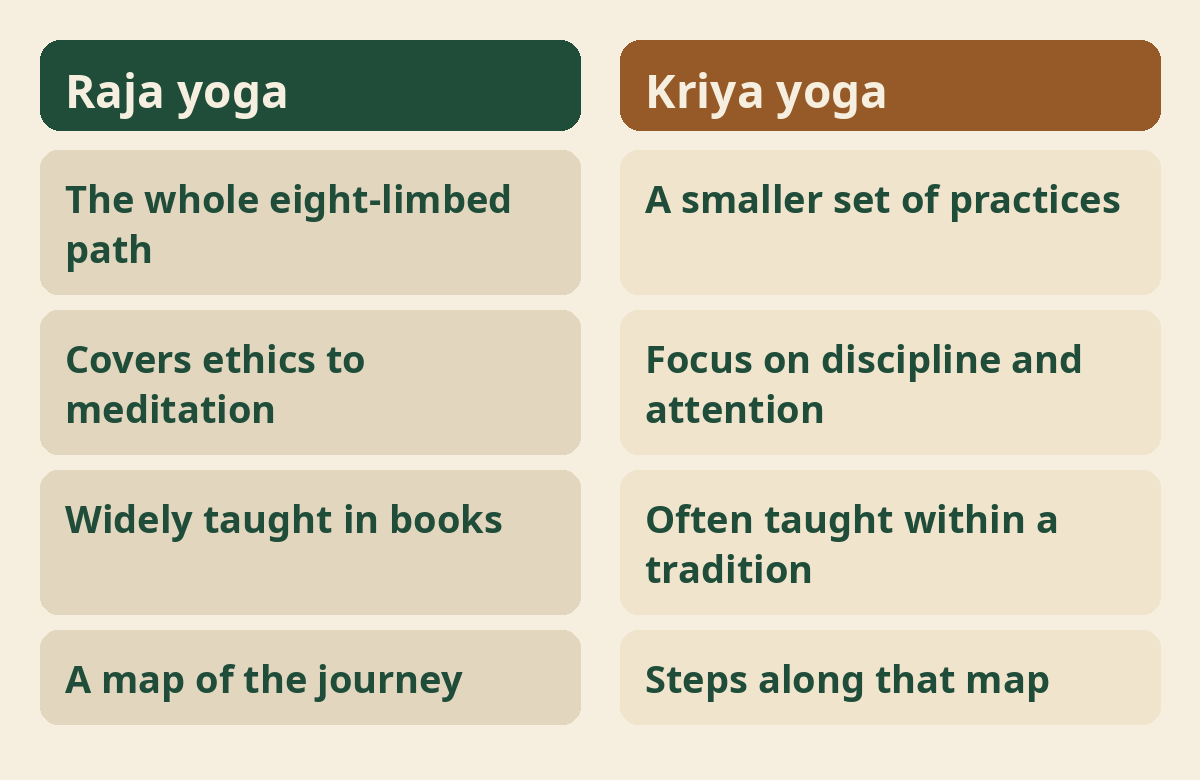
The main difference is scope. Raja yoga is the whole path of eight limbs, while Kriya yoga is a smaller set of practices that prepare or support the mind. One is a map, and the other is a set of steps you can take on that map.
- Size. Raja yoga covers the whole journey. Kriya yoga covers a part of it.
- Source. Raja yoga is tied to the eight limbs. Kriya yoga appears in the Sutras and also in later teaching traditions.
- Practice. Raja yoga can include any limb, from ethics to meditation. Kriya yoga focuses on discipline, study, surrender and, in some lineages, breath and meditation.
- Teaching. Raja yoga ideas are widely published. Specific Kriya techniques are often taught within a tradition.
Is Kriya yoga a part of raja yoga?
In the classical view, yes. Kriya yoga sits inside the wider path of raja yoga as a practical way to prepare the mind. The Sutras present it early, as a way to reduce restlessness and make deeper practice possible. Later teachers built on this idea in different ways, so you may see the two terms used together or kept apart.
You do not need to settle the debate to practise well. It is more useful to know what your own practice is doing: building discipline, steadying the breath or training attention.
How are they used in daily life?
Raja yoga shows up as a way of living and sitting, while Kriya yoga shows up as a short daily routine. A person following a raja yoga approach might think about honesty, simple living and regular meditation. A person doing Kriya practice might keep a set daily time for breath work and quiet sitting.
The two fit together easily. A short, steady routine is one way of living the larger path. Our guide to starting a home yoga practice shows how to build one without pressure.
Which should a beginner start with?
Most beginners do well starting with the basics of raja yoga: a little ethics, a gentle posture, easy breathing and short sitting practice. This is the wider foundation, and it needs no special teacher. Kriya techniques can come later if you feel drawn to them.
If you are curious about the breath side, read our note on Kriya yoga and pranayama, and check whether Kriya yoga is safe for beginners before trying stronger techniques.
How to begin a simple raja-style routine
- Choose one value to practise today, such as honesty or kindness.
- Do a few gentle stretches or a short posture sequence.
- Sit on a chair or cushion with a tall spine.
- Breathe naturally and watch the breath for three to five minutes.
- End by noticing how you feel, then carry that calm into your day.
- Stop any step that causes dizziness, strain or anxiety.
Does either one need a teacher?
Raja yoga ideas can be learned from books and classes, while specific Kriya techniques are often taught by a teacher. A teacher can watch your posture, adjust the pace and notice when something is not suiting you. For general practice, steady effort and a good guide are usually enough.
Choose carefully. A trustworthy teacher is open about what is taught, welcomes questions and takes health conditions seriously. Avoid anyone who pressures you to pay, join or keep secrets.
What do the old texts say?
The Yoga Sutras describe eight limbs and, separately, three habits called kriya yoga. Their wording shows that the two ideas were never identical. The limbs give the structure of the path. Kriya yoga gives a practical starting attitude of effort, learning and humility.
Later writers used the same words in new ways, and some modern schools describe raja yoga mostly as meditation. That is why you will see slightly different explanations from different sources. If you want a simple history, Ranjana Sinha’s book The Journey of Yoga Through Time follows how these ideas developed.
Is there research on these practices?
Research on meditation and breathing practices is still growing. The National Center for Complementary and Integrative Health summarises what is known about yoga effectiveness and safety and meditation and mindfulness. These pages describe general findings, not results for any one named technique.
Who should be careful?
People with heart, lung or blood pressure conditions, pregnant women and anyone who feels unwell should speak with a doctor before breath practice. People who tend toward panic or anxiety may also prefer to keep sessions short and gentle. Meditation is generally quiet and low risk, but it is not right for every person at every moment. Stop if you feel unwell.
How do the goals of the two differ?
Raja yoga aims at a steady, clear mind through the whole path, while Kriya yoga aims at preparing the mind so that path becomes easier to walk. The first is a destination described in broad terms. The second is a method of getting ready. In practice the two goals blur together, because a calmer mind helps every limb.
It is worth being modest about big claims. Writers sometimes promise dramatic results from either path. A safer view is that both are tools for attention, and the benefit comes from regular, gentle effort over a long time, not from any single technique.
What does a simple weekly plan look like?
A balanced week can mix short daily sitting with one longer session for reading or reflection. For example, sit for five to ten minutes each morning. Once a week, spend a little longer on a gentle posture sequence and a quiet read. This keeps the habit light and gives you room to notice what suits you.
- Daily: easy breathing and quiet sitting.
- Weekly: a longer posture session and a short reading on one of the limbs.
- Monthly: a short review of what has helped and what has felt forced.
If you want to add structure, a class or a teacher can help. Keep the plan small enough that you will actually follow it.
Common myths
- “Kriya yoga and raja yoga are the same thing.” They overlap, but one is a path and the other is a set of practices.
- “Raja yoga is only meditation.” It includes ethics, posture and breath as well.
- “You must choose one.” You can build a simple routine that draws on both.
- “Advanced means better.” Steady, gentle practice is the best foundation.
Where to go next
For a calm starting point, try our guides to how long to meditate and how long it takes to learn Kriya yoga. If you like reading, Ranjana Sinha’s Begin Where You Are is written for beginners.
Frequently asked questions
Is Kriya yoga the same as raja yoga?
No. Raja yoga is the whole eight-limbed path. Kriya yoga is a smaller set of practices that sits within or alongside it.
Is raja yoga harder than Kriya yoga?
Not necessarily. Raja yoga is broader, so it can feel bigger. Specific Kriya techniques can ask for more structure and guidance.
Can I practise both?
Yes. Many people combine a simple raja-style routine with a short breathing and sitting practice.
What does raja yoga mean?
It means royal or chief yoga. It refers to the path of mastering the mind, often taught through the eight limbs.
Do I need a guru for raja yoga?
No. The basic ideas can be learned from books and classes. A teacher helps with deeper practice.
Which is better for beginners?
The wider raja-style basics are an easier start: gentle posture, easy breathing and short sitting practice.
The bottom line
Raja yoga is the whole path, and Kriya yoga is a set of practices within it. Start with simple, steady basics, and add more only when you feel ready.

