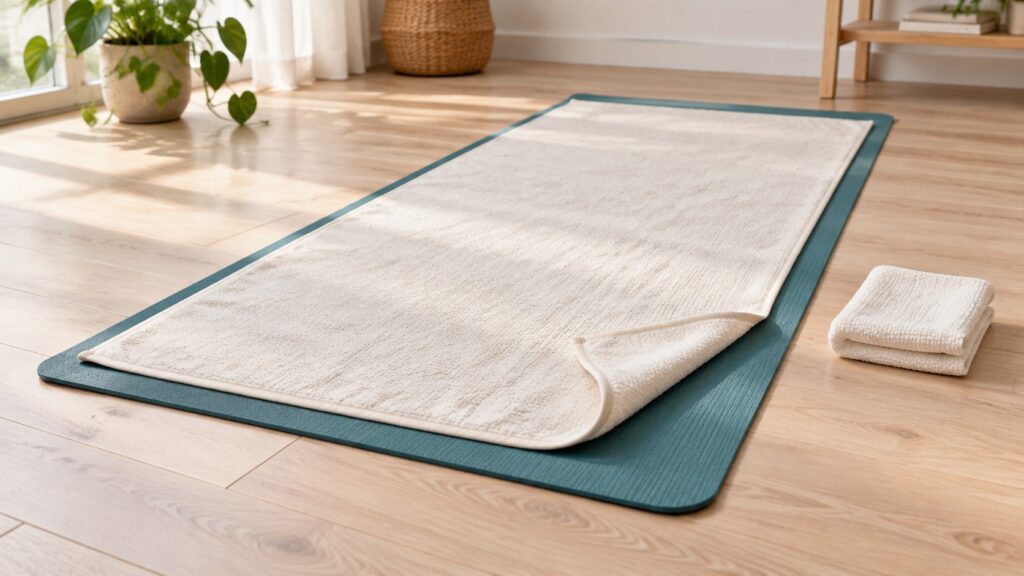
A yoga mat and a yoga towel usually do different jobs. The mat is the main practice surface, providing a layer between you and the floor. A yoga towel is a textile layer that may absorb sweat or change the feel of that surface. Many yoga towels are designed to sit on top of a mat rather than replace it.
If you are choosing what to bring to practice, start with a suitable mat. Add a towel when its design and your practice make it useful. Do not assume that any towel will prevent slipping, or that a thin towel on a hard floor offers the same cushioning as a mat.
The details depend on the product. Some manufacturers allow particular towels to be used directly on the floor; others explicitly call their product a topper that needs a mat underneath. Read the instructions for the item you actually have.
What is a yoga mat for?
A yoga mat creates a defined practice surface. Its thickness, texture, material, and construction affect how it feels under your hands, feet, knees, and body. Different mats are designed for different preferences and conditions, so “non-slip” is not a promise that every mat will grip equally well in every situation.
A mat also needs to stay stable against the floor. If the whole mat slides, adding a towel on top does not fix the contact between the mat and the floor. Check the floor, the underside, and the suitability of the setup before continuing.
For the broader choice of a main practice surface, see our guide to choosing a yoga mat. This comparison focuses on what an additional towel changes and what it does not.
What is a yoga towel for?
A yoga towel is a textile accessory designed for practice. A small hand towel may be placed where extra moisture absorption is needed. A full-length towel may cover much of the mat. Some have grip features on the underside, textured fabric, corner pockets, or another way to help keep them in position.
Manufacturers commonly describe these towels as useful for sweaty practice because they absorb moisture. Some fabrics develop more grip when damp. That is a product-specific feature, not a rule that every towel should be soaked before use.
A towel can also provide a washable textile layer over a shared mat. It does not disinfect the equipment underneath, and it does not remove the need to follow the studio’s hygiene process. Think of it as another layer with its own care needs.
The main differences at a glance
On a small screen, swipe the table sideways to read all columns.
| Question | Yoga mat | Yoga towel |
|---|---|---|
| Main role | Main practice surface between body and floor. | Usually an added textile layer for moisture management or surface feel. |
| Cushioning | Varies with thickness and construction. | Usually much less than a mat; do not assume equivalent support. |
| Moisture | Some surfaces absorb it; others do not. | Often designed to absorb sweat, depending on the fabric. |
| Position | Usually placed directly on a suitable floor. | Often placed over a mat; direct-floor use depends on the product. |
| Care | Follow the exact mat’s cleaning instructions. | Follow the towel’s separate wash and drying label. |
Neither item makes balance or footing automatic. Check how your actual mat, towel, and floor work together. If the towel bunches, slides, or changes grip unexpectedly, stop and adjust the setup rather than assuming it will improve during the next pose.
Do beginners need both?
Not necessarily. If your mat feels comfortable and stable in the conditions you practise in, you may not need a full-length towel. Buying more accessories is not a requirement for beginning yoga.
A towel may be useful if moisture makes the surface difficult to use, if you prefer a washable layer on shared equipment, or if a teacher recommends one for the particular class and mat. A small hand towel may meet a limited need without covering the whole mat.
Try to identify the problem first. “My hands slide when they are sweaty” is different from “the mat slides on the floor” or “my knees need more cushioning.” A towel designed to absorb sweat may help the first issue in some setups. It does not necessarily solve the others.
Does a towel improve grip?
Sometimes, but not automatically. Manduka describes its hot-yoga towels as moisture-activated and useful for sweat management. Its guide also says that a towel may not solve slipping with dry hands and can sometimes make it worse when moisture is absent.
Check where the slip occurs. Is your skin sliding on the towel? Is the towel moving on the mat? Is the mat moving on the floor? These are different contacts. A grippy underside does not prove that the upper fabric suits dry palms, and an absorbent fabric does not guarantee that it will stay flat.
Follow the maker’s setup instructions, including which side faces down. If light dampening is recommended, use that method rather than wetting the whole towel by guesswork. A towel that feels stable in one practice may behave differently when dry, wet, freshly washed, or used on another mat.
No accessory should be used to push through a situation where you cannot keep stable footing. Pause, dry your hands if appropriate, adjust the equipment, or ask the teacher for another option. Avoid treating a towel as a repair for a worn-out mat.
Can a yoga towel replace a mat?
There is no universal answer for every towel and surface. Yoga Ether explicitly describes its Etherloom as a topper, not a replacement for a mat. Manduka’s Yogitoes instructions allow that particular towel to be placed over a mat or directly on the floor. Those different instructions should not be collapsed into a blanket rule.
Even when a product permits direct-floor use, consider what is missing compared with your usual setup. A thin textile may not provide the cushioning you expect on a hard floor. The floor must also be suitable, clean, and stable for that use.
For travel, a towel may be compact, but compactness alone does not establish that it can replace your mat. Check the product’s intended use and the conditions at your destination. If a studio supplies mats, ask about those arrangements instead of assuming a towel will be sufficient.
Is a regular bath towel the same thing?
No. A household towel can be useful for wiping sweat, but it is not automatically designed to stay in place as a practice surface. Thickness, weave, absorbency, and backing differ between products.
Do not put a loose towel under your hands or feet and assume it will grip because it feels soft. Test any permitted setup cautiously before practising, and remove a layer that moves or bunches. A towel used for drying yourself can stay beside the mat rather than becoming part of the surface.
A yoga-specific label is not a guarantee either. Read the intended use and care instructions, and judge the actual stability of the combination. Avoid relying on marketing phrases such as “zero slip” as if they remove the need to check your footing.
How to set up a mat and towel together
- Start with the mat. Lay it on a clean, suitable floor and check that it sits flat without sliding.
- Check the towel’s orientation. Put any designated grip side down, following the product instructions.
- Line up the working area. Smooth folds and ensure the places you expect to use are covered as intended.
- Follow any moisture guidance. Only lightly dampen areas if the maker recommends it; do not assume saturation improves grip.
- Check before moving. Notice whether the towel or mat shifts under light pressure. Adjust or remove an unstable layer.
Keep the setup easy to change. If something moves during practice, pause and flatten it rather than trying to fix it while balancing. Ask a teacher for help if the surface keeps feeling unreliable.
Wash the towel and clean the mat separately
A washable towel does not make a mat machine washable. Each item has its own instructions. A towel may tolerate laundering that would damage the surface or layers of the mat underneath.
For example, Manduka recommends cold washing for its Yogitoes towel and warns against fabric softeners or dryer sheets because they can reduce grip performance. It also notes possible dye transfer from darker colors. These are useful reasons to read the label before first use, especially with a pale mat or light clothing.
Drying rules also vary. Some towels allow low tumble drying, while others call for air drying. Follow the product’s care instructions rather than applying one brand’s method to every towel.
After practice, do not roll a damp towel tightly inside the mat and leave both in a closed bag. Separate them and dry them as directed before storage. For the mat itself, use the maker’s exact care instructions rather than assuming a towel has kept every part clean.
Choose based on the problem, not the accessory list
If you need a main practice surface, choose a suitable mat first. If sweat is the issue, consider whether a small or full-size practice towel is appropriate. If discomfort is the issue, review the mat, support, position, and teacher’s suggestions rather than assuming another fabric layer is enough.
If the mat has lost grip through wear or damage, inspect it and ask the manufacturer about replacement. If cleaning residue is the issue, follow the approved cleaning method. Buying a towel without identifying the cause can leave the same problem underneath a new accessory.
You do not need a towel because other people in a class use one. The useful choice is the one that suits your actual equipment and practice while remaining easy to clean and use safely.
Frequently asked questions
Do I put a yoga towel above or below the mat?
A mat towel is generally designed to go on top of a mat. Follow the instructions for the exact product, including which side faces down.
Can I use a yoga towel without a mat?
Only if the product permits that use and the surface is suitable. Some towels are explicitly toppers that require a mat. Do not assume equal cushioning.
Will a towel stop all slipping?
No. Grip depends on the towel, moisture, mat, floor, and setup. A towel can slide or bunch and may not help with dry-hand slipping.
Should I wet every yoga towel before practice?
No. Some makers suggest light dampening for particular towels. Follow the product instructions rather than soaking any towel by default.
Does a towel disinfect a shared mat?
No. A textile layer is not disinfection. Follow the facility’s cleaning process and wash your towel as directed.
The bottom line
A mat is usually the foundation; a towel is an optional layer for a particular need. Choose the combination by checking support, moisture, stability, and the manufacturer’s instructions. If a layer makes the surface less predictable, remove or adjust it rather than forcing the practice.