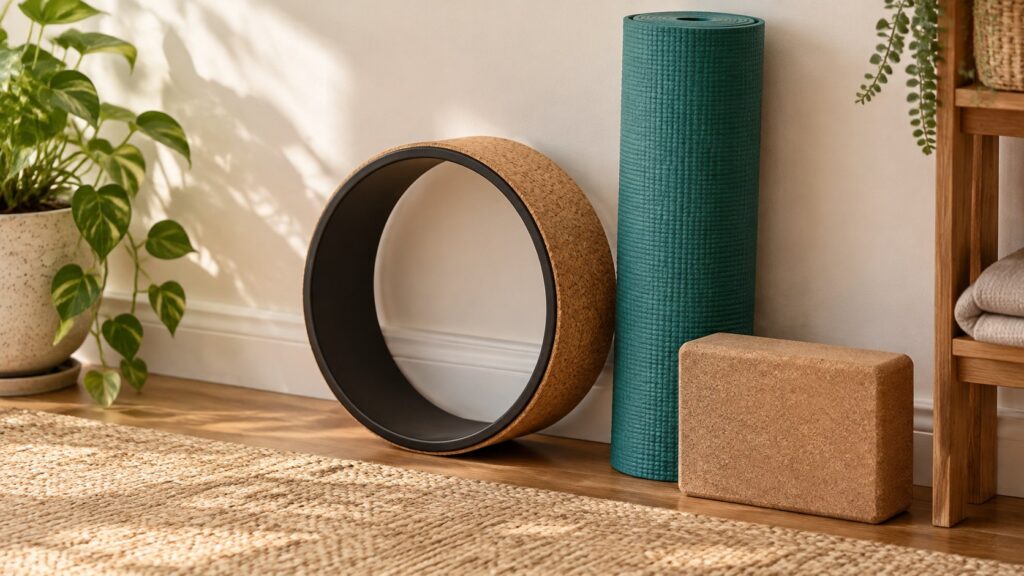
A yoga wheel is a circular prop used in some yoga practices for support, movement, or balance work. Many models have a rigid ring with an outer layer of padding or cork; others use a broader foam construction. Its shape lets it roll, which makes it different from a block or bolster.
A wheel is optional equipment, not a requirement for starting yoga. It does not make a backbend automatically safe, treat a back problem, or remove the need for suitable instruction. If you are new to the prop, the most useful first step is to understand the exact product and learn an appropriate use with a qualified teacher.
This guide explains what to check before using a wheel. It is not a self-directed backbend routine or a recommendation to balance on the prop.
A yoga wheel is not Wheel Pose
The names can be confusing. A yoga wheel is an object. Wheel Pose is a yoga posture. Owning the object does not mean you need to practise that pose, and the prop is not a shortcut that makes an advanced posture appropriate for every beginner.
Manufacturers show wheels in many settings, including supported stretching and more demanding balance work. Those photographs demonstrate possible uses by particular people. They do not tell you which use suits your body, experience, health, or equipment.
Start with your practice needs rather than a photograph of a deep backbend. A teacher may suggest a different prop, a modified movement, or no wheel at all. A less dramatic setup can be the more appropriate choice.
What makes the shape different?
A block offers flat faces. A bolster provides a cushioned support. A wheel has a curved contact surface and can roll. That means the point of contact and the amount of support can change as your body or the prop moves.
The same feature that makes a wheel useful in one exercise can make it unsuitable in another. “Support” does not necessarily mean that the object will remain still. Do not assume a circular prop behaves like a fixed bench or a stable wall.
Different wheel designs also behave differently. Diameter, width, material, surface texture, and construction all matter. A wide foam wheel and a narrow rigid ring should not be treated as interchangeable simply because both are sold as yoga wheels.
What to check on the product
On a small screen, swipe the table sideways to read both columns.
| Check | Why it matters |
|---|---|
| Exact model and intended use | Instructions for one wheel do not automatically apply to another. |
| Diameter and width | These affect the shape and contact area. Bigger or smaller is not universally better. |
| Materials and padding | Construction affects surface feel, care, and the way the prop responds to load. |
| Stated load limit | A limit is product-specific and is not permission for every movement below that number. |
| Condition | Cracks, loose layers, or other damage need attention before use. |
| Care instructions | Cleaning methods must suit the ring, outer layer, and any bonded materials. |
Read the included guide before the first session. If the product arrived without usable instructions, ask the manufacturer or seller for them. Do not borrow a similar-looking wheel’s instructions as if the products had been tested in the same way.
Why a load rating is not a safety guarantee
A manufacturer’s stated capacity describes that product under its stated conditions. It does not establish that every pose, balance, or moving load is appropriate. The position of the wheel, the surface beneath it, and how weight reaches it still matter.
Published capacities vary between products. That is one reason not to use a number copied from an unrelated wheel. Follow the instructions for your model and ask the manufacturer if a proposed use falls outside what the guide explains.
A higher capacity also does not make a wheel a medical device. If your goal is relief from pain or rehabilitation after injury, seek individual advice rather than treating a product rating as evidence of a therapeutic benefit.
Learn the prop with suitable instruction
NCCIH recommends learning yoga with a qualified instructor and notes that learning without supervision has been associated with increased injury risk. That general guidance is useful when considering a prop that can roll and change the amount of support during movement.
Tell the teacher that you are new to wheels, even if you have practised yoga before. Experience with a mat or blocks does not mean you already know the behaviour of a circular prop. Ask the teacher to explain the purpose of a setup and how to leave it safely.
A Yoga Design Lab wheel guide describes itself as a reference to use with instruction from a trained yoga professional. That is a more cautious way to read a pose chart than treating every picture as a home exercise assignment.
You should be able to ask for a simpler option. A teacher who understands the prop can help decide whether a block, bolster, chair, wall, or another setup is more appropriate for the intended task.
Who needs individual advice first?
If you have a health condition, injury, balance concern, or are pregnant, discuss your needs with your health professional and yoga teacher before starting a new practice. NCCIH notes that some people need to modify or avoid particular yoga practices, including those with certain injuries, spinal conditions, severe high blood pressure, or glaucoma.
That does not mean one generic list can clear everyone for wheel use. Your condition, treatment, movement limits, and the proposed exercise matter. Advice about general yoga is not automatically advice about loading your body over a curved prop.
If you are recovering from surgery or have specific rehabilitation instructions, follow those instructions. Do not substitute a wheel routine found online for a clinician’s plan. The Body Wheel’s own disclaimer also advises people with health issues or spinal abnormalities to consult a health professional.
Do not use the wheel to force range
A prop is not a reason to push farther than feels comfortable or to copy someone else’s shape. NCCIH advises beginners to avoid extreme practices such as headstands and shoulder stands. A wheel in the picture does not remove that caution.
Be especially careful with instructions that promise a rapid “spine release,” a guaranteed correction, or a deeper pose for everyone. Those claims do not establish that a particular movement is suitable for you. A product page may describe benefits enthusiastically without providing clinical evidence for treating a condition.
If pain, dizziness, discomfort, or difficulty develops, stop. Do not wait for a fixed number of breaths or repetitions to finish. Seek appropriate professional advice if symptoms persist or if you are unsure what caused them.
Set up the space before any approved use
Use the surface and arrangement specified by your instructor and product guide. Clear enough space to move without hitting furniture or other objects. Keep children and pets away from the active area so an unexpected movement does not interrupt the exercise.
Check that the prop and floor are clean and dry as required. A mat can be part of the setup, but placing a wheel on a mat does not automatically prevent rolling or slipping. Follow the actual instructions rather than assuming more layers always mean more stability.
Know how you will stop and put the prop aside before beginning. If you cannot safely enter or leave the position, it is not an appropriate solo experiment. Ask for direct instruction or choose a different practice.
How to care for a yoga wheel
Follow the exact model’s cleaning instructions. For example, Yoga Design Lab’s cork wheel page says to wipe its cork surface with a damp cloth, air-dry it completely, and store it in a cool, dry place away from direct sunlight. That is a product-specific method, not a universal recipe.
Do not soak a wheel unless the manufacturer explicitly allows it. A surface that looks washable may be bonded to another material. Avoid applying strong cleaners, oils, or improvised treatments that the maker has not approved.
Let the prop dry before use and storage. Check its condition regularly, including the inner ring and outer layer. If you notice damage, deformation, or a loose covering, stop using it and contact the manufacturer for advice rather than trying to hide the defect with tape or another layer.
Store the wheel so it cannot roll into a walkway. Keep it away from conditions that the maker says can damage it. Good storage is part of keeping the equipment predictable for the next use.
Do you need to buy one?
No. A wheel is one optional prop among many. You can develop a yoga practice without it, and an accessory is not a measure of commitment or skill.
If you are curious, ask a teacher whether you can learn with an appropriate studio prop before deciding what equipment you need. Identify the intended use first. The right question is not “Which wheel makes me more flexible?” but “Does this prop suit the practice I have been taught?”
For general equipment context, see our yoga props guide for beginners. A simple, suitable setup is more useful than a collection of props without clear instructions.
Frequently asked questions
Is a yoga wheel the same as Wheel Pose?
No. The wheel is a prop; Wheel Pose is a posture. You do not need to practise that pose to understand or consider the prop.
Is a yoga wheel necessary for beginners?
No. It is optional equipment. Learn the basics with suitable instruction and use props when they serve a clear purpose.
Can it treat back pain?
Do not treat a yoga wheel as a treatment for a back condition. Seek individual medical advice about pain, injury, or rehabilitation before trying a wheel routine.
Does a high load rating make every pose safe?
No. A load rating is product-specific and does not establish that every movement or balance is appropriate for you.
Can I learn from a pose chart alone?
A chart cannot assess your needs or help you leave a difficult position. Use qualified instruction and the exact product’s guide rather than copying advanced examples.
The bottom line
A yoga wheel is a curved, rolling prop with uses that depend on its design and the person using it. Understand the product, seek suitable instruction, and avoid treating deeper movement as the goal. You do not need a wheel to practise yoga, and you never need to push through symptoms to make use of one.