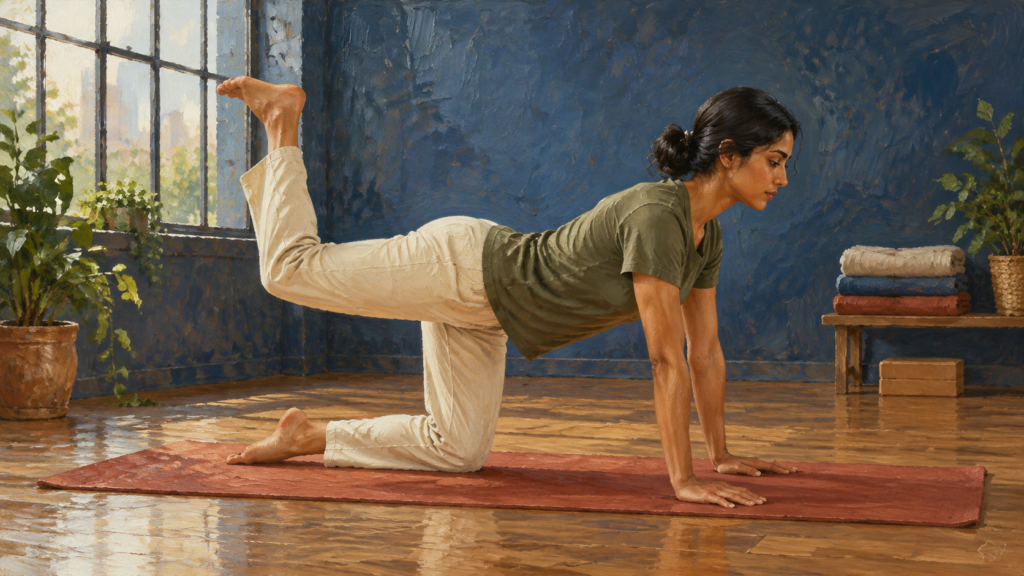
Tiger Pose, or Vyaghrasana, starts on hands and knees and adds a lifted, bent leg with a backbend. That last detail matters: it is not simply Bird Dog with the knee bent. Bird Dog usually asks you to keep the back relatively neutral; Tiger introduces extension as well as a change in balance.
This guide stays with the version that keeps both hands down. It does not teach a foot-to-head target, a one-handed ankle hold or a swinging, breath-held sequence. Learn a manageable version with a qualified teacher rather than using leg height as your measure of success.
What changes when one knee leaves the floor?
In ordinary tabletop, both hands and both knees form the base. Lifting one leg leaves both hands and the other knee doing the supporting work. The backbend adds another movement to that smaller base.
Before adding the lift, check whether hands-and-knees support is comfortable. Tiger is not a wrist-free or knee-free practice. Padding can change contact with the floor, but it does not make joint pain something to work through.
Separate the lift from the urge to go higher
Several teaching sources describe lifting a leg behind you, bending that knee and adding a backbend. They also warn against forcing the range or letting the hip open simply to take the foot higher.
Ask your teacher to show a small version that you can control. Start from a steady tabletop with the hands approximately below the shoulders and the knees below the hips. Move one leg back without swinging it, then explore a modest lift and knee bend. Keep both hands grounded.
Do not chase the sole toward your head. If the pelvis rolls sideways, the lower back pinches or you need to fling the leg upward, reduce the movement or return the knee to the mat. A photograph of a large backbend is not an instruction to reproduce it.
Keep the neck comfortable rather than throwing the chin toward the ceiling. Your teacher can help coordinate the small backbend with the leg movement without turning it into a neck-craning exercise.
Use ordinary breathing, not a breath-holding test
Descriptions of Tiger vary. Some teach a held position; others move between a leg lift and a knee-inward shape. Fitsri’s traditional-style sequence includes breath retention, while other sources use ongoing breathing.
This guide does not prescribe breath retention or repeated swinging between end positions. Keep breathing comfortably and return the knee before fatigue changes your support. There is no required hold time or repetition count here.
Plan the return before starting the other side
Bring the leg back with control and replace the knee on the mat rather than letting it drop. Pause in a comfortable position and check the hands, shoulders, knees and breathing before considering the other side.
You do not have to match the height or time on both sides. If one side feels painful or unfamiliar, do not use the other side’s range as a target. You can stop the practice instead of repeating a movement to investigate a symptom.
Why this is not the same lesson as Bird Dog
In a neutral-back balancing-table or Bird Dog practice, the task is to reach without adding a large backbend. Tiger deliberately includes extension. Yogajala distinguishes those two versions and offers balancing table as a different option when the backbend is not comfortable.
That is a choice between tasks, not a promise that another pose is suitable for an injury. A teacher may recommend a smaller movement, a different starting position or leaving both poses out. You do not need to progress from Bird Dog to Tiger.
Leave the one-handed version for a separate lesson
Some pictures show a hand reaching back to hold the lifted ankle. That removes another supporting contact and adds a shoulder reach and stronger backbend. It is a different balance demand, not an essential finish to the two-handed version.
This article does not teach that variation or suggest using a strap to pull the foot closer. Keeping both hands down is a complete choice.
When to leave Tiger out
Pose references flag back, hip and knee injuries, spinal conditions, neck symptoms and pregnancy as reasons to avoid Tiger or get individual guidance. Do not use this general guide as a prenatal, post-surgery or pain-treatment plan. Ask your healthcare professional and a qualified teacher about suitable alternatives.
Stop for pain, pinching, numbness, tingling, dizziness or restricted breathing. Do not replace painful palms with fists or forearms and continue automatically; changing the support is another setup that needs to suit you. Seek advice for symptoms that persist, recur or concern you.
Claims that Tiger treats sciatica, improves reproductive health, stimulates organs or removes fat from specific areas are not established by the pose descriptions used here. The useful question is whether the movement and its support demands suit your practice, not how many benefits a list promises.
Browse the yoga pose library for other choices. A practice can remain on the ground, use less range or finish without a backbend.
Sources and further reading
- Siddhi Yoga: Vyaghrasana, for the two-handed shape, controlled movement, range choices and cautions. Its treatment claims are not adopted.
- Fitsri: Tiger Pose, for the distinction between the base pose and more demanding variations. Its breath retention, swinging, foot-to-head target and health claims are not prescribed here.
- Yogajala: Tiger Pose, for the difference from neutral-back balancing table, hip control and injury cautions.
- Tummee: Tiger Pose, for the backbend and three-contact support arrangement. Maximal range, locked-elbow cues and fat-loss claims are not adopted.
- Gunjan Kamra on Insight Timer: Tiger Pose, for an example of a dynamic teaching format, not a prescribed repetition sequence or maximal lift.
- NCCIH: Yoga: Effectiveness and Safety, for qualified instruction and individual modifications.