Gentle core yoga is a slow way to notice and use the muscles around your middle without turning practice into a test of strength. This beginner-friendly guide explains what the core does, how to set up comfortably, and how to try a short sequence with options to pause or make each movement smaller.
This article is general information, not medical advice or a personal exercise plan. Ask a qualified health professional before starting if you have a medical condition, are pregnant or recently gave birth, have had surgery or an injury, or are unsure what movement is suitable for you. Stop if you feel pain, dizziness, unusual shortness of breath, numbness, or feel unwell; seek appropriate medical help for concerning symptoms. Never force a range of motion or hold your breath.
What gentle core yoga means
Gentle core yoga uses steady, comfortable movements to help you pay attention to your trunk. The aim is not to flatten your stomach, exhaust your muscles, or perform an advanced pose. A beginner can practise lying down, sitting, standing, or using a wall. Choose a version that lets you breathe normally and stop whenever you need.
What your core includes
Your core is a group of muscles around your trunk and pelvis, not a single muscle. The abdomen, back, diaphragm, and pelvic-floor muscles all contribute to posture and movement in different ways. This guide does not ask you to isolate or diagnose any of them. Think of the middle of your body as a team that supports everyday actions such as reaching, turning, and getting up.
Why choose a gentle approach
A gentle pace gives you time to notice how a movement feels before making it larger. Beginners often learn more from a small, controlled movement than from copying a deep pose. Rest is part of practice, not a failure. You do not need to feel soreness afterward for a session to count, and more repetitions are not automatically better.
Who this practice may suit
This sequence is written for adults who want a simple introduction to mindful movement. It is not a personalized programme and may not suit every body or health situation. If you are new to exercise, returning after a long break, or have a condition that affects movement, get individual guidance from a qualified clinician or appropriately trained yoga teacher before trying the poses. For general information about yoga research and safety, see National Center for Complementary and Integrative Health.
Set a comfortable intention
Begin with the intention to move within a range that feels steady and manageable today. Your body may feel different from one day to another, so use present comfort rather than yesterday’s range as your guide. You can skip any movement, rest between steps, or end the session early. There is no need to prove flexibility, endurance, or discipline.
Make the space simple
Choose a clear, stable space where you can lie down or sit without bumping into furniture. A yoga mat is optional; a firm carpet or other comfortable, non-slippery surface may work. Keep a chair or wall nearby for support if useful. Wear clothing that does not restrict breathing, and keep a phone within reach if that helps you feel secure.
Use optional props
A folded blanket or firm cushion can make floor positions more comfortable. Place support under your head only if it helps your neck stay relaxed, and avoid stacking unstable objects. A sturdy chair can support seated or standing options. Props are tools for comfort, not signs that you are doing the pose incorrectly.
Start with a body check
Before moving, notice whether you feel comfortable resting in your chosen position. Lie on your back with knees bent and feet resting on the floor, or sit with both feet supported. Let your shoulders soften. If lying down is uncomfortable, choose a supported seated position instead; the practice does not depend on getting onto the floor.
Let breathing stay easy
Breathe in a way that feels natural, without forcing a deep breath or holding it. Notice the breath for a few cycles and allow your ribs and abdomen to move as they normally do. During a small effort, you may breathe out gently, but there is no need to coordinate perfectly. If you catch yourself bracing or gasping, pause and make the movement easier.
Learn a light abdominal connection
A light core connection feels like gentle support, not a hard squeeze. If it feels comfortable, imagine preparing for a small movement while keeping your jaw, shoulders, and buttocks relaxed. Continue breathing. Do not pull your stomach in forcefully or press your lower back into the floor. Skip this cue if it causes discomfort or confusion.
Keep the range small
Begin each movement with the smallest range that feels smooth and controlled. A heel may slide only a few centimetres, or a seated reach may stop before your shoulder moves. Small movement is still movement. Increase the range only if you can keep breathing and feel steady, and return to the easier version whenever control or comfort changes.
Try a supported resting position
Resting on your back with knees bent can be a useful starting position for floor options. Place your feet about hip-width apart and let them rest rather than gripping the floor. If your back or hips feel uncomfortable, change position or use a chair. Stay for several easy breaths, then decide whether you want to continue.
Practise gentle pelvic tilts
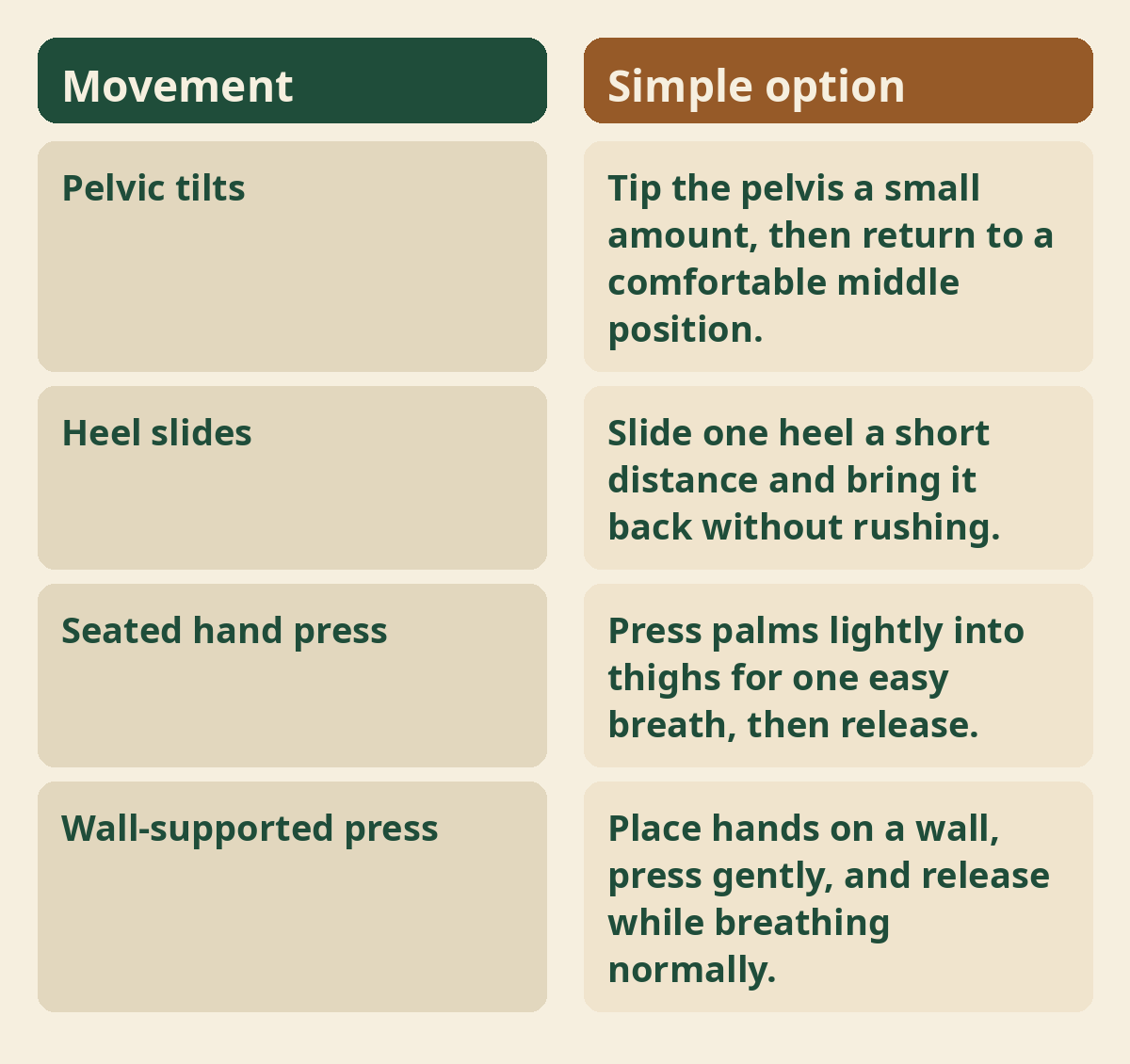
A small pelvic tilt lets you explore movement around your lower trunk without lifting your hips. From the supported resting position, gently tip your pelvis so your lower back changes contact with the floor, then return to a comfortable middle position. Keep the motion modest and breathe continuously. Try four to six slow repetitions, resting sooner if the movement feels tiring or uncomfortable. You can combine them with gentle cat-cow movement.
Explore heel slides
Heel slides practise moving one leg while keeping the rest of the body settled. From the same position, slowly slide one heel a short distance away, then bring it back. Keep the movement small enough that your pelvis feels steady and your breath stays easy. Try three to five on one side, rest, and repeat on the other, or skip either side.
Try a knee-opening option
A small knee opening is an optional way to move one leg outward while lying down. Keep both feet resting on the floor and let one knee drift a little to the side, then guide it back to centre. Do not chase a wide stretch or let the movement become a twist. Use only a range that feels comfortable, and leave this out if it does not suit you.
Add an arm reach
A short arm reach can add movement while your legs remain supported. From the resting position, lift one hand toward the ceiling or slide it along the floor toward your head, only as far as comfortable. Bring it back slowly and alternate sides. Keep your ribs and shoulders relaxed; reduce the range if your back arches or your breath becomes strained.
Use a wall for standing support
A wall-supported stand offers an upright option when floor work is not convenient. Stand facing a wall with your hands resting lightly on it and feet placed comfortably apart. Keep your knees soft. Gently press your hands into the wall for a moment, then release without locking your elbows or holding your breath. Repeat a few times, or simply stand and breathe.
Try a seated press
A seated hand press is a low-range option for practising gentle trunk support. Sit on a stable chair with your feet on the floor. Place your palms against your thighs and press very lightly for a breath, then release. Keep your face and shoulders relaxed. If pressing feels uncomfortable, rest your hands and practise noticing your breath instead.
Explore a small seated turn
A comfortable seated turn can help you notice how your trunk moves without forcing a stretch. Sit tall enough to breathe freely, with your feet supported. Turn your chest a little to one side while keeping your head relaxed, return to centre, and try the other side. Keep the movement gentle; do not pull on your chair or use your hands to force a deeper turn.
Consider a supported bridge only if comfortable
A small bridge is optional and should be left out if it does not feel suitable. Lie with knees bent and feet resting on the floor. If it feels comfortable, gently lift your pelvis a short distance, pause only while breathing easily, and lower slowly. You may instead press your feet down without lifting. Stop if you feel pain, pressure, or strain. See bridge pose for beginners for the basic shape.
Try hands-and-knees preparation
Hands-and-knees work is optional, and a standing wall version is an equally valid choice. If getting down and up is comfortable, place your hands under your shoulders and knees under your hips on a stable surface. Stay still for a few breaths and feel supported. You do not need to add a balance pose; return to sitting or lying down if this position feels awkward. This is gentle preparation for bird-dog pose.
Reach one hand from a stable base
A short hand lift can challenge steadiness without asking you to balance a long limb. From hands and knees, or with hands on a wall, shift no weight abruptly. Lift one hand only a little, or slide it forward along the support, then return. Alternate if comfortable. Keep the movement easy enough to breathe normally, and skip it if your wrists, knees, or balance do not feel secure.
Choose rest between movements
Resting between exercises helps you check whether the next step still feels right. Let your arms relax, sit back, or lie in a supported position for a few breaths. Notice whether you feel steady and comfortable. If you are tired, finish there. You do not have to complete every movement in this article or keep pace with a timer.
Build a short beginner sequence
A short session can include only three or four movements and still be complete. For example, begin with easy breathing, then try pelvic tilts, heel slides, and a wall-supported press. Spend about one or two minutes on each, with pauses as needed. The suggested order is flexible; choose positions that work for you rather than treating the sequence as a fixed workout. A ten-minute routine is enough at first.
Use repetitions as a guide, not a target
The suggested repetitions are a starting point, not a requirement. One to five slow repetitions may be enough while you are learning a movement. Stop before your form becomes rushed or your breath feels restricted. If even one repetition does not feel right, skip it. You can return another day or ask a qualified professional for an adapted option.
Notice common signs to make it easier
Make a movement smaller or stop if you cannot breathe comfortably or stay relaxed. Other reasons to pause include pain, dizziness, unusual weakness, a sense of instability, or discomfort that does not settle when you change position. Do not work through warning signs to finish a routine. If symptoms are concerning or persist, seek advice from an appropriate health professional.
Avoid turning practice into a stomach workout
Gentle core yoga is not a promise of visible abdominal change or a substitute for individualized care. Skip goals based on burning, shaking, or pushing through fatigue. Those sensations are not proof that a pose is useful. Focus instead on whether the movement feels controlled, whether you can breathe, and whether you can stop easily. Rest and everyday movement matter more than chasing a dramatic sensation.
Adapt for a chair or limited floor access
Every floor movement has an option to practise seated or standing, or to leave out. Try the seated hand press, a small seated turn, or a wall-supported press instead of lying down. Use a chair that will not slide and keep both feet supported. If transferring to or from the floor is difficult, do not attempt it without safe assistance and suitable guidance.
Plan a manageable routine
Starting with a brief practice once or twice a week can make it easier to learn what feels comfortable. This is a practical suggestion, not a medical prescription or a promise of results. You may prefer occasional movement, a teacher-led class, or no routine at all. Let your schedule, energy, and professional guidance shape what you do; consistency should never require ignoring discomfort.
Keep a simple practice note
A short note can help you remember which options felt comfortable for you. Record the movement, position, and any support you used, rather than judging your body or scoring performance. If you noticed discomfort, write down what happened and avoid repeating that movement until you have appropriate guidance. A note can also help you explain your experience to a clinician or yoga teacher.
Choose a qualified teacher thoughtfully
A teacher should welcome questions and offer options without pressuring you into a pose. Look for someone with training appropriate to the class and tell them about relevant limitations before practice. Ask whether they can suggest chair or wall variations. A group class cannot replace personal medical advice, and you should feel free to leave a position or stop at any time.
Close the session gently
Finish by resting in a comfortable position and allowing your breathing to return to its usual rhythm. Notice how you feel without expecting a particular result. Move slowly when getting up, using support if needed. If you feel unwell, sit or lie down somewhere safe and seek help if symptoms are concerning. A calm ending is part of the practice, not an extra pose to earn.
Return to the basics
The most useful beginner practice is one you can adapt, pause, and leave without pressure. Keep the movements small, choose support when helpful, and allow breathing to remain easy. Some days, a few quiet breaths may be enough. Gentle core yoga can be explored as mindful movement, but your comfort and any guidance from your health professional should lead every choice.
Where to read next
For a calm, beginner-friendly start, Ranjana Sinha’s Begin Where You Are is written for people who want simple steps. Our guide to starting a home yoga practice adds a gentle routine you can follow at home.
Frequently asked questions
Is gentle core yoga suitable for complete beginners?
This guide is written for beginners, but ask a qualified health professional if you are unsure whether movement is appropriate for you.
Do I need a yoga mat or special equipment?
No, though a stable chair, a clear space, and a comfortable surface may help.
How long should I practise?
Start with a few minutes and pause or stop whenever you need.
Should I feel soreness after gentle core yoga?
No, soreness is not a required sign of a useful practice.
Can I do these movements while pregnant or after surgery?
Ask your clinician for individual guidance before trying a new movement practice during pregnancy or after surgery.
The bottom line
Begin with a comfortable position, choose only the movements that suit you, and let easy breathing set the pace. Gentle core yoga is an invitation to explore mindful movement, not a test or a treatment plan. When in doubt, pause and ask a qualified professional for guidance suited to your situation.