Katonah Yoga is a method developed by Nevine Michaan that brings together hatha yoga, breathing practices, meditation, Taoist ideas, geometry and metaphor. A class may invite you to think about your body as a house, a posture as origami or a movement as part of a pattern.
Those descriptions can sound mysterious before your first lesson. Their practical purpose is to give teachers and students a shared language for looking at position, proportion and repetition. They do not turn a geometric drawing into a medical test or make every body fit one outline.
The most useful introduction separates three things: the method’s teaching language, what a class actually asks you to do and the choices you retain while learning it.
Where does Katonah Yoga come from?
The method takes its name from Katonah, New York. Michaan developed its approach through her study and teaching. The Katonah Yoga Center describes influences from classical hatha yoga, Taoist yoga and Western esoteric philosophy.
Its own foundations material includes posture practice, pranayama, meditation, proportions, maps and metaphor. This is a modern combination of influences, rather than a label for all yoga taught in a particular town or a single ancient sequence.
Teachers bring their own backgrounds to the material. In an interview published by Manduka, Katonah teacher Marco Migliavacca describes a shared vocabulary that can support different classes. Knowing the method’s name is a starting point, but you still need to ask about the level and format of a particular lesson.
Why is there so much talk about geometry?
Descriptions of Katonah Yoga often refer to angles, proportions, fitting and measuring up. A teacher may use these ideas to help you notice the relationship between parts of a posture rather than focus only on reaching farther.
For example, the teaching may direct attention to where a hand or foot sits in relation to the rest of the body. The purpose of the reference is to make an instruction easier to examine and discuss. It is not an invitation to force a joint until it matches a drawing.
Right angles appear frequently in accounts of the method, but a right angle is not a universal prescription for every joint in every pose. An angle on a page cannot decide what is suitable for your injury history, balance or available movement.
If the cue is to make a shape more measured, ask what the teacher wants you to change and why. A clear explanation should leave room for another position, a prop or a smaller range. Precision and personal limits do not have to compete.
Origami is a comparison, not an instruction to fold harder
The Katonah Yoga Center uses origami to describe the organization of postures. Its own explanation makes an important distinction: bodies do not fold like paper. They are three-dimensional, and the comparison concerns how forms fit together.
Think of the image as a way of discussing relationships, not a challenge to create a sharper crease. A person has joints, muscles, a history of movement and limits that a sheet of paper does not have.
A teacher can translate the image into a plain action: change a support, reposition a limb or reduce the size of a movement. If the translation is unclear, ask for it. You do not need to understand every metaphor before you can say that something feels uncomfortable.
| Teaching term | A useful question |
|---|---|
| Measuring up | Which relationship are we checking, and what can change for my body? |
| Origami | What physical action does this image describe? |
| Body as a house | Which part of the posture does the house image help us notice? |
| Map or magic square | Is this a symbolic reference, and how is it being used in this lesson? |
| Repetition | What are we observing when we return to this shape? |
These questions clarify a lesson. They are not a sequence of exercises or a checklist for diagnosing your body.
Maps, numbers and the body-as-house image
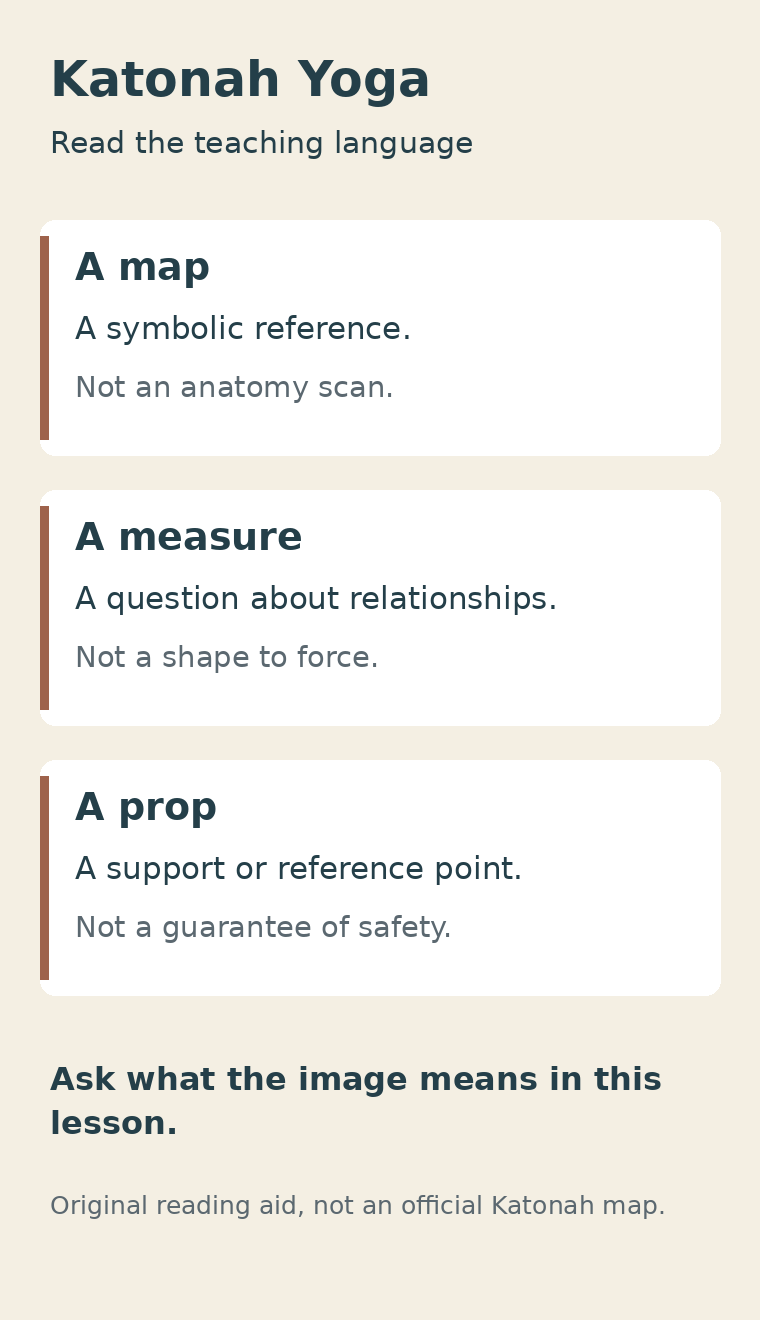
The official Katonah library describes its maps as metaphorical tools that guide imagination. Its materials include number patterns, geometry and the body-as-abode image. A teacher may use a house to organize a discussion of foundation, space or direction.
A map can provide a common point of reference without being a literal picture of anatomy. The method’s magic square belongs to that symbolic teaching framework. It is not a scan, a chart of disease or a way to determine whether an organ is healthy.
You may find the imagery memorable, or you may prefer a direct description of the movement. Either response is useful information when choosing a class. Ask how much time the teacher spends on the maps and whether they explain unfamiliar terms as they appear.
There is no need to reproduce the official charts to begin learning. Nor do you need to assign a personal meaning to every number. Start with what the image is intended to help you notice in the lesson you are actually taking.
Why do classes use props?
Blocks, straps, blankets, walls and chairs appear in descriptions of Katonah practice. They can serve as reference points as well as supports. A teacher may use a prop to make a relationship easier to see, to change the position or to explore a familiar posture differently.
In this setting, a prop is not necessarily something you eventually graduate from. Its role may be part of the lesson itself. Our introduction to yoga props explains the basic equipment, but a Katonah teacher should explain the purpose of the particular setup being used.
More equipment does not automatically mean less effort or less risk. Ask for help with an unfamiliar arrangement rather than copying a photograph, especially where straps, chairs or added weight are involved. Support should not become a means of pushing farther than you can manage.
What might happen in a class?
A lesson may combine familiar postures with discussion, repeated shapes, props, breathing work and meditation. The Studio, a Katonah teaching space in New York, describes a communal, workshop-like format in which the class may pause to explore a posture or an idea.
That is one teaching example, not a promise that every Katonah class follows the same plan. Some teachers offer more flowing movement; others spend longer with an arrangement or concept. Check the actual class description rather than assuming that a method known for precision will always move slowly.
Repetition is part of the vocabulary. Returning to a posture can be an opportunity to compare what changed after an explanation or adjustment. It does not require treating every repetition as an attempt to go deeper.
Before an online class, ask which props and how much clear space are required. A video may show several options, but it cannot know whether your own setup is stable or appropriate. An introductory lesson with opportunities to ask questions can be a better starting point than an unexplained demonstration.
Hands-on guidance should remain a choice
Physical adjustments have a prominent place in some accounts of Katonah teaching. The Studio explicitly describes hands-on work as part of its approach. That makes it worth discussing touch before a class rather than waiting until a teacher is beside your mat.
Ask whether the teacher offers verbal alternatives and how students communicate their preferences. You can decline touch, request an explanation before any assistance or change your mind. A strong teaching tradition does not remove that choice.
Likewise, a teacher’s view that a posture could be more organized is not a reason to endure pain or pressure. Stop and speak up if assistance feels wrong. A different position or a different class may be the right answer.
Breathing practices need their own introduction
Breathwork is a central part of the official description, which discusses rhythm and different phases of a breath. That does not mean a new student should copy breath holds or increase breathing force from a written overview.
Ask which breathing techniques a lesson includes and what alternatives are offered. Keep breathing comfortable rather than treating a count as a test. Stop a technique if it causes dizziness, strain or difficulty breathing.
The National Center for Complementary and Integrative Health advises beginners to avoid forceful breathing and extreme yoga practices. If you have a health condition or are pregnant, discuss your needs with an appropriate health professional and the instructor before taking part.
How is it different from Iyengar yoga?
Both labels may bring props and detailed attention to position to mind, but shared equipment does not make the methods interchangeable. Katonah has its own combination of metaphor, maps, Taoist ideas and teaching vocabulary. An Iyengar yoga introduction describes a different named teaching tradition.
Choose by the explanation, pace, assistance and options offered in the actual class. If you enjoy discussing images and patterns, Katonah’s language may interest you. If you find it distracting, asking for plain instructions is reasonable. A class need not suit everyone to be worth understanding.
Keep health claims separate from teaching images
Some promotional descriptions connect posture, geometry or metaphor with organ function. An appealing image is not evidence that a pose cleans an organ, treats disease or corrects an internal imbalance. It should not be used to diagnose a symptom or replace medical care.
NCCIH notes that yoga studies use many different styles, which makes findings difficult to generalize. Research about yoga overall does not establish a special clinical effect from Katonah’s maps or number patterns.
Existing injuries, glaucoma, severe high blood pressure, balance difficulties and other conditions may call for modifications. Beginners should leave advanced postures and forceful techniques out of their starting point. Seek appropriate care for concerning symptoms rather than interpreting them through a symbolic map.
Katonah Yoga can be understood as a distinctive way of teaching through structure and imagination. Let the language open a question, not close down your judgment. A useful first lesson makes the instructions clearer while leaving your choices intact.
Sources
- Katonah Yoga Center: influences and breathing vocabulary
- Katonah Yoga Center: maps as metaphor
- Katonah Yoga Center: the origami comparison
- Manduka interview: Marco Migliavacca on teaching and props
- The Studio: an example of class format and hands-on work
- Hejhej: practitioner introduction and recurring vocabulary
- NCCIH: yoga evidence and safety