Integral Yoga in Swami Satchidananda’s tradition combines several branches of yoga within one spiritual framework. A posture class is one part of that framework, not its full definition. Study, meditation, devotion, service and mantra repetition also have a place.
The name can be confusing because Sri Aurobindo’s teaching is also called Integral Yoga. These are different systems. This guide focuses on Satchidananda’s approach: how its parts fit together, what its Hatha classes may include and what to ask before joining.
This is an educational overview, not a practice sequence, initiation or treatment plan.
First, check which Integral Yoga is meant
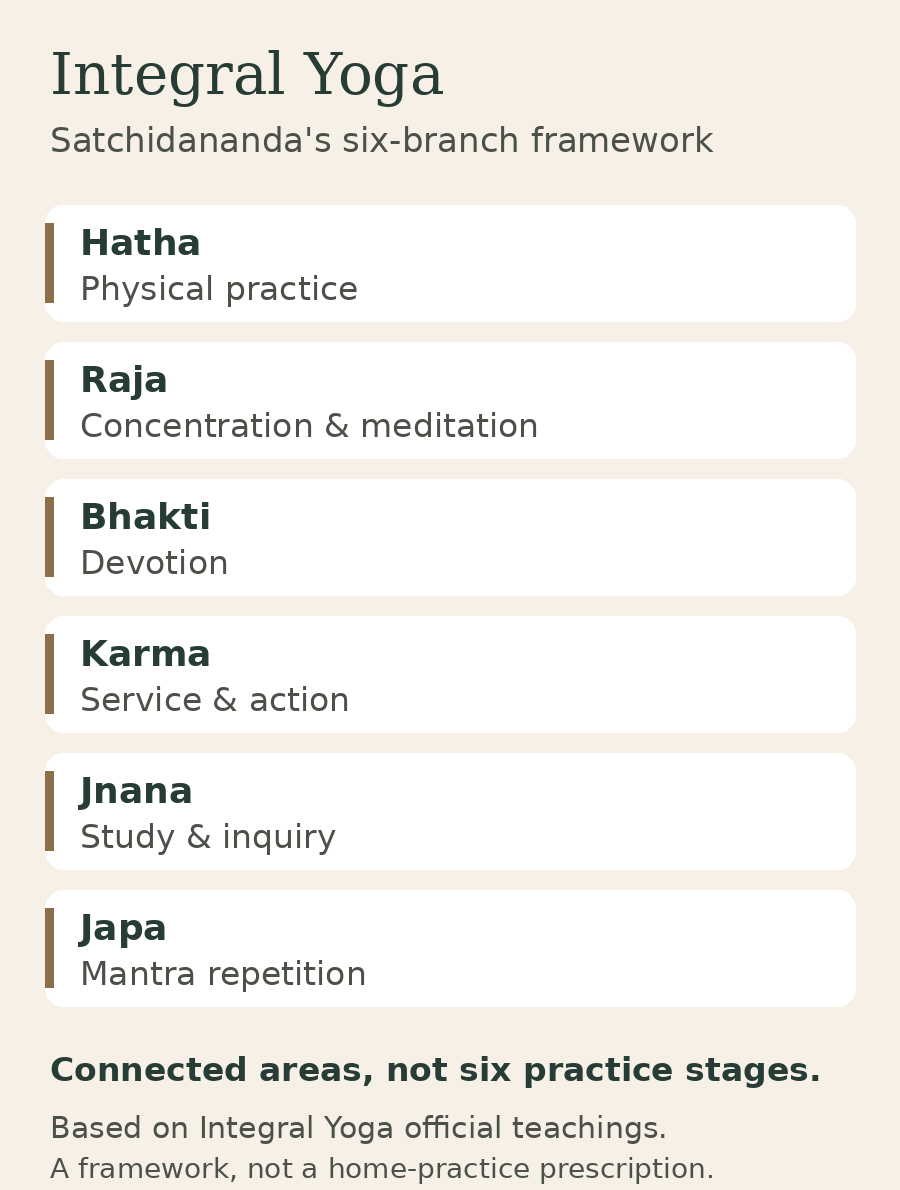
The Integral Yoga organization describes Satchidananda’s system as a synthesis of six branches: Hatha, Raja, Bhakti, Karma, Jnana and Japa. Its lineage account identifies him as a student of Swami Sivananda.
Sri Aurobindo’s Letters on Yoga describes a different spiritual aim: transforming life through divine consciousness. The text explicitly says its practice does not proceed through a fixed set of prescribed forms of meditation or mantras. It should not be treated as another name for Satchidananda’s class framework.
| Source | What the name refers to |
|---|---|
| Satchidananda’s Integral Yoga | A spiritual system combining six branches of yoga, with a recognizable Hatha class approach. |
| Sri Aurobindo’s Integral Yoga | A different spiritual teaching concerned with divine consciousness and transformation of life. |
Neither description is a medical claim. When a teacher or book uses the name, check which source it follows rather than combining the two explanations.
How the six branches fit together
In Satchidananda’s framework, the branches describe connected areas of spiritual life. They are not six poses, six stages to pass or six equal segments that must appear in every class.
- Hatha: physical practices, breathing and deep relaxation.
- Raja: concentration and meditation, with ethical principles and Patanjali’s eight-limbed framework.
- Bhakti: devotion, including prayer, chanting and worship.
- Karma: service and the attitude brought to ordinary activities.
- Jnana: study, discernment and inquiry into the Self.
- Japa: repetition of a mantra.
The distinctive point is their relationship within this particular system. Someone may attend a Hatha class while studying the wider philosophy separately. A discussion of service is not a posture lesson, and a class that includes a chant does not teach everything about devotion.
Our separate introductions to bhakti yoga, karma yoga and japa meditation explain those subjects in more detail. Here, the purpose is to understand the overall map rather than repeat each guide.
What an Integral Yoga Hatha class may include
Two centers give useful concrete examples. Integral Yoga San Francisco’s new-student FAQ describes opening chanting, postures, deep relaxation, breathing practices and a short silent meditation, followed by closing chanting. Integral Yoga Centre Melbourne describes a similar arrangement.
These are examples from named centers, not a universal timetable or a promise about every teacher. They explain why an Integral Yoga class may devote substantial attention to quiet practices rather than using the whole session for movement.
Ask about the class you are actually considering. How much time is spent standing or on the floor? Are transitions explained? What breathing practices are included? Is chanting optional? The name does not answer questions about mobility, physical effort or personal comfort.
Gentle language still needs a clear class level
The organization’s fact sheet lists beginner, intermediate, advanced, gentle and other class formats. That range matters: the wider philosophy does not make every class physically interchangeable.
A slow class can still contain sustained effort or positions that do not suit you. A teacher should explain alternatives and how to pause. Do not assume that a familiar name such as Hatha means the same pace and content in every studio.
San Francisco’s FAQ distinguishes its ordinary classes from prenatal yoga and recommends discussing special needs with a physician and teacher. Treat that as a reminder to ask about suitability, not as permission to apply another center’s class rules to yourself.
Interfaith does not mean entirely secular
Integral Yoga’s teaching page explicitly describes interfaith values and respect for different faiths. Its spiritual purpose should remain visible. Interfaith does not mean that every chant, ritual or explanation is free of religious meaning.
You can ask what an activity means and whether listening is an option. Understanding a teaching is different from personally accepting it. A general class should not leave you guessing whether something is an educational introduction, devotional participation or a formal commitment.
The official teaching also discusses mantra initiation and monastic life. Those are not requirements supplied by this article. Learning about a tradition does not by itself commit you to its vows, sacred formulas or community roles.
Connecting class and ordinary life
The organization presents the integration of practice into daily life as central. Service, study and reflection therefore need not be confined to the minutes spent on a mat.
A useful question after a lesson is which part you want to understand better. Was the class mainly physical practice? Did it introduce a philosophical idea? Would a separate discussion help explain an unfamiliar chant? This keeps learning specific instead of turning the six branches into an oversized daily checklist.
Keep ordinary boundaries intact. An invitation to service does not remove your right to ask about time, responsibilities and consent. A spiritual explanation should not transfer decisions about your healthcare or private life to a teacher.
Separate the philosophy from health promises
Integral Yoga’s materials discuss wellness and specialist programs developed by people connected with the tradition. That history does not establish that an ordinary class treats, prevents or reverses a disease.
NCCIH explains that yoga research uses different practices, which makes findings difficult to compare. Results from a particular program cannot automatically be transferred to every class sharing its lineage or label. Traditional descriptions of purification or spiritual realization are not clinical evidence.
Do not change medication, delay assessment or replace prescribed care because a class is described as balanced or complete. If a health condition is your main reason for seeking yoga, discuss the intended activity with the appropriate healthcare professional and ask what the teacher is qualified to provide.
A manageable way to choose
Begin with a class whose source, content and level are clear. Ask about physical options, spiritual content, breathing methods and the ability to pause. You do not need to attempt advanced postures, locks, cleansing methods or forceful breathing to understand the framework.
NCCIH considers yoga generally safe for healthy people when performed properly with qualified guidance, but injuries can occur. Pregnancy, existing injuries, balance problems, glaucoma and other conditions may require individual changes. Stop for pain, dizziness or difficulty breathing rather than interpreting symptoms as spiritual progress.
The useful starting point is a clear explanation of what you will actually do. Integral Yoga in Satchidananda’s tradition is wider than a posture class, but a broad philosophy should lead to better questions, not fewer choices.
Sources and further reading
- Integral Yoga: the six branches, spiritual aims and interfaith values
- Integral Yoga: lineage, class formats and organizational framework
- Integral Yoga San Francisco: new-student FAQ and class outline
- Integral Yoga Centre Melbourne: its class approach
- Sri Aurobindo: The Aim of the Integral Yoga, a different teaching
- NCCIH: yoga effectiveness and safety