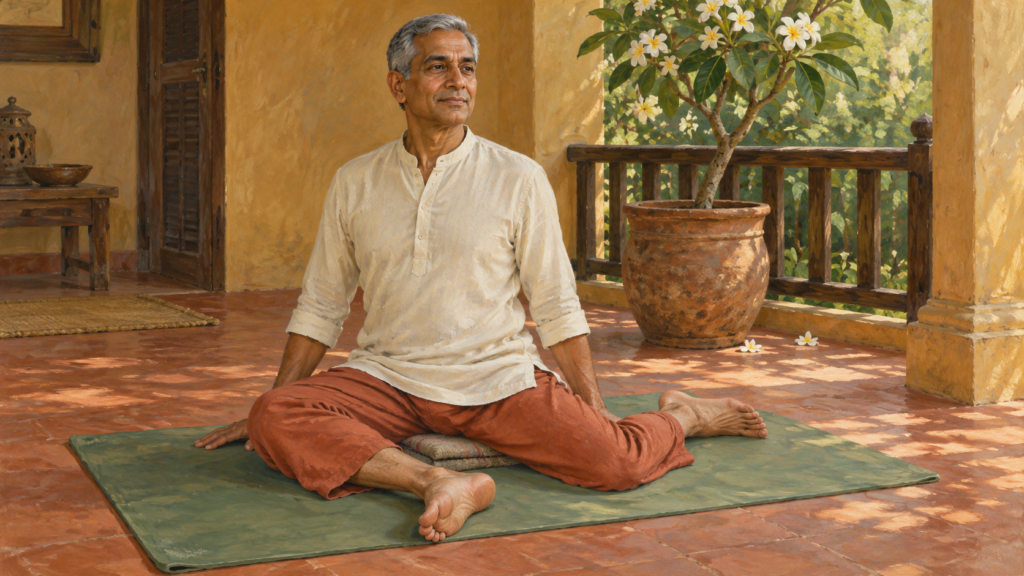
Deer Pose is a seated shape used in Yin yoga. One bent leg rests in front of you and the other bends behind and to the side. The front hip turns outward while the back hip turns inward. That combination makes it different from Butterfly, where both legs open outward, and from Pigeon, where the back leg extends behind you.
This guide stays with an upright, untwisted version. A folded blanket and a smaller leg arrangement can be useful, but neither makes the pose suitable for every hip or knee. Learn the setup with a qualified teacher rather than trying to make two perfect right angles.
Understand the pinwheel shape before arranging the legs
Teachers often describe Deer using a roughly 90-degree bend at each knee. Think of that as a way to recognise the arrangement, not an angle your joints must reach. Your feet do not need to line up with a photograph or the edges of the mat.
In Butterfly, the soles meet in front of the pelvis. In Deer, one foot moves behind and to the side instead. The knees are not stacked as in Cow Face or Fire Log. You also do not need to fold over the front shin.
Begin with the option to use another seat
Get individual advice before trying this position if you have hip, knee, ankle or back symptoms, a joint condition, recent surgery or a hip replacement. Follow any movement limits given by your clinician. During pregnancy, ask your healthcare professional and a qualified prenatal teacher about appropriate practice rather than treating this general guide as a prenatal plan.
If arranging the legs causes pain, pinching or a twisting sensation in a knee, leave the pose out. Do not hold a painful position while waiting for a cushion to make it comfortable.
Explore an upright setup with support nearby
- Start seated. Sit on a mat with a folded blanket and any knee supports within reach. Begin with the legs in a comfortable position rather than pulling them immediately into place.
- Arrange the front leg. Bend one knee so that the shin rests across the space in front of you. Keep the foot a comfortable distance from the pelvis. Do not pull the ankle to turn the thigh farther.
- Move the other bent leg to the side and behind. Use your hands for balance and move slowly. The back knee bends, unlike the straight back leg of Pigeon. Stop if moving that leg needs force or strains a joint.
- Check the seat. Notice whether you tip heavily onto one side. A stable folded blanket or cushion beneath the sitting bones may help. The support should not wobble or make you slide.
- Stay upright. Rest the hands beside you or lightly on the thighs. Keep the neck comfortable and breathe normally. A brief, manageable exploration is enough.
Ask a teacher to check the arrangement if you are unsure which hip is turning or why one side of the pelvis lifts. Do not press the hip or knee toward the floor to correct its appearance.
Adjust the leg position, not just the padding
YinYoga.com’s Deer guide notes a tendency to tilt away from the internally rotating back hip. It suggests bringing the feet closer toward the body when needed. Yogajala likewise describes adjusting the angles and using support rather than forcing both hips down.
A blanket beneath a raised front knee can fill a gap. A raised seat can change the starting position. Neither is an instruction to press down harder. If you cannot find a comfortable arrangement, return to another seat instead of building an unstable pile of props.
A small sensation in the hip region is not the same as joint pain. Stop for pain, numbness, tingling, pinching or restricted breathing. Repeated or persistent symptoms need appropriate advice, not a deeper stretch.
A twist or fold is a separate choice
Some Deer lessons add a turn or lower the torso onto a bolster. Boundless Yoga and Tummee show those additional movements. They are not required to complete the upright version, and this guide does not teach them.
Do not use your hands on a knee to pull the torso around. A supported reclining version is still a different position with its own demands. More props and a quiet appearance do not automatically make it a resting pose for your body.
Do not borrow a long hold from another Yin pose
Published timings differ. YinYoga.com describes Deer mainly as a brief counterpose, while other guides describe longer holds. There is no single duration that follows from the name.
Start briefly with your teacher’s guidance and come out before the position becomes difficult to leave. You do not need to remain still through discomfort or copy the time used for Butterfly, Sphinx or another familiar pose.
Release before changing sides
Place your hands on the mat for support. Shift enough weight to free the back leg, then gently bring it forward without dragging the foot while the knee remains pinned. Return to a comfortable seated position and pause.
Set up the other side separately. You may need different support or a smaller arrangement, and you do not have to match the first side’s angles or time. You can also finish without repeating the pose.
Deer is not a treatment for digestion, asthma, high blood pressure, swelling or menopausal symptoms. Those claims appear in some pose references but are not established by the teaching descriptions used here. Choose from the yoga pose library if another position better suits your practice.
Sources and further reading
- YinYoga.com: Deer Pose, for the front/back hip arrangement, foot-position options, controlled exit and brief counterpose use. Its organ, pregnancy and treatment claims are not adopted.
- Yogajala: Deer Pose, for adjustable leg angles, upright options, seat support and injury cautions. Its treatment and organ claims are not adopted.
- Chris Loebsack at Boundless Yoga: Deer Pose, for the pinwheel arrangement and the distinction between upright and folded variations.
- Asana at Home: Deer Pose, for seat and front-knee support options. Its longer hold and health claims are not prescribed here.
- Tummee: Deer Pose steps, for another leg-setup description and an example that adds a twist. The twist and closed-eye hold are not taught here.
- NCCIH: Yoga: Effectiveness and Safety, for qualified instruction and individual modifications.