Prone means lying face down. In yoga, that position can be the starting place for a supported rest, a forearm-supported chest lift or an active backbend. The shared starting position does not make those practices interchangeable.
Before choosing a pose, separate two questions: does lying on your front suit you, and what do you want to do once you are there? A comfortable face-down rest does not establish that an active lift will suit you. Equally, a class does not need a belly-down section at all.
Prone is a position, not an intensity level
Pose lists often group Crocodile, Sphinx, Cobra and Locust together because the front of the body faces the floor. Within that group, the arms, head, chest and legs do different jobs.
Some versions let the head rest on support. Others ask you to hold the head and chest up. The arms may support part of the lift, remain alongside the body or provide very little help. Look at those details rather than treating every face-down pose as either a rest or a gentle backbend.
This is a selection guide, not a new routine or a set of instructions to try all four poses. Learn an individual setup with a qualified teacher and choose only positions appropriate to your needs.
Check whether the starting position works
Lying on the front puts the abdomen and chest in contact with the surface. Some people find that contact comfortable; others do not. Do not assume discomfort is something you must get used to because a pose is labelled relaxing.
Consider the face, throat and shoulders as well. A supported head position must leave the nose and mouth clear. Resting on one cheek turns the neck, while folded arms change the position of the shoulders. Neither arrangement is automatically comfortable for everyone.
If you cannot breathe easily, feel compressed or need to strain the neck, choose another position. Raising the chest into a backbend is not a compulsory solution to an uncomfortable face-down rest. A teacher can help you choose a suitable seated or side-lying alternative instead.
Rest or active movement?
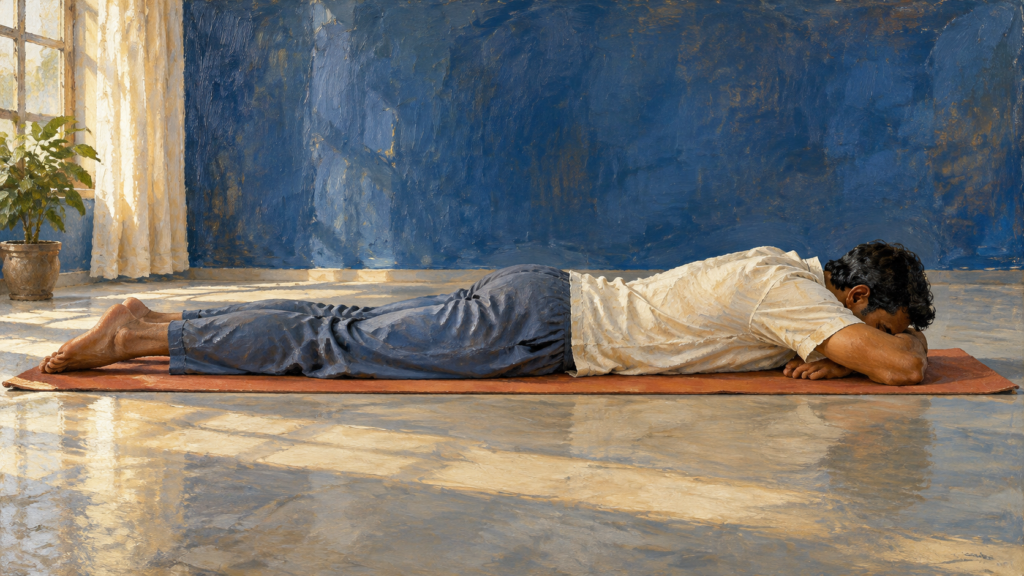
If the purpose is a pause, choose a position that actually lets you rest. Our Crocodile guide covers a low, supported resting version rather than an active chest lift. The name Makarasana is also used for arrangements with the upper chest slightly elevated, so check the version being taught.
If the purpose is to explore back extension, the task changes. You need to manage the lift, ordinary breathing and a controlled return. A quiet-looking posture can still require effort, even if the chest stays close to the floor.
There is no requirement to move from rest into a lift. You can rest in another position while a class practises its prone section.
Compare what supports the upper body
- Forearm support: Sphinx places the forearms on the floor while the chest is raised. That changes the hand contact, but it still asks the shoulders and spine to manage a lifted position. It is not automatically suitable because the wrists are not supporting the body in the same way as a hand-based pose.
- Hands near the chest: a low Cobra may use only light hand pressure. NC State’s teaching page explicitly includes light pressure or no pressing at all. Do not judge the pose only by whether the palms touch the mat, and do not push higher to imitate a straight-arm photograph.
- Arms alongside the body: Locust commonly uses an active chest lift without the forearms propping the torso. Some versions lift the legs as well. That is an additional choice, not a detail that must be copied.
The question is which arrangement you can manage comfortably, not which is universally easiest. Changing support changes the task; it does not remove every demand.
Choose the leg task separately
In many prone positions the legs remain on the floor. In some Locust versions one or both legs lift. Lifting the chest does not mean you must also lift the legs, hands or feet.
Yoga International’s Locust guidance includes keeping the feet down and keeping the palms down as options. Use those examples to understand that several details can vary, not as permission to experiment through back pain.
A modest lift is not an incomplete version that needs to become higher every session. If you are learning, ask the teacher which parts should stay supported and how to return before adding another moving part.
Plan the surface and the way out
Choose a firm, stable surface with enough padding for comfortable contact. A folded blanket can change pressure at the floor, but a larger pile of soft objects is not automatically a better setup. Keep fabric clear of the face and leave the arms room to move.
Getting down and back up is a separate task from the pose. If floor transfers are difficult, do not choose a prone practice simply because it is described as low effort. Arrange appropriate help or choose a practice that does not need the transfer.
Keep active attempts brief enough to lower with control. After lowering, you do not have to push immediately into another backbend or perform a deep counterpose. Pause in a suitable position and decide what comes next without rushing.
When to choose another practice
Ask a health professional about appropriate positions if you are pregnant, have had recent surgery, have an injury or have a condition affecting breathing or comfortable movement. Do not use a general article to decide whether abdominal pressure or back extension is suitable for a personal diagnosis.
Stop for pain, pinching, tingling, numbness, dizziness or restricted breathing. Do not force a large inhalation against the floor or hold the breath to maintain a lift. Seek advice for symptoms that persist, recur or concern you.
Prone poses are optional. Their value is not measured by height, hold time or how many you include. Start with whether the position fits your circumstances, then choose rest, an appropriate active movement or a different base entirely.
For other pose choices, browse the yoga pose library. Choose practices appropriate to your needs rather than treating the list as a required routine.
Sources and further reading
- NC State Yoga I and II: Backbends, for the different support arrangements in Cobra and Locust. Broad protection and health claims are not adopted here.
- Yoga International: Crocodile Pose, for an example of the elevated-chest use of the name Makarasana, distinct from a lower supported rest.
- Yoga International: Locust Pose, for feet-down and palms-down options. Repeatedly increasing lift height is not prescribed here.
- NCCIH: Yoga: Effectiveness and Safety, for qualified instruction and individual modifications. This guide makes no claim that an individual prone pose treats a condition.