Supine means lying on your back. In yoga, it describes a starting position, not a promise that a pose will be passive, comfortable or suitable for everyone. Savasana, a reclining leg stretch and Bridge all begin face up, but they ask for different kinds of support and effort.
A useful way to choose is to ask what stays on the floor, what moves and what has to be held up. That gives you more information than choosing a pose simply because it appears on a list of relaxing practices.
Start with the base, then choose the task
First check whether you can comfortably lie on your back and get into and out of the position. That decision comes before choosing a stretch or lift. If lying face up is uncomfortable, another back-lying pose may not answer the problem.
Next, separate the purpose of the practice:
- Rest: the body settles onto appropriate support without needing to maintain a stretch or hold a limb up.
- Leg movement: a knee or leg changes position while much of the torso remains supported.
- Rotation: a twist changes the relationship between the pelvis and upper body.
- A lift: the pelvis or another part of the body leaves the floor, changing where weight is supported.
These are choices, not stages you must complete in order. A back-lying section of a class can include one of them, several appropriate movements or none.
For rest, ask what can actually stop working
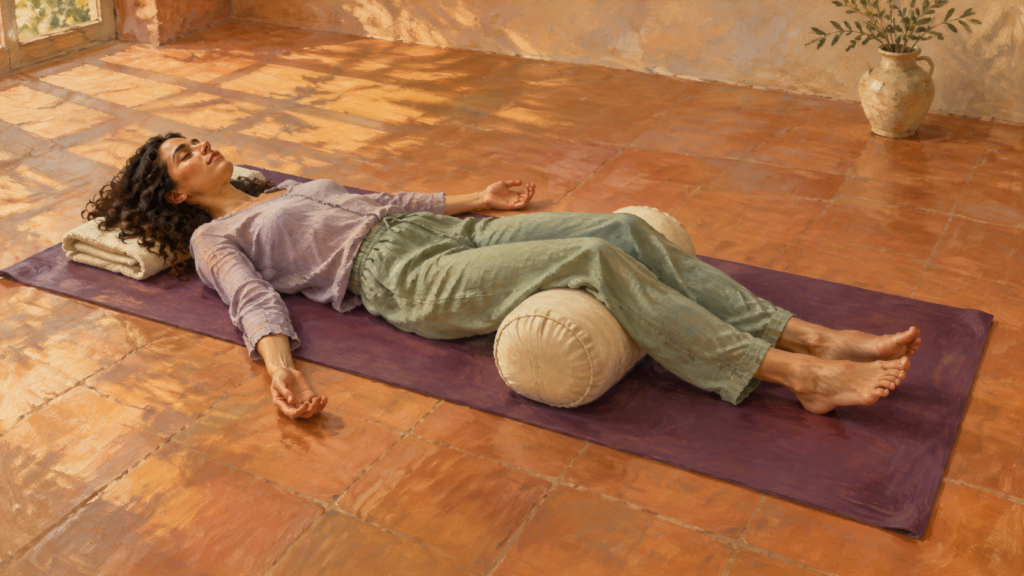
A quiet photograph does not show how much effort someone is making. Bent knees might be easy to maintain with feet on the mat, or the legs might keep working to stop the knees moving. Straight legs might settle comfortably, or a support under the knees might suit the person better.
The relevant test is not whether the position looks like a standard Savasana. It is whether your chosen arrangement allows comfortable breathing and leaves you free to stop holding yourself in place. You can keep the eyes open and move when needed.
Restorative yoga often uses props in seated or reclining shapes, as NC State’s teaching material explains. But reclining and restorative do not mean the same thing. A leg held above you or an unsupported pelvic lift can be active even though the head remains down.
For a leg stretch, separate reach from range
In a reclining leg stretch, the arms may need to reach toward a leg or hold a strap. That introduces a task the resting version did not have. Check whether the shoulders or head start lifting as you try to reach.
A strap can bridge a reach gap. It is not a reason to pull the leg farther. Yoga International’s Reclining Big Toe guidance includes a strap option and an option to keep the opposite foot on the floor with its knee bent. Those are examples of changing the arrangement rather than insisting that both legs must be straight.
You do not need to grip the toes, straighten the raised knee fully or create a vertical leg. Learn the particular setup with a qualified teacher. If you are gripping, straining or losing ordinary breathing, return to support rather than making the strap work harder.
For a twist, notice that two areas move differently
A reclining twist is not simply a rest with the knees moved to the side. The pelvis and upper body no longer face in exactly the same direction. That changes the task for the back, hips and shoulders.
Do not make the floor a target for every body part. Trying to press a knee down while pinning the opposite shoulder can turn a small rotation into a forced shape. A teacher can help choose a smaller range or suitable support; neither a deeper twist nor a longer stay is required.
If rotation is not appropriate for you, leave that category out. You do not need a twist after every backbend or at the end of every session.
For an active lift, reassess the support
Bridge begins on the back, but raising the pelvis changes the points supporting the body. It should not be grouped with a fully supported rest simply because both start with bent knees.
If you choose to learn an active lift, learn how to lower with control as part of the same lesson. Height is not the only detail to consider. The feet, shoulders, head and neck all need an appropriate arrangement, and you should be able to end the effort before fatigue changes it.
A supported backbend with a prop is another setup, not an instruction to slide any hard object under the waist. Have a qualified teacher show suitable placement before using that version. This guide does not prescribe a block position or a backbend progression.
Keep the setup simple enough to manage
Use a stable surface with enough padding for comfortable contact. Arrange any head or leg support before settling rather than reaching awkwardly for it halfway through a pose. A prop should meet the body where support is needed; more height and more equipment are not automatically better.
Consider what you will need to change between positions. Moving from straight-legged rest to a strap-supported leg stretch requires more than a new name: the feet, hands and equipment all have a different job. Pause to organise them rather than rushing through a remembered sequence.
Floor access is a separate decision. If lowering to the floor or getting back up is difficult, plan an appropriate route or choose a seated practice. Do not count on a pose being accessible solely because it involves lying down.
When back-lying practice needs individual advice
In later pregnancy, NHS guidance advises avoiding activities that involve lying flat on the back for more than a few minutes. Ask your midwife or healthcare professional and a qualified prenatal teacher about suitable alternatives. A general supine-pose list is not a prenatal plan, and feeling comfortable briefly does not replace that advice.
Get individual guidance if you have an injury, recent surgery or a condition affecting comfortable movement or breathing. Do not use a reclining stretch to diagnose or treat pain. Research about yoga overall does not prove a benefit from a particular pose.
Stop for pain, tingling, numbness, dizziness, restricted breathing or distress. Change position rather than waiting for symptoms to settle while holding the pose. Seek healthcare advice for symptoms that persist, recur or worry you.
Choose a small amount, not a complete catalogue
You do not need a pose from every category. If the purpose is rest, an active lift may be unnecessary. If the purpose is learning a movement, a short attempt with a clear return can be more useful than adding several unfamiliar shapes.
Before starting, know how you will leave the position and whether you need help. Leave time to change position and sit or stand without rushing. A useful supine practice includes the entry, the task and the way out, not only the moment captured in a photograph.
For other pose choices, browse the yoga pose library. Choose practices appropriate to your needs rather than treating the list as a required routine.
Sources and further reading
- Yoga Basics: Supine Yoga Poses, for the category definition and range of pose types. Its treatment, sleep and universal relaxation claims are not adopted here.
- NC State Yoga I and II: Reclining Poses, for examples of different reclining shapes, not a recommended sequence.
- NC State Yoga I and II: Restorative, for the distinction between a supported resting practice and a body position.
- Yoga International: Reclining Big Toe Pose, for strap use and the opposite-knee-bent option.
- NHS: Exercise in pregnancy, for the caution about lying flat on the back in later pregnancy.
- NCCIH: Yoga: Effectiveness and Safety, for qualified instruction, safety and individual modifications.