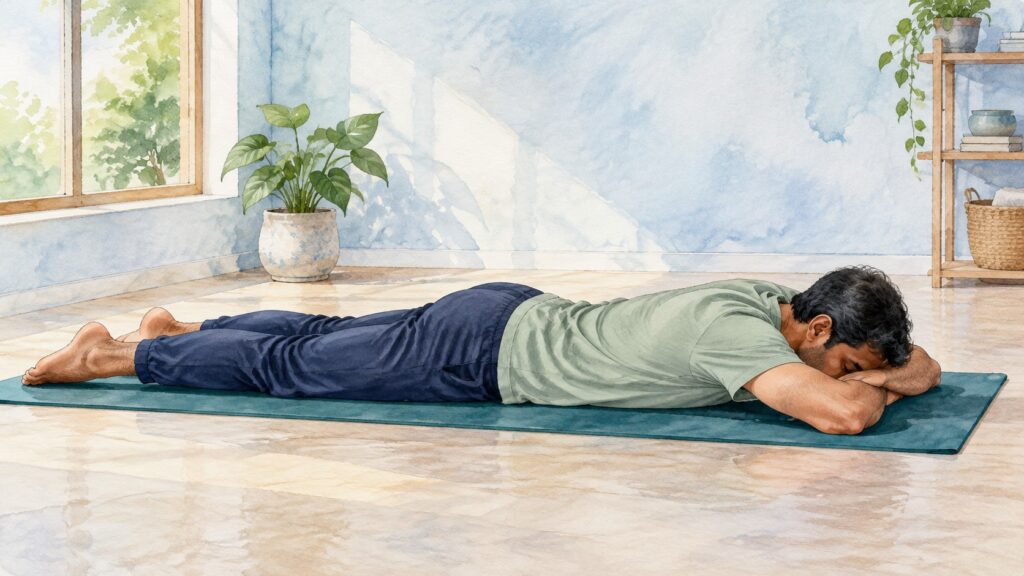
Crocodile Pose, or Makarasana, is a face-down resting position. The abdomen and pelvis rest on the mat, the legs extend behind you, and the forehead rests on folded arms or suitable support. Unlike Cobra or Sphinx, the aim is not to hold the chest up in an active backbend.
This guide covers the resting version. Yoga teachers use the name Makarasana for more than one arrangement, so ask which version is intended if a class gives different instructions. No single arm position or foot angle is compulsory.
First decide whether face-down rest suits you
A quiet-looking pose can still be uncomfortable. Pressure against the abdomen, chest or face may make lying on your front a poor choice. Choose seated or side-lying rest instead if you cannot breathe easily, dislike the pressure, or need to strain your neck to keep your face clear.
This is general yoga education, not medical advice. Ask your healthcare professional about suitable positions if you are pregnant, have had recent surgery, have an injury, or have a health condition affecting breathing or comfortable floor rest. Do not use this pose to test a painful area or replace care for symptoms.
Set up a low, supported version
- Choose the surface. Use a mat or folded blanket on a firm floor. Add enough padding for comfort without creating an unstable pile of cushions.
- Lie on your front slowly. Extend the legs behind you. Let them separate to a comfortable width. The feet can turn out gently, but do not force them into a prescribed angle.
- Fold the arms in front. Rest the forehead on the forearms. Move the arms a little farther forward if drawing them close lifts the chest or strains the neck or back.
- Check the face and throat. Keep the nose and mouth clear. Support the forehead rather than pressing the face into fabric. Nothing should press across the throat.
- Let the floor support you. Keep the abdomen and pelvis down. You do not need to squeeze the buttocks, lift the knees or pull the shoulders into a fixed shape.
- Try a brief rest. Stay for a few comfortable, unforced breaths, then reassess. A longer hold is optional, not a target you must reach.
If the first arrangement does not work, change it or choose another position. A rest pose is not an endurance exercise.
Adjust the support, not your tolerance for discomfort
Shoulders feel crowded: Slide the folded arms farther from the body so the chest can settle lower. If this still strains the shoulders, come out rather than trying to relax through it.
Forehead support feels too low: A small folded towel can change the height. Check that it supports the forehead without blocking the nose, pushing the neck back or covering the throat. More height is not automatically better.
Feet or ankles feel awkward: Change the leg spacing or let the feet settle at a different angle. Avoid pressing the ankles into the mat to copy a photograph.
The abdomen or chest feels compressed: Choose a different resting position. Props are optional tools, not a reason to persist when face-down rest does not suit you.
Notice breathing without making it a drill
Contact between the abdomen and the floor may make the movement of breathing easier to notice. You might feel gentle movement around the belly, lower ribs or back. There is no need to push the belly hard into the floor, force a large inhalation, hold the breath or make your breathing match a count.
If attention to breathing feels unpleasant, keep your eyes open and notice the support beneath you instead. Leave the position if breathing becomes restricted. The pose does not need to produce a particular emotional response to be a valid pause.
How to leave the pose
Move the fingers and feet, then release the folded-arm position slowly. Use your arms to help roll onto one side if that is comfortable. Pause before sitting up or moving to your next position. Avoid pushing straight into a strong backbend simply because you are already lying face down.
Crocodile, Sphinx and Savasana are different choices
Crocodile is a prone rest with the forehead supported. Sphinx uses the forearms to support a lifted chest. Savasana is usually a back-lying rest. None is a required substitute for the others: comfort, breathing and the purpose of your practice guide the choice.
You can use a short Crocodile rest between suitable floor poses or as a quiet pause on its own. For other shapes, explore the yoga pose library. Stop for pain, tingling, numbness, dizziness or restricted breathing rather than holding the pose longer.
Sources and further reading
- Yoga International: Makarasana, for the folded-arm setup and variations in arm and foot position.
- Himalayan Institute: Crocodile Pose, for prone support and the importance of keeping props clear of the throat.
- NCCIH: Yoga, effectiveness and safety, for general safety guidance. Research on yoga overall does not establish a treatment effect for this individual pose.