Yoga side bends appear in standing, seated and kneeling practices. The sideways movement may look similar, but changing the base changes what else you need to manage: standing balance, a comfortable seat, knee contact or an extended leg.
Choose the base before choosing how far to lean. A smaller movement in a position you can enter and leave comfortably is more useful than copying a deep bend that makes another part of your body struggle. These options are not a sequence you have to complete.
What counts as a side bend?
A side bend moves the torso sideways. You may hear the term lateral flexion. It is different from simply reaching an arm overhead, turning the chest or folding forward, although some yoga poses combine those actions.
Julie Gudmestad’s Yoga Journal article distinguishes side-bending poses from Triangle and Extended Side Angle, where the teaching task includes keeping length through both sides of the waist. A diagonal torso in a photograph does not tell you that every pose is doing the same job.
This guide stays with choosing a manageable side-bending position. It does not teach bound variations, deep seated folds or a treatment for back pain.
Standing: no floor transfer, but balance still matters
A standing side bend can fit when you want to remain on your feet. You do not need to kneel, cross the legs or get back up from the floor. Both feet can remain down while you explore a small movement.
Standing also means managing your weight as the torso moves sideways. If you feel unsteady before leaning, do not add a large reach to test yourself. Choose a suitable seated option or ask a teacher about support. A wall nearby is not a guarantee that a balance challenge is appropriate.
Keep the arm position separate from the lean. You can leave a hand at the waist rather than raising it overhead. Do not pull one wrist with the other hand to make a deeper bend. Return toward upright before changing the arm arrangement or starting the other side.
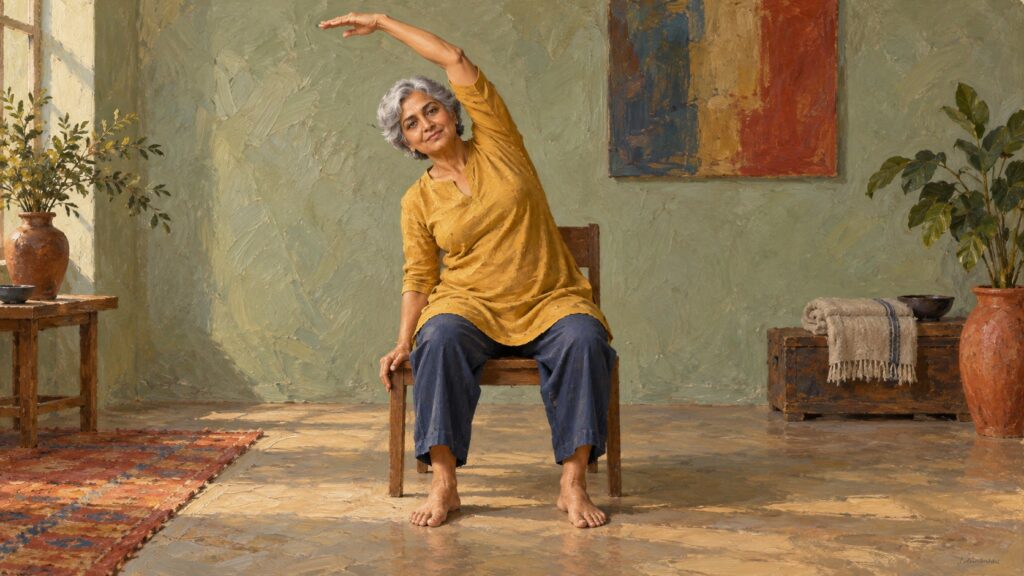
Chair-seated: a seat without a floor-level setup
A chair can remove the need to stand during the side bend or to sit on the floor. That may be useful when the floor transfer itself is inconvenient. It does not remove every balance demand: reaching far sideways can still make you feel unstable.
For its seated exercises, the NHS specifies a solid, stable chair without wheels and a position with the feet flat on the floor. Use a suitable seat on a stable surface, with room for your arms. If your usual chair does not let you sit comfortably with supported feet, seek an appropriate adaptation instead of balancing on a loose cushion stack.
Keep the movement small enough that you do not slide, lift off the seat or need to pull hard on the chair. A resting hand can help you notice the contact, but it should not be used to haul the torso farther over. Come back to a comfortable upright seat between sides.
Floor-seated: the leg position is part of the choice
Sitting on the floor does not automatically make a side bend simpler. Cross-legged sitting, straight legs and wide legs ask for different arrangements at the hips and knees. A difficult seat can dominate the movement before the sideways lean even begins.
Gudmestad explains how restrictions around the legs and pelvis can affect seated side bending. The practical lesson is not to diagnose yourself as tight. It is to avoid treating a seated shape as an isolated waist stretch while ignoring the leg position.
If the starting seat feels forced, change the seat, choose a chair or leave the side bend out. A folded blanket may be a useful support, but it is not a requirement to force a particular leg arrangement. There is no need to reach a foot, put the head toward a knee or match the depth on both sides.
Kneeling: Gate Pose adds knee contact and a side leg
Gate Pose, or Parighasana, is a kneeling member of this family, usually with one leg extended to the side. It combines the torso movement with a different base from either standing or sitting.
Before choosing it, consider whether kneeling and arranging the side leg are comfortable and whether you can get into and out of the position without rushing. Padding can change the contact with a firm floor. It does not make knee pain something to ignore, and it does not make every kneeling position suitable.
You can choose a standing or seated side bend instead of Gate without losing a required step. Do not add the extended-leg shape merely because it looks more like a yoga photograph.
A short way to choose
- Need to avoid floor transfers? Compare a comfortable standing position with a suitable chair seat.
- Standing feels uncertain? Do not assume a deeper bend with wall contact solves the problem. Ask about a supported seated option.
- Floor sitting is already uncomfortable? Change the seat before adding the lean.
- Kneeling is unsuitable? Leave Gate out rather than trying to endure the contact.
- The overhead arm is uncomfortable? Keep it lower. The arm reach is not the definition of a side bend.
Comfort, symptoms and individual guidance
Keep breathing ordinary and unforced. Stop for pain, pinching, tingling, numbness, dizziness or an inability to breathe comfortably. Do not use a long hold or a stronger pull to investigate a warning sensation.
Ask a health professional and qualified teacher about your needs if you have an injury, a health condition, pregnancy-related concerns or movement restrictions. A chair, blanket or smaller range is not automatic medical clearance. Seek advice for symptoms that persist, recur or concern you.
Side bends are optional movements, not a way to remove waist fat or a promised treatment. Choose the base that suits your circumstances, keep the exploration modest and leave room to change your mind.
For other pose choices, browse the yoga pose library. Choose practices appropriate to your needs rather than treating the list as a required routine.
Sources and further reading
- Yoga Journal: The Anatomy of a Satisfying Side Stretch, by Julie Gudmestad, for lateral flexion and the influence of leg and pelvic position. Disease and breathing-benefit claims are not adopted here.
- Yoga Journal: 4 Side Bends You Didn’t Know You Needed, by Kathryn Budig, for standing and Gate examples. The bound variation, wrist pulling and fixed holds are not taught here.
- NHS: Sitting exercises, for stable-chair choice and seated fit within its own routine.
- NCCIH: Yoga: Effectiveness and Safety, for qualified instruction and individual modifications.