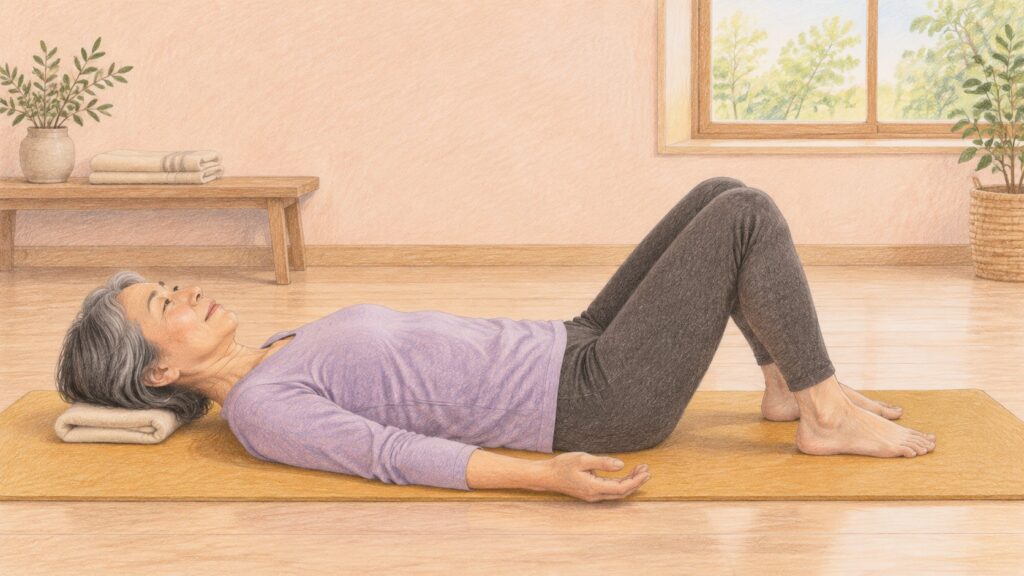
Constructive Rest is a back-lying position with the knees bent and the feet on the floor. The pelvis, back and head stay supported while the arms rest comfortably. It can be a quiet pause before movement, between floor poses, or at the end of a practice.
The name also appears in somatic movement and other body-awareness teaching. This guide describes a simple yoga version, not a treatment method. You do not need to press the lower back flat, create a large arch, or make the body look perfectly symmetrical.
What makes it different from Savasana?
In the usual form of Savasana, the legs extend along the floor. In Constructive Rest, the feet stay grounded and the knees point upward. That changes the leg position without asking you to hold the legs in the air.
Neither position is better for everyone. Bent knees may feel more comfortable than straight legs for some people; others prefer side-lying or supported sitting. Constructive Rest is also different from Bridge Pose: the pelvis stays on the floor rather than lifting.
A simple setup
- Find a suitable surface. Use a mat or a folded blanket on a firm floor, with enough space to roll onto your side. If getting to the floor is difficult, choose seated rest or ask a qualified teacher about an appropriate alternative.
- Lower yourself with support. Come onto one side and use your arms to help lower the head and torso before rolling onto your back, if that route is comfortable for you.
- Bend both knees. Place the soles on the mat about hip-width apart. Start with the heels far enough from the pelvis that the shins are roughly upright, then adjust for comfort.
- Let the knees find an easy position. Begin with the thighs approximately parallel. Avoid pushing the knees wide or squeezing them together as an exercise.
- Settle the arms and head. Rest the arms beside you or place the hands lightly on the torso. Use a thin folded towel beneath the head if it otherwise tips back uncomfortably. Keep the face directed upward without forcing the chin down.
- Pause and check. Let the pelvis remain heavy on the mat. Keep breathing normally and notice whether the position actually feels restful.
If the legs will not settle
Feet that are too close or too far away can make the legs work harder than expected. Move them a small amount and reassess rather than holding a rigid textbook distance. Keep both feet fully supported.
Some teachers use a wider-foot version with the knees leaning gently toward each other. That is a variation, not a requirement. Do not press the knees together, and leave it out if it creates pressure at the hips or knees. If keeping the knees upright still feels effortful, change to another resting position instead of turning the pause into a strength hold.
Leave the back’s natural shape alone
Constructive Rest does not require repeated pelvic tilts, flattening the waist against the floor, or tucking the tailbone strongly. Those are separate movement instructions. For a quiet rest, let the back take a comfortable shape without trying to manufacture a particular gap beneath it.
Start with minimal props. A towel beneath the head may help some people; a high pillow may instead push the chin toward the chest. If a prop creates pressure, remove it. Do not place a hard object under the lower back to force a change in posture.
How long, and how should you breathe?
Start with a few easy breaths and check your comfort before staying longer. There is no compulsory minimum. You can leave the eyes open, soften the gaze or close them if that feels comfortable.
Allow breathing to happen without a count or breath hold. The hands can rest lightly on the abdomen, but do not push the belly down or try to make each breath larger. If focusing on breathing is unpleasant, notice the mat beneath the feet and back instead.
Come out before rest becomes strain
Stop for pain, tingling, numbness, dizziness, unusual pressure or difficulty breathing. If lying on the back is uncomfortable, change position rather than waiting for the discomfort to disappear. This pose is not a way to diagnose a back problem or release a specific muscle on demand.
Ask your healthcare professional about suitable resting positions if you are pregnant, have had recent surgery, have an injury, or have a medical restriction. General yoga guidance cannot decide which position is appropriate for an individual condition.
To finish, move the fingers and feet, then roll onto a comfortable side without rushing. Pause there and use the arms to help you sit up. If that transition is difficult, get individual guidance rather than pulling yourself up by the head or neck.
Where it fits in a practice
Use Constructive Rest as a short check-in before a floor practice, a pause between movements, or a final rest when you prefer bent knees. You do not need to add stretches, breathing drills or meditation for the pause to count. Explore the yoga pose library when you are ready to choose your next movement.
Sources and further reading
- Jillian Pransky: Constructive Rest and support choices, for the knees-bent, feet-grounded setup and head-support options.
- PathaYoga: Constructive Rest Position, for the basic position and allowing the spine’s natural curves.
- NCCIH: Yoga, effectiveness and safety, for general safety guidance. Evidence about yoga as a whole is not proof of a medical benefit from this single position.