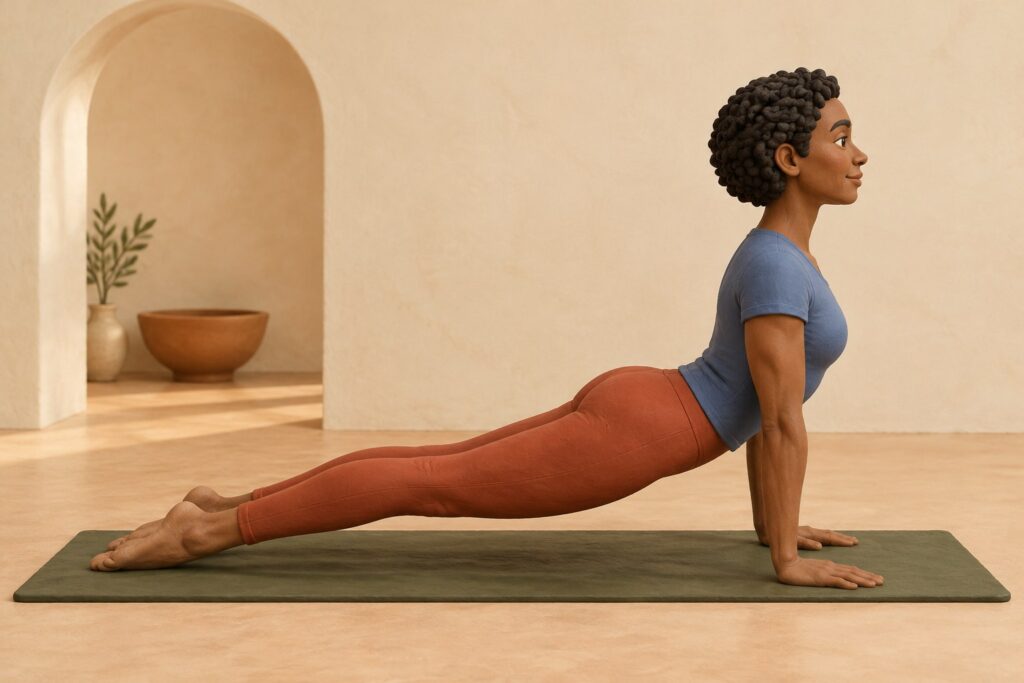
Upward-Facing Dog, or Urdhva Mukha Svanasana, is a backbend supported by the palms and the tops of the feet. In its full form, the knees and thighs lift clear of the mat as the chest moves forward and up. That support pattern is the main difference from Cobra, where the pelvis and legs remain on the floor.
Upward Dog appears often in flowing yoga classes, but its familiarity does not make it a compulsory beginner pose. It asks the wrists, arms, shoulders and legs to support a lifted backbend. This guide is general education, not medical advice. Ask your healthcare professional before trying it if you have wrist, shoulder, neck or back symptoms, an injury, pregnancy-related concerns, a health condition or a medical restriction.
Know which backbend you are choosing
In a small Cobra Pose, the pelvis and legs stay down, and the elbows may remain bent. You can lift the chest only a little. In full Upward Dog, the hands and tops of the feet take the support while the thighs and knees leave the floor.
These are different options, not a ranking of good and bad yoga. Choosing Cobra in a class is not an incomplete attempt at Upward Dog. It changes the load and the shape. Nor should you straighten the elbows in Cobra simply to make it look more like a lifted pose.
Why the legs matter
When the thighs stay lifted, the legs are participating in support rather than resting passively on the floor. Pressing through the tops of the feet and using the legs helps distinguish the full pose from a chest lift with the lower body left behind.
If the knees repeatedly drop, the shoulders sink or the lower back feels compressed, do not keep pushing the chest higher. Lower with control and choose a smaller backbend. A more dramatic curve is not the goal.
Begin outside a fast flow
Learn the setup as a separate movement before trying to catch it between Chaturanga and Downward Dog. A quick transition can hide where you are putting weight or make it difficult to stop when something feels wrong.
Use a firm, non-slip mat with clear space around it. Warm up with comfortable movements and, if appropriate for you, a small Cobra rather than going straight into a deep backbend. If lying face down or placing the hands by the ribs is uncomfortable, choose another movement instead of forcing the starting position.
A careful entry from the floor
A qualified teacher can help you check whether this full version suits you. Do not try to lift through wrist, shoulder or back pain.
- Lie on your belly with the legs extended behind you, about hip-width apart. Rest the tops of the feet on the mat rather than tucking the toes.
- Place the hands beside the lower ribs, fingers spread. Keep the elbows directed back and arrange the palms before adding pressure.
- Press through the hands and tops of the feet. Begin to lift the chest forward and up while using the legs.
- If the movement remains comfortable and controlled, straighten the arms without forcing the elbows backward. In the full pose, the shoulders are approximately above the wrists and the knees and thighs lift off the mat.
- Keep the neck long and the shoulders away from the ears. Look forward rather than throwing the head back.
- Stay only briefly, with easy breathing. Lower the knees and legs with control, bend the elbows as needed and return the torso toward the mat without dropping.
Do not force the full lift if you cannot maintain that support. Return to a smaller shape or stop. There is no fixed height your chest must reach.
Do not hang between the shoulders
Pressing through the palms should help you support the chest. If the shoulders creep toward the ears and the neck seems to disappear between them, come down and reset. Trying to lift the chin higher does not solve a collapsing shoulder position.
Keep the fingers spread and avoid dumping all the pressure into the heels of the hands. If the wrists hurt, lower and stop rather than rotating the hands abruptly under load. A teacher may offer another setup, but a prop is not a reason to continue through pain.
Keep the curve out of the neck-only effort
Upward-Facing Dog does not require looking at the ceiling. Let the gaze stay forward where the back of the neck feels long. The head should follow the overall movement of the spine rather than being flung backward to create the impression of a bigger backbend.
If looking forward still strains the neck, lower the pose. Do not try to hold the head up through worsening discomfort just because the rest of the shape looks close to a photograph.
What if the lower back feels pinched?
Come out rather than pushing farther. Yoga Journal’s teaching guidance notes that this pose can strain the lower back and describes supported options and a smaller range. That is a caution about the demand, not a promise that one adjustment will resolve every person’s symptoms.
Avoid using the arms to drive the torso into a curve you cannot comfortably support. You may prefer a small Cobra, another supported movement chosen with a teacher, or no backbend at all. Pain, tingling, numbness or symptoms that concern you need appropriate advice, not repeated tests of the same pose.
Knees-down and supported versions
Some teaching sources call a knees-and-thighs-down variation a modified Upward Dog. Other classes may describe a similar lower-body support as part of the Cobra family. Names vary, so listen for the actual support points rather than relying on the label.
Whatever it is called, keeping the legs down does not mean the arms must force a deep backbend. Let the range remain small. If you are unsure what the teacher intends, ask whether the knees should lift and whether bent elbows are an option.
Bolsters, blocks and chair variations also exist, but they need a stable arrangement and suitable support height. Do not improvise slippery hand supports or move into an unfamiliar chair backbend without instruction. The simplest alternative may be a different pose.
Getting out matters as much as lifting
For this introduction, lower toward the floor instead of rushing straight into another pose. Keep enough energy to bend the arms and bring the body down with control. Rest in a position that feels comfortable.
You do not have to roll over the toes, jump backward or pass immediately into Downward Dog. If a class moves faster than you can arrange the transition, pause and rejoin later. Learning an exit separately is more useful than trying to hide uncertainty inside a flow.
Using it in a Sun Salutation
Some Sun Salutation styles include Upward Dog; others use Cobra or another variation. Our beginner Sun Salutation guide uses a gentle Cobra. That is a deliberate option, not a missing step that everyone needs to replace.
If you learn Upward Dog, begin with one controlled attempt rather than adding it to every round immediately. Repeated hand-supported backbends can become more demanding as you tire. Choose the version you can manage today, not the one you held once at the start of class.
What the pose can reasonably offer
Upward Dog is a way to explore a lifted backbend and coordinate the hands, feet, legs and torso. Some people enjoy the open-chested shape. Others find that a smaller backbend or a different position is more comfortable.
This article does not present it as a treatment for depression, fatigue, posture disorders or back pain. Research about yoga programmes does not establish a particular health result from one posture. A pose should not replace assessment or care for symptoms.
Common questions
Must my thighs lift?
In the full pose, yes. If you keep them down, choose a suitable modified backbend rather than forcing straight arms and calling it the full shape.
Can I keep doing Cobra instead?
Yes, if Cobra itself is comfortable and appropriate for you. There is no requirement to progress from it to Upward Dog.
Must I look up?
No. Looking forward with a long neck is enough. Do not throw the head backward to increase the curve.
What if I cannot lift without wrist pain?
Stop. Do not use repeated attempts to work through pain. Ask your healthcare professional about symptoms and your teacher about an alternative.
Sources and further reading
- Yoga Journal: Upward-Facing Dog, used for the support pattern, basic setup, legs-down option and shoulder cues.
- Yoga Journal: Urdhva Mukha Svanasana teaching guide, used for lower-back cautions and the role of supported variations.
- NCCIH: Yoga, effectiveness and safety, used for general safety and individual-modification guidance.
Compare other options in the beginner yoga pose library. The right practice does not depend on including every familiar class pose.