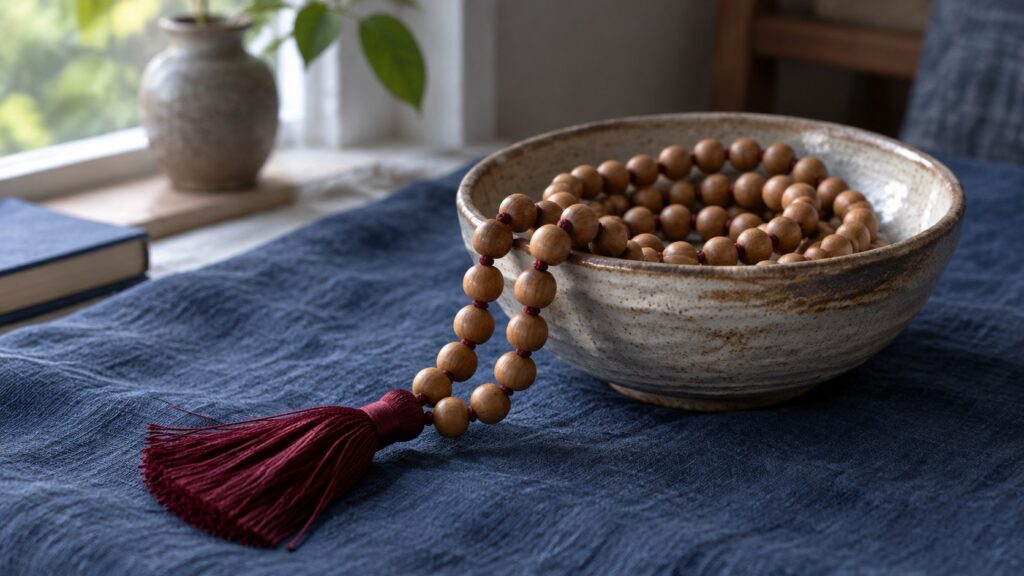
Japa meditation centers on the repeated remembrance or recitation of a mantra or divine name. Repetition may be audible, quiet, or mental, depending on the teaching. In many settings it is a religious practice, not simply a technique for becoming more productive.
The word is easy to define briefly, but the practice has different forms and purposes across traditions. This guide introduces its relationship with meaning, the Yoga Sutras, and mala beads without prescribing a sacred formula or promising a particular spiritual or medical result.
What does japa mean?
The Sanskrit term is associated with repetition, muttering, or quiet recitation. The Centre for Yoga Studies lists these meanings in its vocabulary for Yoga Sutra 1.28, including the repetition of a sacred formula or a deity’s name.
Scholar Andre Padoux opens his study of japa by warning that its meanings and religious uses have varied over a long history. That is a useful correction to the idea that every practice called japa has one identical method.
For an introductory understanding, hold two elements together: something is repeated, and the repetition has a context. What is repeated, how it is received, and what it means depend on the source of the teaching.
Japa in the Yoga Sutras
Yoga Sutra 1.27 introduces pranava as the expression of Ishvara. The following verse, 1.28, concerns its repetition and contemplation or cultivation of its meaning. The pronoun matters: the verse does not appear as an isolated instruction to repeat any phrase for any purpose.
The translation and commentary presented by Wisdom Library connect the repetition with pranava, commonly identified as Om, and its meaning with Ishvara. Bhoja’s commentary likewise joins repetition with reflection on what the sacred syllable signifies.
The Centre for Yoga Studies presents a translation emphasizing cultivation of purpose. These word choices are not identical, but they all keep repetition connected with more than mechanical sound production.
If you are studying the verse, read the preceding passage and a commentary rather than turning a short quotation into a complete practice manual. This guide is an introduction, not initiation into a lineage.
Repetition and meaning belong together
It is possible to repeat a familiar phrase while thinking about something entirely different. The mouth or the counting hand can continue even when attention has wandered. A completed number does not necessarily describe the quality of engagement.
Swami Krishnananda’s explanation of Yoga Sutra 1.28 emphasizes considering what the mantra signifies. His account is a traditional spiritual explanation, not a clinical study. Its relevant lesson here is to ask about meaning rather than treating a mantra as an arbitrary sound file.
A teacher can clarify whether a practice emphasizes pronunciation, remembrance, devotion, contemplation, mental repetition, or some combination. Ask those questions at the start. You should not have to infer the intended purpose from a short video or a decorative quotation.
Audible, quiet, and mental repetition
Japa is not limited to loud chanting. Traditional explanations include low-voiced or whispered repetition and repetition held mentally. An account of sound and silence in Vedic practices discusses both quiet and mental approaches.
The exact labels and instructions can differ. Do not assume a rule about tongue movement, loudness, speed, or breath coordination from one source applies to every other source.
For a beginner following a teacher, the practical question is simple: what form am I being taught? If it is vocal, ask how to keep it comfortable. If it is mental, ask how to return when distracted without adding physical effort or breath-holding.
Do not rank other practitioners by whether their repetition can be heard. An outwardly quiet person may be following a different instruction, and an audible practice may have a purpose that is not apparent from watching it.
What is a japa mala?
A mala is a string of beads used in some practices to count repetitions and provide a physical cue. Rolf Sovik’s Himalayan Institute article explains the common arrangement of one repetition per bead.
The same article describes a usual mala with 108 beads and an additional meru bead, while noting that smaller malas also exist. It also presents a convention in which a full round is credited as one hundred repetitions. That counting convention belongs to the teaching described; do not assume every community uses it.
A mala therefore has both a practical and, for many practitioners, a symbolic role. It is not merely a necklace, but neither should its material be treated as proof of spiritual progress or a cure for illness.
You do not need to buy an expensive object to understand the idea of japa. If your instruction uses a mala, learn the handling and counting conventions from that instruction.
Why mala handling differs
You may encounter different guidance about which hand or fingers to use, whether the beads are kept private, and what happens at the marker bead. The Himalayan Institute describes reversing direction rather than crossing the meru bead.
Read such details as conventions within a practice, not evidence that anyone using another method is careless. A good introductory explanation should identify whose method it is presenting.
If moving beads is uncomfortable or distracts you from learning, ask the teacher about another way to proceed. Keep the hand and shoulder comfortable rather than gripping the string tightly to meet an imagined standard.
The tool should support the practice being taught. Learning complicated bead movements before understanding the mantra or purpose can reverse that relationship.
Japa and meditation: related, not identical labels
People often use japa meditation as a convenient phrase. Within a particular teaching, however, repetition and meditation may be distinguished. Pandit Rajmani Tigunait’s Himalayan Institute explanation describes japa with a mala as a foundation for meditation and discusses a movement between active repetition and a more continuous inward experience.
That is a teaching account, not a test you must pass or a prediction of what will happen in your next sitting. It also does not establish that all meditation must involve a mantra.
Our eight limbs of yoga guide introduces concentration, meditation, and absorption within a different part of the Yoga Sutras. Keeping vocabulary in context is more useful than forcing every related term to mean the same thing.
Choosing a source before choosing a mantra
A list of popular syllables is not enough to explain a religious practice. Before taking up a mantra, learn its source, meaning, pronunciation, and the expectations surrounding its use.
Some teaching settings involve a personally received mantra. The Centre for Yoga Studies includes commentary emphasizing a reliable source for mantra, while Himalayan Institute accounts describe personal instruction. An introductory article should not pretend to supply that relationship.
- Ask which text, teacher, or tradition the instruction comes from.
- Ask whether the formula is openly taught or has particular receiving requirements.
- Ask what the words mean and what uncertainties remain in translation.
- Ask how the practice should be adapted or paused if it becomes uncomfortable.
You can study japa respectfully without adopting a devotional belief. If you prefer a secular attention exercise, name it clearly rather than claiming that repeating a newly invented motivational slogan is identical to every traditional form of japa.
A beginner’s learning sequence
The following is a modern learning checklist, not a traditional ritual or a substitute for individual instruction. It deliberately does not assign a mantra, sacred count, or promised outcome.
- Understand the context. Read a short source passage with its surrounding verses or hear an explanation from a reliable teacher.
- Clarify the method. Establish whether the instruction is audible, quiet, or mental and whether counting is part of it.
- Keep the setup ordinary. Use a comfortable seat; there is no need to force a difficult posture to learn vocabulary or listen.
- Notice wandering without turning it into a verdict. Ask how your teacher recommends returning to the practice.
- Review what you learned. Record a question about meaning or method rather than awarding yourself a spiritual grade.
If you already follow a tradition, its guidance takes priority over this general checklist. A short online overview should help you ask better questions, not quietly replace your existing instruction.
Counts are not a race
Traditional disciplines can include specific counts, but that does not authorize a beginner to borrow an intensive target from another person’s practice. Swami Krishnananda describes demanding repetition disciplines in a spiritual context; they are not a general recommendation from this guide.
Do not rush syllables to finish a round or treat missing a number as a personal failure. First resolve what the practice requires and why. A target without context can distract from meaning and encourage strain.
Likewise, do not use tingling, unusual sensations, or a blank feeling as proof of correct practice or attainment. This article does not offer an interpretation of altered states.
Safety and realistic expectations
NCCIH notes that meditation includes many different practices and that evidence about possible harms is limited. Negative experiences can occur. Findings about meditation as a broad category are not proof that a particular mantra practice treats a specific condition.
If a practice increases distress or feels destabilizing, pause it and seek suitable guidance. Do not continue simply because discomfort has been labeled spiritual progress. Necessary medical or mental-health care should not be replaced by repetition.
This guide makes no promise of a cure, guaranteed calm, supernatural powers, or realization within a fixed number of days. Traditional spiritual claims can be studied as traditional claims without presenting them as established medical facts.
Frequently asked questions
Must japa be spoken aloud?
No. Quiet and mental forms are also described, depending on the teaching.
Is a mala required?
A mala is a counting and attention aid in some practices. Follow the method you are learning rather than assuming every form requires one.
Is 108 a universal beginner target?
No. A common bead arrangement does not establish the right practice commitment for every person.
Is japa always a secular exercise?
No. It often has a religious or devotional context that should be acknowledged.
The bottom line
Japa joins repetition with a source, purpose, and meaning. Learn those together, treat a mala as a tool rather than a guarantee, and seek clear instruction instead of chasing counts or unusual experiences.
Sources and further reading
- Yoga Sutra1.27
- Yoga Sutra1.28
- Vyasa and Vachaspati Mishra on1.28
- Bhoja on1.28
- Swami Krishnananda: Recitation of mantra
- Andre Padoux: Le Japa, introductory page
- Vedic mantras: sound and silence
- Himalayan Institute: How to use a mala
- Himalayan Institute: How japa leads to meditation
- NCCIH: Meditation safety
About the author: Ranjana Sinha
Ranjana Sinha is a yoga teacher with an MSc in Yoga and an M.PEd in physical education. She previously worked as an assistant professor of physical education and yoga and has taught at Kaivalyadhama Institute. Read more about Ranjana.
This article is general education, not medical advice. Speak with a health professional about your individual needs.