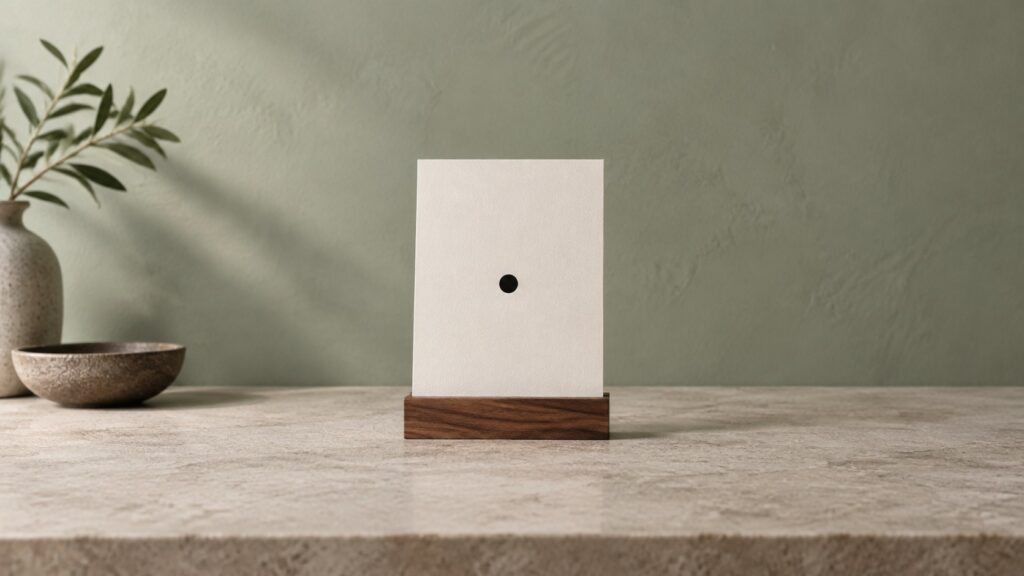
Trataka, also written tratak, is a yogic practice of steady gazing. A small visual point is used as the focus. Candle-gazing is a familiar modern example, but the term is not simply another name for every meditation performed with open eyes.
The practice appears in the Hatha Yoga Pradipika, where it is described within the cleansing techniques. Its historical description and traditional health claims need to be distinguished from modern evidence and personal safety. This guide explains that distinction without prescribing a prolonged, unblinking candle routine.
What the traditional text says
In the Pancham Sinh translation of the Hatha Yoga Pradipika, verse 2.31 describes calmly gazing steadily at a small mark until the eyes fill with tears. The following verse makes a traditional claim about eye diseases and lethargy.
Those statements tell us how the practice is presented in that text. They are not modern clinical evidence that staring treats an eye condition, and they should not be converted into an instruction to force tears at home.
A historical passage can be studied respectfully while its health claims are examined separately. Reading a translation does not establish the suitability of its practice description for a particular reader.
Is trataka always candle-gazing?
The short classical description refers to a small mark, not exclusively to a candle flame. Modern articles and teaching methods often use a flame, but they can add details that are not contained in that single verse.
When comparing instructions, identify the object, whether it is moving or still, what the eyes are asked to do, and whether there are other exercises before or after gazing. Two routines with the same name may differ substantially.
This matters especially when reading research. A modified programme using near and distant targets, eye movements, breathing, or chanting is not necessarily a study of sitting alone and staring at a candle.
Do not assume a moving screen animation or a bright light is a suitable substitute for a teacher’s intended object. The name of a practice is not enough information to choose the stimulus.
Steady attention is not a staring contest
The historical reference to tears can make beginners believe they should suppress every blink or continue through irritation. This guide does not recommend that approach.
The American Academy of Ophthalmology explains that reduced blinking during visually demanding activities can contribute to dryness and discomfort. Its eye-care guidance encourages breaks from sustained screen viewing. That is relevant when someone proposes a practice built around prolonged fixation.
An ophthalmologist quoted by The Indian Express warns that staring at a flame too long without blinking can cause dryness, irritation, or headaches and advises stopping when the eyes feel strained, watery, or uncomfortable.
Do not interpret pain or watering as proof of progress. A teacher’s explanation should make room for comfort, blinking, stopping, and an alternative practice. A timer should never override those considerations.
Trataka versus ordinary open-eye meditation
Many meditation instructions use an easy, soft gaze without deliberately fixing on a small object. That is different from the specific steady-gazing description associated with trataka.
Our open-eye meditation guide discusses a relaxed gaze and natural blinking. If that is your aim, you do not need to add a flame, suppress blinking, or relabel the practice as a cleansing technique.
Keeping the distinction clear also helps with expectations. Someone who finds ordinary open-eye meditation comfortable has not automatically established that a more demanding fixation exercise is suitable.
You can choose another attention object, such as an ordinary sound, rather than assuming that visual effort is necessary for meditation. Learning about trataka does not create an obligation to practise it.
What research can and cannot tell us
Trataka appears in research on attention and eye-related outcomes, but the label alone does not tell us what was tested. Look for the actual intervention, comparison group, participants, and outcome.
A randomized trial published in the International Journal of Yoga studied a programme including ocular exercises and modified trataka in people receiving standard glaucoma treatment. The modified routine included near and distant focusing and other components. It was not simply a candle-gazing test.
The authors reported no statistically significant difference in mean eye pressure between the groups at the measured time points and concluded that the exercises used could not be recommended to manage raised pressure in glaucoma. Some changes from baseline differed between groups, particularly for right-eye pressure, but this did not change the authors’ conclusion that the tested exercises could not be recommended for managing raised eye pressure. They also noted that the contributions of individual components could not be separated.
This does not settle every possible question about every version of trataka. It does show why a headline about yoga and eyes must not become a claim that candle-gazing treats glaucoma or restores vision.
Read eye-health claims carefully
Before accepting a claim, ask what improvement actually means. Feeling more comfortable, performing differently on an attention task, changing an eye-pressure measurement, and improving visual function are different outcomes.
Also ask whether people continued ordinary treatment. A study of an added practice does not show that medication, examinations, glasses, or another established form of care can be stopped.
- Was the exact gazing method described?
- Were other exercises included in the same programme?
- Was there a comparison group?
- Were the results between groups or only changes within one group?
- Did the authors explain limitations and the length of follow-up?
A promising observation is a reason for better research, not permission to make a cure claim. This article does not recommend trataka as treatment for glaucoma, dry eye, short-sightedness, or any other eye condition.
Who should seek advice first?
If you have an eye condition, ongoing dryness or irritation, recent eye treatment, or symptoms that concern you, speak with your eye-care professional before taking up a fixed-gazing practice. A general yoga article cannot assess your eyes.
The ophthalmologist interviewed by The Indian Express specifically calls for caution with chronic dry eyes, migraines, uncorrected vision problems, and conditions such as glaucoma. Children should not be encouraged to copy an unsupervised staring challenge.
If flickering light or another visual stimulus has caused symptoms for you, do not experiment with a flame to test your tolerance. Ask your clinician about suitable activities and consider a nonvisual attention practice instead.
These are reasons to obtain individual guidance, not a checklist that makes everyone else automatically safe. Stop if the practice is uncomfortable or distressing.
Candle safety is a separate issue
Even if a gazing practice is appropriate, an open flame creates a household hazard. A calm atmosphere does not make a candle less capable of starting a fire.
The U.S. Fire Administration recommends considering battery-operated flameless candles. For lit candles, it advises stable holders, placement where they cannot be knocked down, and at least twelve inches of clearance from anything that burns.
It also says to extinguish candles before leaving the room or going to bed and not to use lit candles in bedrooms or sleeping areas. Do not arrange a practice that could leave a flame burning when attention drifts or someone falls asleep.
A flameless candle removes the open flame, but that does not establish that its light pattern is appropriate for gazing. Fire safety and suitability of a visual exercise are two different questions.
What to ask a teacher
Good instruction should explain more than where to put the candle. Ask how the teacher’s method relates to the traditional passage and which parts are modern adaptations.
- What is the aim of the practice in this teaching?
- Is the method steady gazing, a soft gaze, or a sequence of several exercises?
- How are blinking and eye comfort handled?
- What symptoms mean I should stop?
- What alternative can I use if visual fixation is unsuitable?
Be cautious about universal assurances, promises to remove glasses, or instructions to ignore pain until tears appear. Those claims go beyond what a short historical description or a limited research programme can establish.
A useful way to study the practice
Before attempting a routine, make a simple comparison note. This is a modern study exercise, not a gazing protocol.
- Record the source. Name the text, teacher, or research paper rather than writing that yoga says something.
- Record the method. Note the object and any accompanying movements or breathing instructions.
- Separate the claim. Mark whether it is a traditional assertion, a personal report, or a measured research result.
- Record the safety boundary. Include blinking, stopping, personal eye-care advice, and fire precautions when relevant.
- Keep the open question. Write what you still need to ask instead of filling the gap with a guess.
This approach makes apparently contradictory advice easier to understand. One author may be describing a text, another a modified classroom practice, and another an experimental programme. Their statements should not be merged into one universal prescription.
Frequently asked questions
Is trataka the same as any open-eye meditation?
No. A relaxed open gaze is not necessarily the steady-gazing practice described under this name.
Must I use a candle?
No. The classical verse refers to a small mark. Ask which method your source actually teaches.
Should I force myself not to blink?
This guide does not recommend forcing a prolonged unblinking stare or continuing through discomfort.
Does it replace eye treatment?
No. Do not replace eye examinations, prescribed treatment, or appropriate vision care with a gazing practice.
Are tears a goal I should chase?
No. A historical description of tears is not personal clearance to ignore irritation or strain.
The bottom line
Trataka is a specific yogic gazing practice with a historical context, not a miracle eye treatment. Distinguish the source from its adaptations, protect eye comfort, and treat candle safety and personal suitability as real questions rather than afterthoughts.
Sources and further reading
- Hatha Yoga Pradipika, chapter2, Pancham Sinh translation
- Hatha Yoga Pradipika, comparison translation
- International Journal of Yoga: Modified trataka and glaucoma RCT
- AAO: Digital devices and eye discomfort
- The Indian Express: Ophthalmologist comments on tratak
- U.S. Fire Administration: Candle safety
About the author: Ranjana Sinha
Ranjana Sinha is a yoga teacher with an MSc in Yoga and an M.PEd in physical education. She previously worked as an assistant professor of physical education and yoga and has taught at Kaivalyadhama Institute. Read more about Ranjana.
This article is general education, not medical advice. Speak with a health professional about your individual needs.