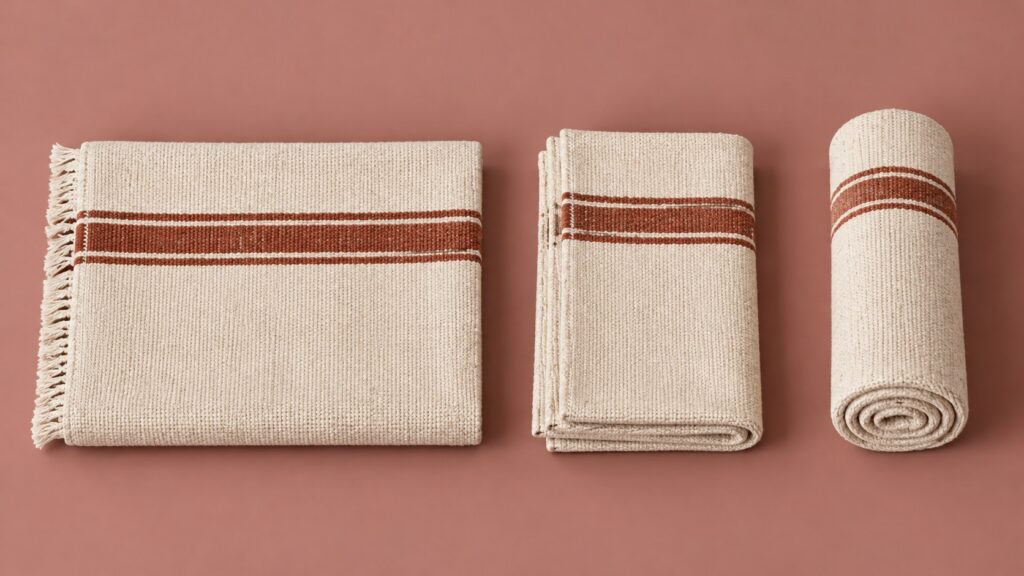
To fold a yoga blanket, start with it flat, match the corners, smooth each layer, and stop when the shape suits its intended job. A neat fold is more useful than a tall pile of loose fabric.
You do not need a special blanket to begin learning about these uses. A suitable household blanket may work for simple comfort or covering, while a dense, evenly folding blanket can be easier to arrange as a support.
This guide concentrates on folding, troubleshooting, and caring for the fabric. It does not treat a blanket as protection against injury or as a substitute for an appropriate pose, qualified instruction, or medical advice.
Check the blanket before folding
Yoga equipment guides describe blankets as props for seated and resting positions as well as for covering the body during relaxation. Manduka and YogaAum both discuss folding, rolling, and adapting a blanket to the task.
For an overview of prop uses, see our guide to yoga bolsters and blankets. For support, look beyond softness. A blanket should make a reasonably even surface when folded, without large lumps, slippery layers, or a hard decorative seam exactly where you will rest your weight.
The right shape depends on the job. A broad, low pad is different from a small, tall stack. A cover for warmth does not need to meet the same demands as something you sit on.
A yoga label alone does not settle any of these questions. Check the actual fabric, construction, dimensions, care instructions, and behavior when folded rather than assuming every yoga blanket is interchangeable.
Common materials and what to check
Blankets sold for yoga include cotton, wool, and mixed-fiber products. Manufacturer and retailer descriptions show that a product called cotton or wool may still be a blend, so read its stated fiber content.
- Cotton: consider the weave, surface feel, folded firmness, and the specific washing instructions. The word cotton does not guarantee that every blanket will feel or fold alike.
- Wool or wool blend: check whether the texture is comfortable for you and whether the care routine is practical. Avoid a material that causes irritation or that you know you cannot tolerate.
- Mixed fibers: examine the actual composition rather than guessing from a traditional pattern, color, or product name.
Avoid blanket-wide claims such as all cotton is machine washable or all wool must be treated in one way. Even retailer guidance gives different drying instructions for different products.
If you need a washable prop for frequent shared use, maintenance may matter more than decorative appearance. For personal practice, texture and the ability to make a steady fold may be the more immediate questions.
Start with a smooth, low fold
Online Yoga School describes several folds, including a repeated half-fold, an accordion fold, and a roll. The common preparation is simple: start with the blanket open and match the edges as you fold.
- Lay it flat. Remove objects and smooth out major wrinkles before making the first fold.
- Match the edges. Fold in half and bring the corners together rather than gathering the fabric into a pile.
- Smooth each layer. Check for trapped bunches or a twisted corner before folding again.
- Make only the shape you need. Stop when the pad has a suitable width and modest height for its intended use.
- Check it before loading it. Press the folded surface with your hands and see whether layers slide or collapse unevenly.
Three half-folds are one teaching example, not a universal prescription. A small thin blanket and a large dense one will produce different shapes from the same number of folds.
Keep fringe, labels, and thick seams away from contact areas. If the result is unstable, unfold and start again or choose another support instead of trying to balance on it.
Making a broad pad rather than a tall stack
A broad pad spreads the folded fabric across a useful area. A tall stack concentrates the same material into a smaller footprint. Those arrangements are not interchangeable, even when they contain the same blanket.
To keep the pad broad, change the direction of the next fold instead of automatically folding the shortest side again. Open it and try another arrangement if the result becomes too narrow for the intended contact area.
Place the finished pad on the surface where it will be used. Check it there, not only while holding it in your hands: a neat fold can still slide against a smooth floor or another prop.
For sitting, modest height and easy access matter more than producing a perfect square. If you need an increasingly high stack to tolerate a position, ask about a chair or another position rather than treating more cloth as the only solution.
Making an accordion fold
Online Yoga School describes an accordion or trifold arrangement: from a prepared rectangle, fold one third over and the other third under. The result is a layered shape rather than fabric bundled into a ball.
Lay out the existing rectangle first. Estimate three equal sections, fold deliberately, and smooth each section as you go. Exact measurements are less important than avoiding a twisted middle or a thick lump at one end.
Check the ends after folding. If one section projects much farther than another, reopen the last fold and realign it instead of tucking the extra material underneath at random.
This is a way to prepare fabric, not a complete instruction for a supported pose. The teacher still needs to explain where the shape goes, how much height is appropriate, and how to change the setup if it is uncomfortable.
Making and checking a roll
The teaching guide also describes rolling a prepared blanket lengthwise. Start with an even rectangle and roll gradually, keeping the two ends aligned rather than letting one end travel faster.
Pause partway through and check whether the roll has become cone-shaped. If one end is much thicker, unroll to the uneven section, smooth it, and begin again.
Test whether the finished roll stays together on the intended surface. If it immediately uncoils or moves when touched, change the preparation or use another support.
A roll is not automatically suitable for the neck, spine, or a backbend. Do not press it into a painful area or copy an elevated pose from a photograph. Learn the arrangement with individual instruction when the placement matters.
Troubleshooting an uneven fold
- One side feels higher: check for a doubled corner, seam, or section tucked underneath. Open that part and flatten it.
- The layers slide: inspect both the fabric and the surface beneath it. A tidy shape is not enough if its layers cannot stay together.
- A hard ridge appears: move fringe, labels, and thick hems away from the contact area, or choose another blanket.
- The fold collapses: distinguish softness from stable support. A soft cover may be better used for warmth.
- The pad is too small: use a broader arrangement or a more suitable prop rather than balancing on an undersized stack.
Make changes before placing substantial weight on the blanket. Do not pull loose cloth from beneath a heavily loaded joint or rely on a companion to keep an unstable pile together.
When not to solve the problem with another fold
Extra fabric can change floor contact, but it does not establish that a painful position is appropriate. If discomfort remains or increases, come out and consider a different position rather than continuing to add layers.
This guide deliberately does not teach a shoulderstand stack. NCCIH advises beginners to avoid extreme practices such as shoulderstands. A blanket does not remove that concern or make an inversion a beginner exercise.
A cover for warmth is another separate task. Unfold it as needed, keep the face clear, and make sure it can be removed easily. An ordinary yoga blanket is not a prescription for concentrated pressure or a substitute for a weighted product.
If you have an injury or a health condition, discuss individual needs with a health professional and a qualified instructor. A prop can be part of an adapted setup, but its presence alone does not make that setup suitable.
Can you use a household blanket?
For covering during rest, a clean household blanket may do the job. For support, test the fold and surface rather than assuming that any soft throw will work.
A loosely gathered duvet is not equivalent to a firm, even pad. Likewise, a very slippery fabric may be pleasant as a cover but unsuitable as a support where layers need to stay together.
Start with the task you actually have. If you only want warmth, there is no need to build a collection of props. If you need repeatable height or a stable shape, compare what your blanket can provide with a block, bolster, or chair.
These props are not universal substitutes for one another. A blanket can change shape, a block holds a more defined shape, and a bolster provides a larger cushion. Choose for the setup rather than trying to make one item perform every role.
Cleaning and storage
Follow the care label for the exact blanket. Yogashop’s guidance illustrates why this matters: it allows low-temperature tumble drying for one cotton product while advising air drying for Manduka blankets.
That difference should not be flattened into one rule for all cotton or all blended fabrics. Check washing temperature, detergent restrictions, drying method, and any warning about shrinkage or changes in texture.
After washing, let the blanket dry fully before folding it for storage. Keep it in a clean, dry place and inspect it for damaged seams, trapped objects, or uneven bunching before the next use.
For shared equipment, use the studio’s cleaning and handling procedure. A blanket that looks tidy is not automatically ready for another person, and a personal preference to wash less often is not a shared-use hygiene policy.
Frequently asked questions
Do I need a yoga blanket to start yoga?
No. It is one optional prop. The useful question is whether it solves a particular comfort, support, or warmth need in your practice.
Is a thicker fold always better?
No. Extra layers can change stability as well as height. Use a suitable, even shape rather than making the tallest possible stack.
Will a blanket fix knee pain?
This guide makes no such claim. Padding may change floor contact, but pain can require a different position or professional assessment.
Can every yoga blanket go in a dryer?
No. Care instructions differ by product. Read the exact label or manufacturer guidance before washing or drying it.
Does using props mean I am less advanced?
No. A prop is a tool for a specific setup, not a grade. Choosing support or a different position is more useful than forcing a shape for appearance.
The bottom line
A yoga blanket is useful when its shape matches a clear job: an even seat, modest padding, or a comfortable cover. Check fabric and care instructions, fold carefully, and stop treating extra thickness as an automatic improvement. A prop should support an appropriate practice, not persuade you to ignore discomfort.
Sources and further reading
- Manduka: A Guide to Yoga Props
- Online Yoga School: How to Fold a Yoga Blanket
- Yogashop: Yoga blanket care
- Stretch Now: Uses for a yoga blanket
- YogaAum: Guide to the yoga blanket
- NCCIH: Yoga, what you need to know
About the author: Ranjana Sinha
Ranjana Sinha is a yoga teacher with an MSc in Yoga and an M.PEd in physical education. She previously worked as an assistant professor of physical education and yoga and has taught at Kaivalyadhama Institute. Read more about Ranjana.
This article is general education, not medical advice. Speak with a health professional about your individual needs.