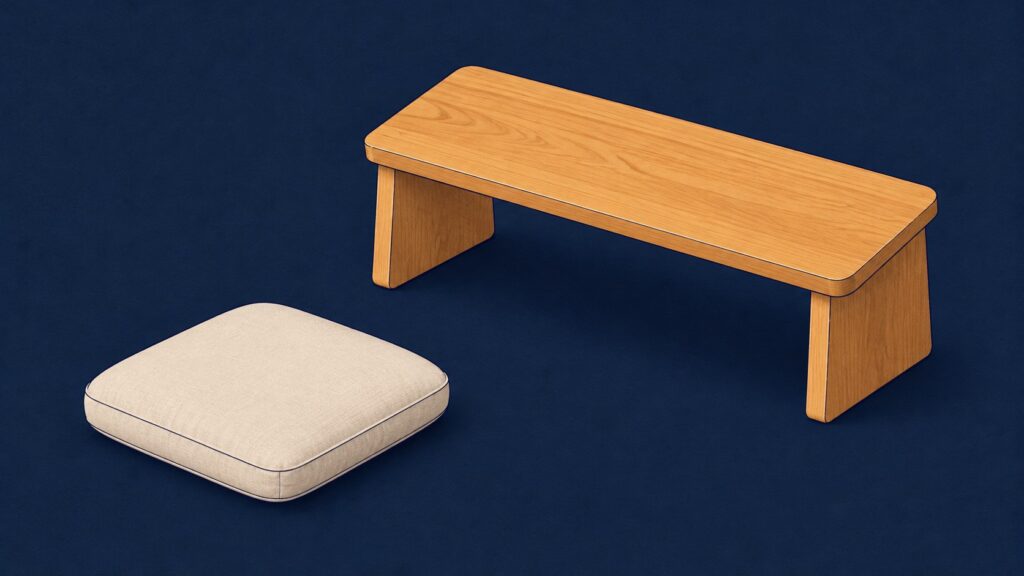
A meditation bench is a low seat commonly used for kneeling meditation, often called seiza. It supports the pelvis while the lower legs remain on the floor beneath or beside the seat.
It is an alternative to a floor cushion, not a requirement for meditation and not a cure for uncomfortable knees or ankles. A chair may be a better choice if getting down, kneeling, or getting up is difficult.
This guide explains the main designs, fit checks, setup questions, and limits. It does not recommend a particular product or assume that a bench suitable for one person will suit another.
What a meditation bench does
A kneeling bench creates a seat above the lower legs rather than asking the pelvis to rest directly on the heels. The exact arrangement depends on the bench design and the manufacturer’s instructions.
Sage Meditation describes benches with supports near the outside edges and others with supports closer to the center. These layouts leave different spaces for the calves, ankles, and feet.
The Western Chan Fellowship describes a kneeling bench as an alternative for people who find cross-legged sitting difficult but do not want a chair. That is an option, not a rule that a chair is less appropriate.
The useful question is whether a particular setup lets you sit comfortably and change position when needed. A bench does not make a painful posture necessary, and remaining still is not more important than responding to discomfort.
Bench, cushion, or chair?
These supports offer different sitting arrangements. A floor cushion often raises a cross-legged seat. A kneeling bench supports a kneeling position. A chair can avoid the need to kneel or get close to the floor.
Choose the position before choosing equipment. If kneeling itself is unsuitable, a different bench height may not solve the problem. If a chair already works well, there is no requirement to replace it.
A meditation stool may refer to a kneeling bench, but product names are not consistent enough to rely on alone. Read the intended-use description and look at the actual leg clearance and support layout.
For a wider introduction to floor supports, see our guide to yoga bolsters and blankets. Different props should be compared by the job they do, not treated as interchangeable accessories.
Fixed, folding, and adjustable designs
- Fixed bench: the supports remain in place. There is less assembly during setup, but the shape takes up more storage space.
- Folding bench: the supports fold for transport. The opening or locking procedure becomes part of the safety check before every use.
- Adjustable design: the seat height or arrangement can change. Follow the exact adjustment instructions rather than assuming all mechanisms work alike.
Still Sitting’s guide includes fixed wooden seats and an adjustable fabric-seat design. Sage Meditation discusses different hinge and latch arrangements. Their differences are a reason to read instructions, not to invent one universal setup method.
Portability is useful only if the bench can be set up correctly where you intend to use it. Consider whether the folded size, carrying weight, and assembly steps fit your actual routine.
Do not place weight on a bench with a support partly opened or an adjustment not secured. If the mechanism is unclear, ask the manufacturer before trying it.
Why body height is only a starting point
Retailers often group benches into low, standard, or tall sizes. Bluecony explicitly notes that two people of the same overall height may prefer different seats because their proportions and mobility differ.
Check available space for your lower legs, the seat’s usable width and depth, and how easily you can enter and leave the position. Those details may matter as much as the number printed as seat height.
A sloped seat also has more than one height: its front and back may differ. Confirm how a manufacturer measures it before comparing two products that appear to have the same specification.
No single height chart can guarantee fit. Treat a chart as the seller’s starting point for its own design, not a prescription for everyone who is a particular height.
Check the seat angle and edges
Many kneeling benches slope downward toward the front. Some use a fixed angle; others allow a different relationship with the floor through their support shape or adjustment mechanism.
Sage Meditation notes that the front or back edge can feel intrusive when the seat angle is not suitable. That is a practical fit question rather than something to endure until meditation makes it disappear.
Look for enough usable seat area and a surface that is comfortable against clothing. Check for rough edges, damaged finishes, exposed hardware, and anything that could catch fabric.
Do not tilt a fixed bench onto an unintended edge to imitate an adjustable design. If the angle is wrong, use another seat or get guidance about the intended adjustment.
A cautious first setup
Use the instructions for the exact bench. The following checklist is for inspecting a setup, not a substitute for a manufacturer’s assembly directions or help with an unfamiliar kneeling position.
- Check condition. Inspect the seat, supports, fasteners, hinges, and any fabric or adjustment straps for damage or looseness.
- Choose a level surface. Avoid a sloping or uneven area and anything that lets one support sink farther than the other.
- Secure the mechanism. Open and lock folding parts or set adjustments exactly as directed. Keep fingers away from closing hinges.
- Check the space around it. Leave room to change position and get up. Keep loose objects and fabric out of the support mechanism.
- Try only a brief sit. If kneeling is appropriate for you, enter carefully and assess comfort before considering a longer session.
Have suitable support or assistance available if floor transfers are difficult. Do not use a light meditation bench as a grab rail unless it is specifically designed for that purpose.
What a fit check should include
Ask whether the pelvis is supported, the lower legs have room, and the setup feels stable without gripping or forcing a posture. Check that no edge or support presses sharply into the body.
Notice the effort needed to sit down and get up. A position that seems acceptable once settled may still be unsuitable if entering or leaving it is awkward or unsafe.
Do not aim for a photograph-perfect spinal shape by pulling the shoulders back or holding the breath. The bench should not require constant muscular bracing to keep you from sliding.
End the trial if you experience pain, numbness, tingling, or increasing discomfort. Change position rather than waiting for a timer to finish. Persistent or recurring symptoms deserve appropriate professional advice.
Padding is a separate decision
Some people use a floor cushion or folded blanket beneath the knees and lower legs. Some bench designs use a seat cushion; other manufacturers intend their seats to be used without one.
Adding padding changes height and sometimes stability. A thick soft cushion can change the effective seat angle or slide against the bench. Do not assume that more softness always improves fit.
If the instructions allow padding, keep it even and check that it does not interfere with supports, hinges, or a locking system. Check the entire setup again after making a change.
Padding may change contact with the floor, but this article does not claim it treats a joint condition. If kneeling remains uncomfortable, consider a chair or another position rather than repeatedly adding layers.
Do not turn a bench into a medical promise
Product descriptions may say that a bench improves posture, relieves pressure, or makes long meditation comfortable. Those statements do not establish that it treats back pain, repairs a knee, or prevents injury.
A merchant’s account can explain how a mechanism works or which dimensions a model has. It is not clinical evidence that the same bench will help every person with a health condition.
If you have an existing injury, recent surgery, balance concerns, or difficulty with kneeling, seek individual advice before experimenting. A higher bench is not automatically an adequate modification.
Meditation itself is also not a replacement for care. NCCIH cautions against using meditation to postpone health treatment and notes that negative experiences can occur. A comfortable seat does not remove those wider considerations.
Care, transport, and storage
Follow the exact cleaning instructions for the finish, cushion, and any fabric components. A method suitable for a removable cover may not be suitable for wood or an adjustment strap.
Before packing a folding bench, remove your weight and close it as directed. Protect fingers, secure loose parts, and avoid placing heavy objects on a mechanism not designed to carry them during transport.
Inspect it again after travel or storage. A bench that was sound at home can develop a loose fastener or damaged part. Stop using it until a problem is addressed according to the manufacturer’s advice.
This guide does not provide a woodworking plan or a load-rating calculation. Building a seat requires suitable materials and construction; a simple appearance is not proof that an improvised bench can support a person safely.
Frequently asked questions
Must I kneel to meditate?
No. A bench is one option. A chair or another appropriate position may be more comfortable and accessible.
Can I choose only by my height?
No. Body proportions, leg room, seat angle, mobility, and ease of getting up also matter.
Is a folding bench less safe than a fixed one?
Design and condition matter. A folding mechanism must be secured correctly; a fixed bench also needs sound construction and a stable surface.
Should I add a seat cushion?
Check the bench’s instructions. Padding can change fit and stability, and some designs are intended for use without it.
Will a bench make kneeling pain disappear?
This guide makes no such promise. Stop an uncomfortable trial and consider another position or appropriate advice.
The bottom line
A meditation bench can offer a kneeling seat, but the right choice depends on fit, construction, the intended setup, and your ability to use it comfortably. Read the instructions, test briefly, and keep a chair or another position among the valid options. Equipment should support practice, not turn discomfort into an obligation.
Sources and further reading
- Manner of Yoga: Acha bench instructions
- Still Sitting: Choosing a meditation bench
- Bluecony: Choosing bench height
- Sage Meditation: Bench designs and fit
- Western Chan Fellowship: Meditation bench design
- NCCIH: Meditation and mindfulness, safety
About the author: Ranjana Sinha
Ranjana Sinha is a yoga teacher with an MSc in Yoga and an M.PEd in physical education. She previously worked as an assistant professor of physical education and yoga and has taught at Kaivalyadhama Institute. Read more about Ranjana.
This article is general education, not medical advice. Speak with a health professional about your individual needs.