You can meditate with music or without it. The better choice depends on what you are practising and whether the sound helps you follow the exercise or pulls you away from it. Silence is not a badge of seriousness, and a pleasant soundtrack does not automatically make a session meditation. Decide what you want to pay attention to, then choose a setting that supports that intention.
This guide compares practical options without claiming that a particular playlist, frequency or style of music treats a health condition. It is for gentle attention practice, not a replacement for medical or mental health care.
Does meditation require complete silence?
No. Sound can be part of the practice rather than a sign that the session has gone wrong. UCLA Mindful’s guided meditation library includes body-and-sound and breath-sound-body practices alongside breathing meditation and body scans.
That does not mean you must add music. Listening to ordinary sounds in your surroundings is different from choosing a soundtrack. A fan, distant conversation or a passing vehicle can be noticed as sound without needing to become the centre of a story.
There are also methods with particular instructions about environment and attention. If you are learning through a course or teacher, ask how music fits that method instead of assuming every meditation uses the same rules.
Our meditation for beginners guide introduces the basic process of noticing distraction and returning. That process matters more here than achieving a perfectly silent room.
Music, guidance and sound: what is the difference?
On a small screen, swipe the table sideways to read all three columns.
| Option | What it provides | A question to ask |
|---|---|---|
| Guided meditation | Spoken instructions for an attention exercise | Can I follow the guidance comfortably? |
| Background music | A chosen soundtrack while another focus remains primary | Does it support the exercise or compete with it? |
| Listening practice | Sound itself is the chosen focus | Can I notice sound without analysing every detail? |
| No added audio | The existing environment, including ordinary noise | Can I allow some sound without trying to control it all? |
A recording can contain both guidance and music, but the roles remain different. A voice may explain what to do; a soundtrack may simply be part of the setting. You can enjoy either without pretending they are interchangeable.
When might music be useful?
Music is an option to test if it makes it easier for you to settle into a chosen exercise. You might prefer a quiet, predictable recording while noticing your body or listening carefully to sound. This is a personal observation to make, not a promise that music improves everyone’s concentration.
Before starting, decide what the music is for. Is it background while you notice contact with a chair? Is listening itself the exercise? Or are you taking an ordinary rest with music? All are possible activities, but naming them honestly helps you understand what you are doing.
There is no need to turn an enjoyable rest into a meditation achievement. Likewise, a session can involve distraction and still be a useful opportunity to practise returning attention. A soothing feeling is not the only measure.
When might music get in the way?
If you keep anticipating the next section, remembering a performance or changing tracks, the recording may be taking over the exercise. Lyrics, sudden volume changes or a strongly personal association can also make one recording less suitable for you than another.
These are reasons to experiment, not universal rules against songs or familiar music. Notice what actually happens. If you spend the session searching for the perfect track, simplify the setup before deciding that you cannot meditate.
Music can also make spoken instructions harder to hear. If you follow a guided practice, choose a recording in which the voice is clear and the pace gives you time to respond. You should not need to strain to understand what comes next.
Our guide to common meditation obstacles offers related ways to approach distraction without treating it as a personal defect.
How to compare music and no added audio
Try a small, informal comparison rather than committing to one option forever. Keep the posture and approximate length similar, and change only the audio. The aim is to learn your preference, not to conduct a scientific experiment or prove a health benefit.
- Choose a simple exercise. For example, notice the feeling of your feet on the floor and return when attention wanders.
- Try one session without added audio. Ordinary environmental sound is allowed. There is no need to make the room completely silent.
- Try another with a chosen recording. Set it up before you begin, at a comfortable level, and avoid browsing during the exercise.
- Compare practical details. Could you follow the exercise? Did the audio demand attention you intended to place elsewhere? Did you feel free to stop?
- Choose what fits today. A preference can change with the setting or the practice. It need not become a permanent rule.
You can keep the sessions short. Our guide to how long to meditate discusses manageable practice without treating a longer session as automatically better.
A simple sound-awareness exercise
This original exercise is an optional way to explore listening. It is not a reproduction of a guided recording or a clinical programme. Use a safe setting where you do not need to monitor traffic, equipment or another responsibility.
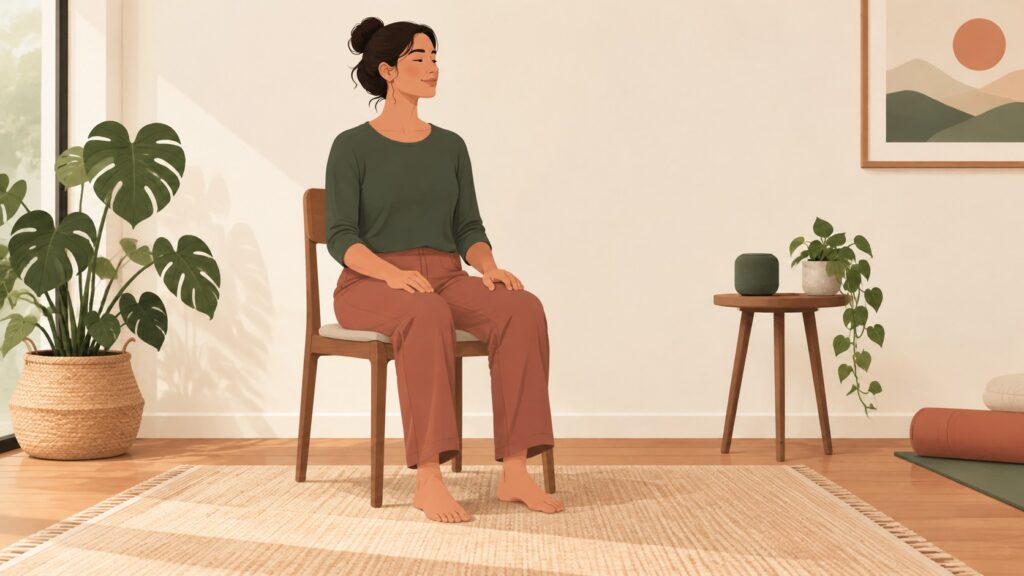
Sit comfortably, or choose another position that suits you. Notice the contact between your body and its support. Let your breathing remain ordinary. Then notice a sound that is already present. You do not need to identify its source or decide whether you like it.
Notice that sounds can begin, change and end. If you realise you are following a train of thought, acknowledge that and listen again. You can include quiet moments without trying to manufacture silence. Finish by noticing the room and moving when you are ready.
If sound is uncomfortable or overwhelming, do not force this exercise. Choose another focus or stop. Our body-scan meditation guide describes a different focus, though body awareness is also optional rather than suitable for everyone.
How should you choose a recording?
Read the description before listening. For guided meditation, look for a clear explanation of what the exercise involves, who offers it and whether you can adapt or stop. UCLA Mindful provides a range of named guided practices, and the NHS beginner meditation page provides another starting point for learning.
For background music, practical features matter: a comfortable level, no unwanted interruptions and a recording you do not need to manage continuously. Headphones are optional. A speaker may be simpler if headphones feel intrusive or uncomfortable.
Keep awareness of your surroundings where that matters for safety. Do not meditate while driving or doing something that requires attention. You do not need expensive equipment, a paid subscription or a special frequency to begin a basic attention exercise.
What about special frequencies and healing claims?
A number in a track title is not clinical evidence. Claims that a recording repairs organs, guarantees a brain state or cures anxiety need relevant research. A marketing description or a listener’s enthusiastic comment does not establish those effects.
The NCCIH review of meditation and mindfulness discusses evidence and limitations across meditation practices. It should not be used to imply that every soundtrack or named audio product has been tested.
You can enjoy a recording without repeating its health claims. Describe your experience in ordinary terms, such as “I found this pleasant” or “I could follow the guidance,” rather than concluding that an unmeasured biological change occurred.
Can you use music before bed?
You may prefer a quiet recording as part of winding down. That is different from proving that music or meditation treats insomnia. If the intention is to stay alert for an attention exercise, becoming sleepy may suggest another time or posture. If the intention is simply to rest, you may choose a different approach.
Our before-bed meditation guide discusses that setting. Persistent sleep difficulties should be discussed with a health professional rather than managed only by changing playlists.
Decide in advance how the audio will end so you do not need to keep handling your phone. The simplest routine is often easier to repeat than one requiring several recordings and settings.
What if silence or music makes you uncomfortable?
Neither option is something you must endure. You can open your eyes, change the focus, move, lower or stop the audio, or end the session. A difficult reaction does not mean you need a more intense recording.
NCCIH notes that safety research on meditation is limited and negative experiences, including anxiety and depression, have been reported. Do not use meditation to delay care or replace prescribed treatment. If practice increases distress or symptoms persist, seek appropriate professional advice.
If closing your eyes feels uncomfortable, our guide to eyes-open meditation describes another option. Adaptation is part of making a practice suitable, not a shortcut you need to apologise for.
Frequently asked questions
Can beginners meditate with music?
Yes, music is an option. Decide whether it is background or your chosen focus, and notice whether it helps you follow the exercise.
Is silence always better?
No single audio setting suits every practice or person. No added audio still includes ordinary environmental sound; a perfectly silent room is not required.
Are headphones necessary?
No. A speaker or no audio may suit you better. Choose a comfortable setup that does not compromise awareness of your surroundings where safety matters.
Does a special frequency guarantee deeper meditation?
A track label does not establish a guaranteed meditation state or health effect. Relevant claims need evidence, not only promotional wording.
Is listening to relaxing music automatically meditation?
Not necessarily. Resting with music is different from deliberately practising attention. Both can be chosen without pretending they are the same activity.
The bottom line
Choose music, guidance or no added audio according to the exercise and your experience, not a rule that one is always superior. Set up simply, keep the sound comfortable and notice what your attention is doing. You can change the setting or stop whenever the practice no longer feels suitable.