You sit down on your mat after a long day, your lower back feels tight, and the teacher on the video asks for a deep bend you are not sure about. Many beginners stop right there and wonder what is safe. This guide covers the yoga poses to avoid with back pain, why they can feel risky, and calmer options to try instead.
This article is general education about yoga and is not medical advice. If you have ongoing back pain, an injury, or any health condition, please check with your doctor before you try anything here.
Which yoga poses should I avoid with back pain?
Most beginners with a sore back are wise to skip deep forward folds, big backbends, hard twists, and long holds on straight legs. These shapes load the spine in strong ways, and a stiff or tender back may not like that yet. Skipping them for now does not mean never. It just means you start with easier choices and build up slowly.
Why do some poses feel risky for a sore back?
Some poses ask the spine to bend, arch, or twist far past what a tired back is used to. When muscles around the spine are tight or weak, the joints take more of the strain. A pose that feels fine for one person can feel sharp for another. Your own body is the best guide, so listen closely.
Is it really necessary to avoid poses?
You do not need to fear yoga, but choosing wisely at the start is a smart habit. A short list of poses to skip or change keeps your practice kind to your back. Many people find that modifying a pose works better than dropping yoga altogether. Results vary, and what suits you may differ from what suits a friend.
Talk to your doctor before you begin
The first step is a chat with your doctor, especially if your pain is new, strong, or has lasted a while. Your doctor knows your history and can tell you which movements to avoid. Bring up numbness, tingling, or pain that travels into a leg. Those signs need a professional look before any stretching routine.
Is yoga a treatment for back pain?
No, yoga is not a treatment, and this guide does not offer one. Yoga is a form of movement and breath practice that some people enjoy alongside the care their doctor suggests. It should never replace medical advice or therapy. Think of it as a calm habit, not a fix.
Deep standing forward fold
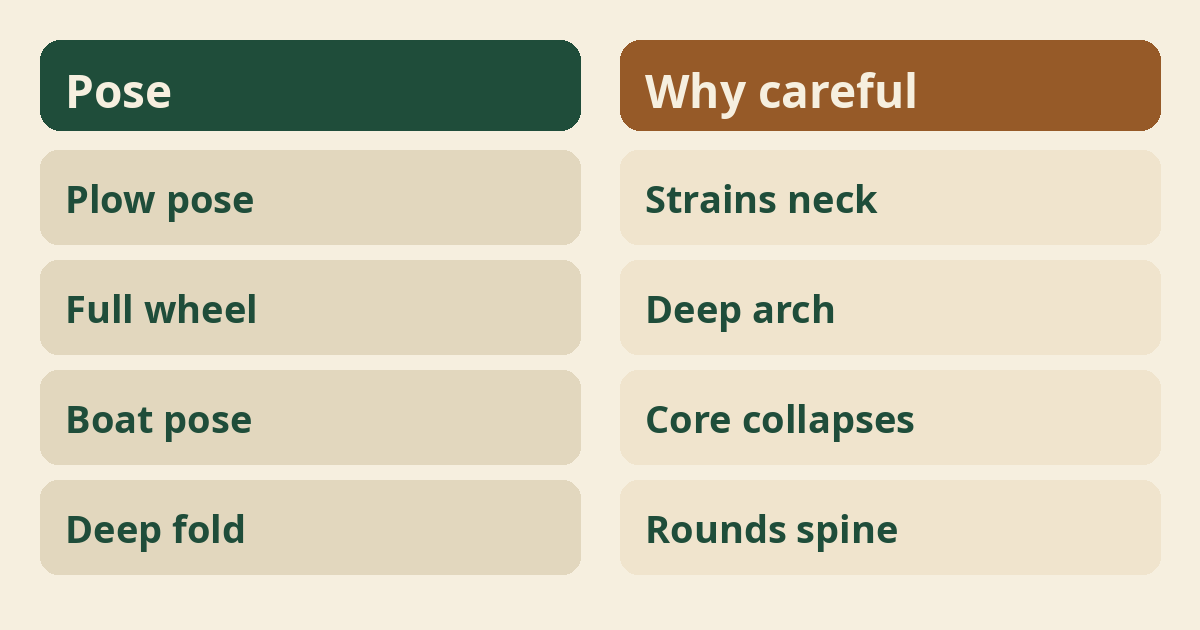
A deep standing forward fold, with straight legs and a dropped head, can pull hard on a tight lower back. Tight hamstrings make the spine do extra work as you hang down. If you like this shape, bend your knees a lot, keep your hands on your thighs, and stop well before the stretch feels sharp.
Seated forward fold with straight legs
A seated forward fold with both legs straight often makes beginners round the lower back to reach their toes. Reaching forward matters less than keeping the spine long. Sit on a folded blanket, bend your knees, and hold a strap or just rest your hands on your shins. Skip it on days your back feels sore.
Plow pose
Plow pose, where the legs swing over the head, is one of the poses beginners with back pain are usually told to skip. The weight of the body can rest on the neck and upper spine, and the lower back gets pulled into a deep curve. It is an advanced shape. There is no rush to learn it, and plenty of easier poses give a calm stretch.
Full wheel pose
Full wheel pose is a deep backbend that asks for strong shoulders, open hips, and a very mobile spine. Beginners often push into the lower back to get up. That can feel uncomfortable fast. Leave it for later, if ever, and only with a teacher who knows your history and your doctor’s advice.
Camel pose
Camel pose, a kneeling backbend, can squeeze the lower back if you drop your head and push the hips forward. Many beginners cannot reach their heels without crunching. If you want to explore it later, place your hands on your hips and lift the chest slightly. Stay small and stop at any pinch.
Deep cobra and upward dog
Strong cobra and upward dog backbends can press the lower back when you lift high with your arms. A low, small lift works better at first. Keep your hips close to the floor, let your back muscles do the work, and keep your elbows bent. If you feel pinching, lower down and rest.
Big seated and lying twists
Deep twists that you force with your arms can strain a tender back, especially when the spine is already tight. Twisting gets easy when you move from the upper back and ribs. If you crank from the lower back, it may protest. Keep any twist small and slow, and skip it on sore days.
Boat pose
Boat pose asks your core to hold your legs in the air, and many beginners let the lower back collapse. A tired core hands the load to the spine. Keep your feet on the floor and your knees bent, sit tall, and rest. Build core strength with easier moves before you try lifting your legs.
Double leg raises
Lifting both straight legs off the floor while lying down can tug on the lower back. The long weight of the legs works like a lever on the spine. If you want a core challenge, try one bent knee at a time with your back resting flat. Stop if you feel your back arch up.
Full locust pose
Lifting your chest and legs at the same time in full locust can squeeze the lower back. It is a strong back-muscle effort, and a sore back may not be ready. Try lifting only one leg at a time, or just the chest, a tiny bit. Breathe easily and rest between tries.
Bow pose
Bow pose pulls the feet toward the head in a deep arch and is hard on a tight lower back. You need open shoulders and quads to do it well. Most beginners bend the lower back to compensate. Pass on this one for now, and look at slower backbends once your teacher agrees.
Headstand and shoulder stand
Headstand and shoulder stand put your body weight on your neck and upper back, so they are poor early choices. They also take balance and strength that come with time. For a back that is already tender, these inversions are best skipped. A calm legs-up rest on the floor gives a softer feeling.
Hard hip openers and deep squats
Very deep hip stretches and low squats can shift strain into the lower back if the hips are tight. When the hips cannot open, the spine often rounds to make up the difference. Use a block or folded blanket under your seat, and keep your range small. Be patient with tight hips.
Which poses are safer to try first?
Easy, slow, low-impact moves are usually a better starting point for a sore back. Many beginners like child’s pose, cat-cow, and mountain pose because they ask for little. You can read more in this guide to resting in child’s pose and a walk through slow cat-cow movements. Move within a comfortable range.
Use props to make poses kinder
Blocks, straps, and folded blankets can make a pose feel much safer for a stiff back. A block under your hand brings the floor closer. A strap lets you stay tall. Our page on simple props every beginner can use shows easy ways to set up. Use what helps you stay comfortable.
Bend your knees more than you think
A bent knee is the quickest change that takes pressure off the lower back in many poses. Bending the knees lets the hips tilt naturally and keeps the spine long. It looks small, yet it can change how a whole pose feels. No teacher will mind, and your back may thank you.
Breathing through each pose
Slow belly breathing keeps you calm and helps you notice when a pose is too much. If your breath gets short or tight, the pose is probably too big. Breathe in through your nose, and let your belly soften as you breathe out. Try this easy belly breathing practice before you move.
How long should I hold a pose?
For a sore back, short holds of a few breaths are a sensible place to start. Long holds can tire muscles that already feel tense. Come out slowly, rest, and check in with yourself. If you feel fine, you can stay a little longer next time, one breath at a time.
How often should I practice?
A short, calm session a few times a week is plenty for most beginners. Doing less at the start lets your body get used to new shapes. Rest days matter too. You can compare ideas in this look at how often to practice yoga, and pick a rhythm that fits your week.
Common mistakes beginners make
The biggest mistakes are pushing into pain, copying an advanced video, and holding the breath. Many people also rush into deep bends to look like the photo. Try to move slowly, ask questions, and choose the easy version first. Nobody gets points for the deepest stretch.
What pain should make me stop?
Sharp, pinching, burning, or spreading pain is a clear sign to stop the pose right away. A mild stretch sensation is different from pain. If you feel tingling, numbness, or pain that travels down a leg, stop and check with your doctor. Do not push through it.
Who should be extra careful?
People with recent injuries, ongoing pain, pregnancy, or a medical back condition should be extra careful and ask their doctor first. A teacher cannot see inside your body, so your doctor’s guidance comes first. If you are expecting, read how prenatal and regular yoga differ and get your doctor’s approval before starting.
Can you do yoga with a bad back at all?
Many people with a sore back do enjoy yoga, once their doctor agrees and they choose poses with care. The key is to pick low-impact shapes and listen to the body. Our article on doing yoga with a bad back goes deeper on this. Results vary from person to person.
What benefits might you notice?
Many people find that slow yoga leaves them feeling more relaxed and a little more at ease in their body. Some also say they feel more aware of how they sit and stand. Results vary, and yoga is not a treatment. For general facts on yoga and health, see National Center for Complementary and Integrative Health as a starting point.
Cornerstone guide for lower back pain
If you want the full picture, our main guide yoga-for-lower-back-pain covers a beginner approach to a sore lower back. It is the best place to start after reading this list, since it focuses on what to do rather than what to skip. Read it slowly, and share it with your doctor if you have questions.
Gentle ways to ease into a session
Start with a few minutes of slow walking or easy movement so your body feels warm before you stretch. A warm back is usually less cranky than a cold one. Roll your shoulders, sway your hips a little, and move your arms. Then begin your first pose with a calm, steady breath.
Sitting all day and your back
Long hours at a desk can leave the back feeling stiff, and small breaks may help you feel better. Stand up, roll your shoulders, and take a few easy breaths. See desk-friendly yoga moves for ideas that need no mat. Be kind to yourself on busy days.
How to progress safely
Progress means adding small changes slowly, only when your last session felt comfortable. Try one extra breath, a slightly deeper bend, or one new pose each week. If your back complains, go back a step. There is no deadline, and slow progress is still progress.
Do you need a teacher?
A qualified teacher can spot habits you cannot see and suggest changes that suit your back. Tell your teacher about your pain before class starts. A good one will offer easier versions and respect your limits. Small classes or private lessons often give more attention to beginners.
The right mindset for a sore back
Patience and curiosity work better than pushing hard when your back is tender. Treat each session as a check-in rather than a test. Some days you will do more, and some days you will do less. Both are fine, and both count as practice.
Where to read next
For a calm, beginner-friendly start, Ranjana Sinha’s Begin Where You Are is written for people who want simple steps. Our guide to starting a home yoga practice adds a gentle routine you can follow at home.
Frequently asked questions
Is it okay to skip a pose in a class video?
Yes, skipping or swapping a pose is always fine, and a calm rest in child’s pose is a good option.
Why does my back hurt after a forward fold?
Straight legs and a rounded spine can strain a tight lower back, so try bending your knees next time and check with your doctor if pain continues.
Are all backbends off limits for beginners?
Not always, but deep ones are best avoided at first, and small, slow lifts are a better start.
What should I do if a pose pinches?
Come out slowly, rest, and tell your doctor or teacher if it happens again.
Is it safe to practice on days my back feels sore?
Rest is often wiser on sore days, and a doctor can tell you what is right for you.
The bottom line
Choose poses that feel kind, skip the ones that do not, and keep your doctor in the loop as you go.