Some days your heart pounds, your chest feels tight, and your thoughts race for no clear reason. On those panic days, a few slow yoga poses and calm breathing can be a small comfort while you ride it out. This guide shows you simple beginner moves you can do at home, right in the middle of a hard day. Nothing fancy, nothing fast. Just easy positions, slow breaths, and kind steps that many people find soothing. You can start in pajamas, in your living room, today.
This article is general education, not medical advice or mental health care. If you live with panic attacks or any health condition, please check with your doctor or therapist before trying new exercises.
What is a panic day?
A panic day is any day when fear or body alarm feelings hit hard and normal life starts to feel shaky. Some people get a racing heart, a tight chest, or dizzy spells. Others feel a wave of dread that is hard to name. These days can come out of nowhere, and they are more common than most people think.
Why do people try yoga on hard days?
Many people turn to slow yoga on panic days because it gives the body something simple and kind to do. When your thoughts race, moving slowly can feel like an anchor. You do not have to fix anything. You just breathe, move a little, and let the wave pass at its own pace.
Can yoga for panic attacks bring comfort?
Many people use yoga for panic attacks as a comfort tool, and some say it takes the edge off a hard moment. Results vary from person to person. It may help you feel a little more settled, or it may simply give you a quiet place to wait out the storm. Either is a fine outcome.
What yoga cannot do
Yoga cannot stop a panic attack, and it cannot replace care from a doctor or therapist. Think of it as a soft blanket, not a repair kit. It may make the hard minutes a little easier to sit through. The heavy lifting belongs to professional care.
Is this a treatment for panic attacks?
No, yoga is not a treatment for panic attacks, panic disorder, or any other condition. A treatment is something a licensed clinician plans and tracks with you. Yoga is a comfort practice you can add alongside that care. If you live with panic attacks, your clinician should always come first.
Talk with your doctor first
If you get panic attacks, bring yoga up with your doctor or therapist before you start. They know your history and can tell you whether slow movement fits your situation. They can also flag anything to avoid. A two minute chat at your next visit is enough to begin.
Who should be extra careful
People with heart conditions, breathing problems, recent injuries, or pregnancy should get medical advice before trying yoga. The same goes if panic comes with fainting or chest pain that is new to you. When in doubt, ask first and practice later. Your safety matters more than any pose.
What do you need to start?
You need a quiet spot, a few spare minutes, and clothes you can breathe in. A mat is nice but a carpet or rug works fine. Keep some water nearby. That is the whole list, which is part of why yoga suits a rough day.
Where should you practice?
Pick a spot where you feel safe and will not be disturbed for a few minutes. A bedroom corner or a stretch of living room floor is perfect. Dim the lights if that feels soothing. Some people like a closed door so they can relax without an audience.
How to start in five minutes
Start smaller than you think you should: one pose, a few slow breaths, done. On a panic day, a short practice you finish beats a long one you skip. Set a timer for five minutes. When it rings, you are free to stop or keep going.
Step 1: Get grounded
Stand or sit still and notice the points where your body touches the floor or the chair. Feel your feet and press down a little. Mountain pose is a simple way to do this, and our beginner guide to mountain pose walks you through it slowly.
Step 2: Slow your breathing
Breathe in through your nose for a slow count of four, then out for a slow count of six. A longer out-breath is the classic comfort move. If counting feels stressful, just make the exhale a little longer than the inhale. The belly breathing basics for beginners give you an easy place to learn this.
Step 3: Child’s pose
Kneel, fold forward, and rest your forehead on the mat or a folded blanket. This curled shape feels sheltered to many people on panic days. Stay for five to ten slow breaths. The child’s pose guide for beginners shows simple ways to pad your knees and ankles.
Step 4: Slow cat-cow
On your hands and knees, round your back as you breathe out, then soften it as you breathe in. Move at half your normal speed. The rhythm of breath and motion gives a racing mind one thing to follow. See the cat-cow guide for beginners if the movement is new to you.
Step 5: Butterfly fold
Sit with the soles of your feet together and let your knees ease out to the sides. You can hinge forward a little or stay tall, and there is no prize for depth here. The butterfly pose beginner guide covers cushions and support if your hips feel tight.
Step 6: Rest on your back
Lie down, let your arms rest by your sides, and do nothing for a few minutes. This resting pose is where many people feel the practice land. If lying flat feels too exposed on a panic day, bend your knees or hug a pillow. Comfort rules everything here.
Breathing basics for shaky moments
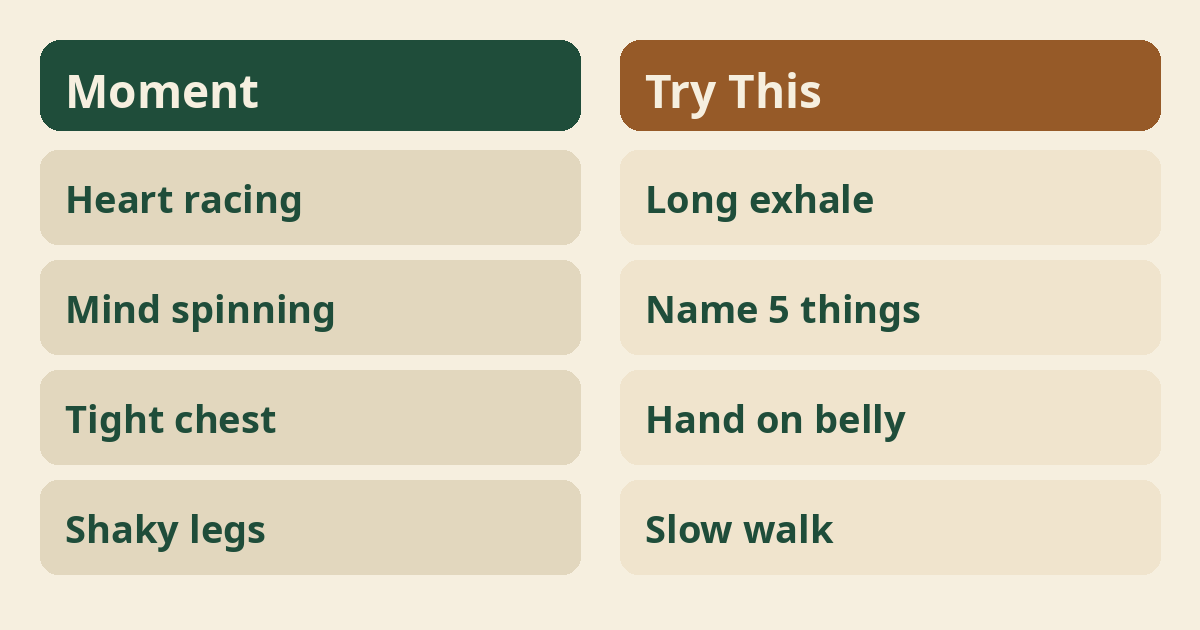
When panic makes your breath fast and shallow, slow belly breathing is the kindest counter-move. Put one hand on your belly and feel it move under your hand. Do not force big breaths. Small and slow beats deep and strained, especially in the middle of a wave.
How long should a session be?
Five to fifteen minutes is plenty for a panic day. Short practices lower the pressure on a day that already has too much of it. If you feel good at minute five and want more, take it. If you are done at minute three, that counts too.
How often should you practice?
A little most days beats a lot once in a while, especially when panic is in the picture. Regular short sessions teach your body the route to calm so it is easier to find on a bad day. The guide on how often you should do yoga helps you pick a rhythm that fits real life.
What if panic rises mid-pose?
If a pose makes you feel worse, come out of it right away and return to something safe. Sit up, open your eyes, look around the room, and name a few things you see. There is no failing a yoga practice. Stopping early is a skill, not a setback.
Common mistakes on panic days
The biggest mistake is trying to use yoga to fight the panic instead of riding alongside it. Other traps are holding your breath, pushing for deep stretches, and judging yourself for a wobbly practice. None of these help. Small, slow, and kind is the whole method.
Props that help
A pillow, a folded blanket, and a wall are the only props most people need on a panic day. A blanket under your head makes child’s pose softer, and a wall behind your back makes sitting steadier. If you want more ideas, the beginner guide to yoga props covers what is worth having at home.
Morning or night?
Practice whenever panic tends to visit you, or whenever you can steal five quiet minutes. Some people like a short morning session to set an easy tone for the day. Others save it for the evening when everything catches up with them. Both work.
A short routine for a rough day
One simple sequence: ground your feet, breathe slowly, child’s pose, cat-cow, butterfly, rest. That is six small steps and about ten minutes. You can do them in any order. Write the list on a sticky note so a panicky brain does not have to remember it.
Benefits people often mention
Many people say slow yoga leaves them feeling a little steadier and less alone with their panic, though results vary. Research groups like National Center for Complementary and Integrative Health note that yoga is widely studied for stress and wellbeing, with mixed but interesting findings. Some people sleep more easily after an evening practice, and others simply like having something kind to do. None of this is guaranteed, and that is okay.
Building the habit slowly
Add one minute or one pose at a time, and only when the current practice feels easy. Progress on panic days is not about flexibility or perfect form. It is about building a familiar path you can walk when things get loud. Slow growth is the kind that sticks.
Working with a teacher
A beginner-friendly or trauma-informed teacher can help you find shapes that feel safe for your body. Tell them you are practicing around panic days. A good teacher will offer options and never push. Even one or two classes can give you the confidence to practice at home.
Anxiety and panic are cousins
Panic tends to arrive in sudden waves, while anxiety is more of a constant hum, and the yoga for each can look a little different. If your hard days lean more toward steady worry than sudden surges, our cornerstone guide to yoga for anxiety covers that slower daily path. For wider stress, the beginner guide to yoga for stress relief is a good next read.
Mindset for panic days
Think of the practice as company for the wave, not a weapon against it. You are not trying to win. You are giving yourself a soft place to land while your body does what bodies sometimes do. That shift in attitude changes everything.
When to skip the mat
Skip yoga and get help if you have chest pain you have never had before, new trouble breathing, or thoughts of harming yourself. Those moments call for urgent care or a crisis line, not a stretch. Yoga will still be there tomorrow. Take care of the big stuff first.
Signs you need more support
If panic days are getting more frequent, lasting longer, or shrinking your life, it is time to talk with a professional. Avoiding work, travel, or friends because of panic is a real signal. A doctor or therapist has tools that yoga never will. Reaching for those tools is strength, not weakness.
Yoga away from home
You can borrow pieces of this practice anywhere, because slow breathing and small stretches need no mat at all. Nobody needs to know you are practicing. Lengthen your exhale on a walk, or roll your shoulders at your desk. The desk yoga guide for beginners has moves that hide in plain sight.
Keeping expectations kind
Expect yoga to be a small comfort, not a switch that turns panic off. Some days it will feel like it helps a lot. Some days it will feel like nothing happened. Both are normal, and neither means you did it wrong.
Your first week plan
For your first week, aim for three short sessions on days that feel okay, not only on panic days. Practicing on easier days builds the habit before you need it. Keep the routine the same each time. Familiarity is what makes it work when a panic day arrives.
Where to read next
For a calm, beginner-friendly start, Ranjana Sinha’s Begin Where You Are is written for people who want simple steps. Our guide to starting a home yoga practice adds a gentle routine you can follow at home.
Frequently asked questions
Can I do yoga in the middle of a panic attack?
Yes, many people find slow breathing and simple restful shapes comfortable mid-wave, but stop right away if anything makes you feel worse.
What if I cry during the practice?
That is common and completely okay, since stillness can let stored feelings surface in a safe place.
Do I need to tell my therapist I am doing yoga?
It is a good idea, because your therapist can help you fit the practice around the care you already have.
Which single pose should I learn first?
Child’s pose is the favorite starting point for panic days because it feels sheltered and needs almost no effort.
Will yoga make the panic days go away?
There is no promise of that, so think of yoga as comfort and company while lasting change comes from professional care.
The bottom line
On your next panic day, give yourself five slow minutes on the floor and let that be enough.