
Mountain pose is a simple standing pose where you stand tall with steady feet, soft knees and a long spine. It is the base for many other poses and a calm place to reset. This guide shows how to do it step by step, with easy options for beginners.
This is general education, not medical advice. If you have blood pressure concerns, dizziness, balance problems, foot or knee pain, are pregnant or have a health condition, check with your doctor before trying this pose.
What is mountain pose?
Mountain pose, or tadasana, is a simple standing pose where you stand tall with feet grounded, legs steady, spine long and arms relaxed at your sides. It looks like plain standing, but it is the base for many other poses. Practising it teaches you how to stack your body, spread your weight and breathe evenly. Beginners can do it anywhere, with no props and no special skill.
Why do people practise it?
People practise mountain pose to learn good standing alignment, to feel steady and to start a session with calm attention. It is often the first pose in a class and the place you return to between poses. After long sitting, standing tall feels refreshing. Our guide to yoga for posture explains more about how posture and yoga fit together.
How do you place your feet?
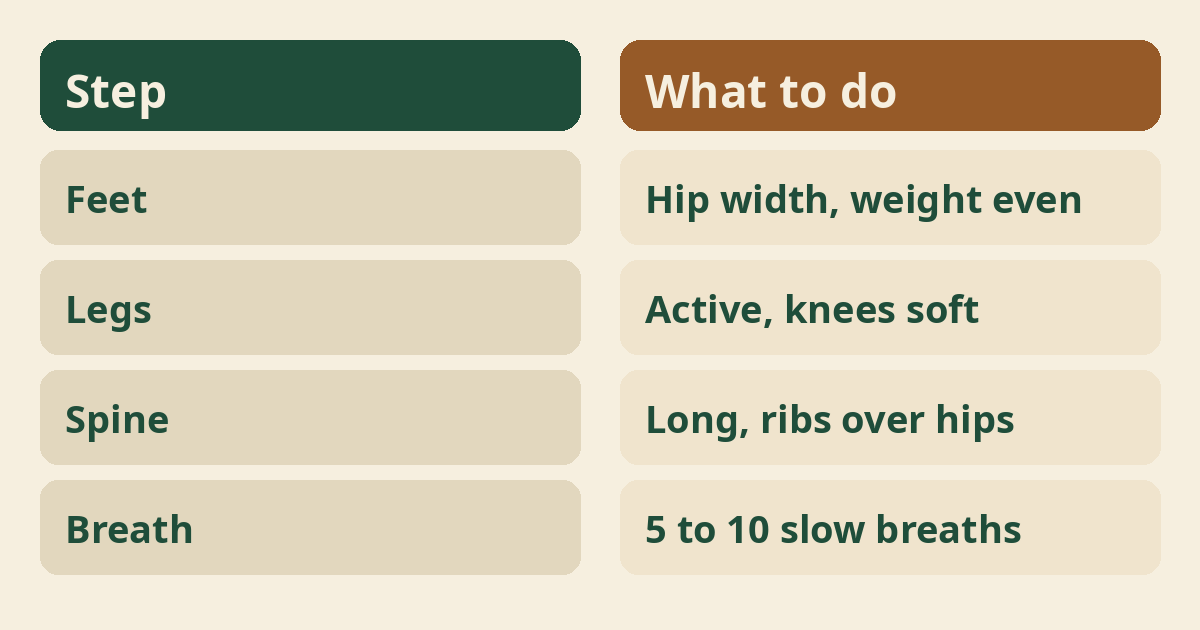
Stand with the feet hip width apart or together, toes pointing forward, and spread your weight evenly across both feet. Feel the big toe, little toe and heel on each foot. If standing with the feet together feels wobbly, keep them a fist width apart. A stable base makes everything above it easier.
What should the legs do?
Keep the legs active but the knees soft, so you feel supported without locking the joints. Imagine gently lifting the kneecaps without clenching. Locked knees can feel stiff and tire you faster. A tiny bend is often kinder. Our guide to yoga for knees has more gentle knee care ideas.
How do you stack the hips and ribs?
Let the hips sit over the ankles and the ribs sit over the hips, with a neutral pelvis, neither tucked under nor pushed back. Many people stand with the ribs flared or the lower back arched. Soften the front ribs and lengthen the tailbone toward the floor. Small changes are enough. You are looking for a long, easy spine, not a stiff one.
What should the shoulders and arms do?
Roll the shoulders back and down, let the arms hang beside you with the palms facing forward or inward, and keep the neck long. If the shoulders creep up toward your ears, let them drop on an out breath. Relaxed fingers help. The chest should feel open but not pushed out.
Where should you look?
Look straight ahead at a spot at eye level, with the chin level and the jaw relaxed. A steady gaze helps your balance. Our guide to yoga for balance uses the same idea. If you feel dizzy, soften the gaze or close your eyes only if you feel steady.
How do you breathe in mountain pose?
Breathe slowly through the nose, letting each in breath lengthen the spine and each out breath settle the body. Do not force the breath. Our guide to belly breathing explains an easy pattern you can use here. Count five slow breaths to start.
How long should you hold it?
Hold for five to ten slow breaths, or as long as it feels comfortable. This is a pose you can return to many times a day. Short, calm holds are fine. Our guide on how often to do yoga helps you build a routine.
What is the arms overhead version?
Raise the arms up beside the ears on an in breath, with the palms facing each other, then lower them on an out breath. Keep the shoulders relaxed and the ribs soft. If lifting the arms hurts the shoulders, keep them lower or rest the hands on the hips. Move slowly and do not strain.
What if you feel unsteady?
Stand with your back near a wall, or place a chair in front of you to hold, and widen the feet a little. A wider stance gives a bigger base. Using a wall or chair is a smart choice, not a failure. Our guide to chair yoga shows how supported poses work.
Can you do it seated?
Yes. Sit tall on a chair with both feet on the floor, hands on the thighs, and use the same long spine and steady breath. This is a good option if standing is hard. The idea is the same: stack the body and breathe evenly. Many people use it at a desk.
How can you use it as a reset?
Pause for a minute between tasks, stand in mountain pose and take five slow breaths to settle your attention. It costs nothing and takes little time. Our guide to yoga at your desk has more short breaks you can use during a working day.
What are common mistakes?
Locking the knees, leaning back, lifting the chin, gripping the toes and holding the breath. Soften the knees, spread your weight, keep the chin level and let the breath move. If you find yourself tense, relax the jaw and shoulders first.
What are the benefits?
Many people find mountain pose helps them feel more upright, steady and aware of how they stand, though results vary. Our guide to the benefits of yoga explains what regular practice may offer. The National Center for Complementary and Integrative Health notes that research on yoga is still developing, so keep expectations modest.
What poses come after it?
Tree pose, warrior pose and a gentle forward fold all grow naturally from mountain pose. Our guides to tree pose and warrior pose show how to build on this base. Return to mountain between poses to reset.
How does it fit in a routine?
Use it at the start and end of a short session, and between standing poses, as a quiet reset. Our morning yoga routine begins with simple standing work. Even one minute of mountain pose before the day starts can help you feel settled.
How can you check your alignment?
Stand sideways to a mirror, or ask a friend to look, and see whether the ear, shoulder, hip and ankle line up. You do not need to be perfect. Small corrections matter more than big ones. Try again with a relaxed jaw and soft knees and see how it feels.
What about the feet and toes?
Spread the toes gently and press evenly into the floor without gripping. Strong, aware feet help the whole body. If your arches feel tired, rest a moment. Barefoot on a mat gives the best feedback.
Who should be careful?
People with blood pressure concerns, dizziness, balance problems, foot or knee pain, or pregnancy should check with a doctor first. Our guide to prenatal yoga explains special care. Keep a chair or wall close. Stop if you feel faint or unwell.
Can older adults practise it?
Yes, with a wall or chair for support and a comfortable stance. Our guide to yoga after 50 shows gentle options. Move slowly and keep support within reach.
Does it help with stress?
The slow breathing and calm attention may feel soothing, but mountain pose is not a treatment for stress. Our guide to yoga for stress relief has more ideas. If stress is heavy, speak to a doctor.
When should you see a doctor?
See a doctor before starting if you have an injury, a health condition, pregnancy or any concern. Stop if you feel pain, numbness or dizziness. This guide is general education, not medical advice.
What should you wear and where should you practise?
Wear comfortable clothes that let you move freely, and stand on a non slip mat or a flat floor with space around you. Bare feet give the best grip. Clear the space and keep a chair or wall within reach. Our yoga mat guide explains how to choose a mat.
How can you tell you are doing it right?
You should feel tall and steady, with even weight on both feet, a relaxed jaw and an easy breath. If you feel strain in the knees, lower back or neck, ease off and reset. Mountain pose should feel simple and calm, not tense.
How can you build up over time?
Add a few breaths to your holds, try the arms overhead version, and then try closing your eyes only when you feel very steady. Change one thing at a time. Allow a few weeks. If a day feels off, use the wall or a chair and be kind to yourself.
What is a simple practice plan?
Stand in mountain pose for five breaths, raise the arms for three breaths, then rest the hands on the thighs and repeat twice. It takes about three minutes. Do it once a day for a week and notice how your standing feels. Small, steady practice builds good habits.
Why does a simple pose matter?
Because the way you stand shapes every other pose, mountain pose is a quiet teacher for the rest of your practice. Time spent here pays off in balance, breath and attention. Do not rush past it. Many experienced practitioners come back to it often.
Where to read next
For a calm, beginner-friendly start, Ranjana Sinha’s Begin Where You Are is written for people who want simple steps. Our guide to starting a home yoga practice adds a gentle routine you can follow at home.
Frequently asked questions
What is mountain pose good for?
Learning steady, upright standing and calming your attention.
How long should I hold mountain pose?
Five to ten slow breaths.
Should my knees be locked?
No. Keep them soft.
Can I do it sitting?
Yes, on a chair with feet flat on the floor.
Is mountain pose safe?
Usually, but check with a doctor if you have blood pressure, balance or foot concerns.
The bottom line
Mountain pose is quiet but powerful. Keep the knees soft, spread your weight and breathe slowly.

