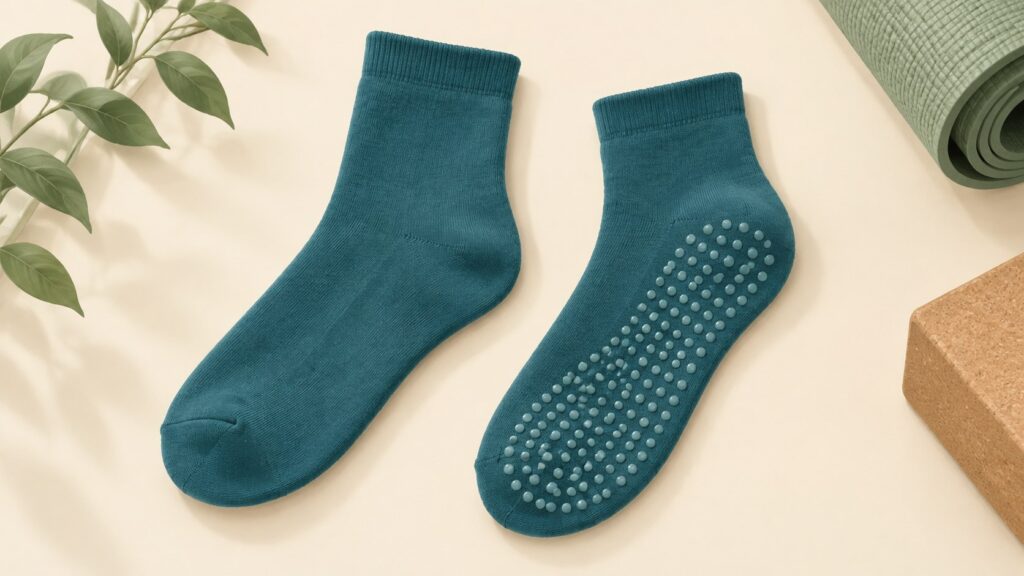
Yoga socks are socks designed for practice, usually with grip material on the sole. They may be useful when you prefer covered feet or when a studio requires them. They are not a guarantee against slipping, a replacement for every mat, or a treatment for a foot problem.
Before choosing a pair, check the class rules, the intended use of the product, and the fit on your own feet. Then consider how the socks behave with the floor or mat you will actually use. A grip pattern that looks convincing in a photograph does not answer those questions.
This guide explains the main designs, what to check, and how care instructions differ. It is an equipment guide rather than a ranking of brands or a medical recommendation.
What makes yoga socks different?
Grip socks add a patterned material to the underside of a fabric sock. Designs vary: some cover the whole foot, some separate each toe, and some leave part of the toes exposed. Other designs use an open upper or straps across the foot.
The name alone does not establish the fabric, grip composition, coverage, fit, or washing method. For example, the manufacturers reviewed here sell cotton-rich blends as well as polyester-rich blends. Read the actual product details rather than assuming all yoga socks are made alike.
A pair marketed for yoga may also be sold for Pilates or barre. That does not mean the equipment, movements, or class requirements in those activities are identical. Check the use you need, not only the category printed on the packaging.
Do you need socks for yoga?
Not necessarily. Studio policies vary. Fly’s FAQ requires grip socks for its barre and yoga classes, while Balance Yoga + Pilates recommends barefoot practice for yoga and grip socks for Pilates.
Those are examples of different venue rules, not a rule for every class. Ask the place or teacher you will attend. If you need an exception because of an injury or another individual concern, discuss it before the session rather than arriving with an assumption.
At home, identify the reason you want socks. Covered feet, personal comfort, or a requirement in a guided class are different reasons from trying to fix an unstable surface. Buying socks without understanding the problem may leave the original issue unchanged.
Full toe, five toe, or open toe?
A full-toe sock may enclose the toes together in an ordinary sock shape. A five-toe design has separate compartments. A half-toe or open-toe design leaves the ends of the toes exposed. Product names can differ, so inspect the design rather than relying on a label alone.
Choose based on comfort and intended use. Individual compartments should not force your toes into an uncomfortable position. A design that leaves the toes exposed provides a different amount of coverage from one that encloses them.
Claims that a particular toe design will strengthen feet, correct alignment, or prevent injury require more than a product description. This guide does not make those claims. You can prefer a design without treating that preference as a medical result.
Fit matters on both sides of the sock
The grip sole touches the floor or mat, while your foot touches the inside of the fabric. Check both contacts. If the sole stays in place but the sock twists around your foot, the setup still needs attention.
Use the size chart for the product and the correct shoe-size system. ToeSox directs buyers to its product size chart and recommends sizing up when between its chart sizes. That is brand-specific guidance, not a reason to size up in every brand.
Check the heel position, toe space, seams, and any strap or cuff. The fabric should not bunch under the foot or feel painfully tight. If a new pair causes discomfort, stop using it and reconsider the size or design rather than assuming your feet must adapt to it.
Grip is not a promise on every surface
Manufacturers often use phrases such as non-slip, grippy, or secure footing. Treat these as descriptions of the product’s purpose, not proof that no slip can occur.
Check the actual floor or mat, the condition of the sole, and whether the sock moves on your foot. Moisture, dirt, fabric position, and wear are reasons to pause and inspect the setup rather than relying on the word grip.
Begin with simple, familiar movement in a suitable space. Do not test new socks by immediately attempting a difficult balance or a faster sequence. If the contact feels unpredictable, stop and ask the teacher about another option.
Yoga socks versus ordinary socks
An ordinary sock does not necessarily have an added grip sole. It should not be assumed to perform like a product designed with that feature. A soft or thick sock can still behave differently from bare feet on the same floor.
Nor does a yoga label make every design suitable for every person. Compare the intended use, size, coverage, and care instructions. Check whether your class permits the item and whether it remains in position during the movements you actually do.
If you are cold during quiet sitting, warmth is a different question from traction during standing practice. You may choose different clothing for those activities rather than expecting one accessory to solve both needs.
Do yoga socks replace a mat?
Not in every role. Socks cover your feet. They do not provide a practice surface under your hands, knees, hips, or back, and they do not automatically add the cushioning you expect from a mat.
Gaiam describes particular grip socks as intended for use with or without a mat. That is information about those products’ intended use. It is not evidence that every floor suits every pose or that socks replace the mat for every contact point.
If you are considering a mat-free session, choose the practice to suit the conditions. Do not use a sock purchase as the reason to continue a sequence on a surface that feels uncomfortable or unstable.
Check studio rules before buying
Ask whether socks are required, optional, or unsuitable for the class. If required, check whether a particular type of grip or coverage is specified. A rule from another studio does not answer for the class you are attending.
You can also ask whether the same policy applies to yoga, Pilates, and barre. A mixed studio may run these activities with different expectations, as the venue examples above show.
If you already own a suitable pair, you may not need another. This is a practical equipment decision, not an obligation to build an accessory collection. Check the requirements first and avoid buying only because a product appears in a class photograph.
Washing instructions are not universal
Read the label for the exact pair. ToeSox’s grip-sock guidance says to wash inside out on a gentle cycle and allows line drying or low dryer heat. It advises against bleach and ironing.
TAVI’s Savvy Tec guidance also says to turn the socks inside out, but specifies a gentle cold wash, no fabric softener, and air drying. Gaiam’s yoga-barre example specifies cold washing with similar colours, a gentle cycle, mild detergent, and flat drying.
The practical lesson is the difference, not a single recipe. Do not apply one brand’s permission to tumble dry to every pair. Keep the care label available, especially when several people share laundry duties.
Check condition before practice
Look for wear, damaged fabric, loose grip material, or a change in how the socks fit. Compare their behaviour with the setup you expect rather than continuing simply because they still look presentable.
If the sole no longer works as expected, follow the manufacturer’s advice about care or replacement. Do not add glue, oils, or an improvised treatment to create grip unless the maker specifically directs it.
A fresh pair is not automatically the answer to every slip. Check the floor, mat, and how the fabric sits on your foot too. If the problem remains, ask the teacher to help identify what needs changing.
Keep hygiene claims modest
Socks add a textile layer, but that does not establish that they disinfect a floor or prevent a fungal infection. Product marketing about hygiene should not be turned into a promise of disease protection.
Follow the studio’s cleaning procedures and the socks’ care label. Keep used equipment separate from clean items as appropriate and allow washed socks to dry as directed before storage.
If you have a skin problem or another concern affecting your feet, seek individual health advice. Covering it with a grip sock does not establish that the practice or the product is appropriate.
Do not treat them as fall-prevention equipment
A grip feature is not a personal fall-prevention plan. This guide does not claim that yoga socks prevent falls, improve a medical balance disorder, or substitute for prescribed footwear or support.
If balance, sensation, pain, or a health condition affects your practice, ask a health professional and a qualified teacher about suitable activity and equipment. Do not rely on a retailer’s stability language to settle an individual safety decision.
The same caution applies to advanced poses. Socks do not remove the need for instruction, appropriate progression, and a suitable environment.
A practical selection checklist
- Check the class. Confirm whether grip socks are required or permitted.
- Identify the purpose. Separate coverage and comfort from an unresolved slipping problem.
- Read the design details. Check toe coverage, fabric blend, and intended use.
- Use the product’s size chart. Look for comfortable fit without twisting or bunching.
- Check the whole setup. Include the floor or mat and the contact inside the sock.
- Keep the care instructions. Washing and drying rules vary between products.
Frequently asked questions
Are yoga socks compulsory?
Not everywhere. Some studios require them and others recommend barefoot yoga. Check your own class.
Are five-toe socks better for everyone?
No universal design suits everyone. Check comfort, toe space, fit, and intended use rather than assuming a medical benefit.
Can I use ordinary socks instead?
Do not assume they provide equivalent grip. Follow class rules and check whether the actual setup is stable.
Can every grip sock go in the dryer?
No. Some manufacturers permit low heat while others specify air drying. Follow the exact pair’s label.
Do grip socks guarantee that I will not slip?
No. Fit, surface, condition, and movement still matter. Stop if the contact feels unreliable.
The bottom line
Choose yoga socks for a clear purpose and a comfortable fit. Check the class rules, the product’s intended use, and the whole surface setup. Care for the actual pair as directed, and keep grip claims separate from promises about injury, infection, or falls.