Triangle and Pyramid both use a split standing stance, and both may show a long front leg with a hand near the foot. That shared outline can hide a useful difference: Triangle reaches sideways with the chest turning toward the side of the room, while Pyramid folds forward over the front leg.
This comparison is for understanding the choice, not for learning a direct transition between the poses. Learn each setup with a qualified teacher. Neither is a test of flexibility, and neither is required in a complete practice.
Start with the direction of the torso
In Triangle, or Trikonasana, the torso extends over the front leg with a sideways orientation. The upper side of the chest turns toward the room. In Pyramid, or Parsvottanasana, the torso faces more toward the front leg as it inclines forward.
That makes the two shapes different even when both use a high hand support and only a small reach. You do not have to reach the floor to notice which direction you are practising.
Pyramid is also called Intense Side Stretch Pose. The name can be confusing: it does not mean the same side-facing action as Triangle. YogaUOnline’s guide describes Pyramid primarily as a forward-folding task involving the back of the front leg, rather than a side-body stretch.
Do not copy one stance into the other
The feet and pelvis need to suit the actual pose, not only the direction of the arms. A Triangle stance is commonly arranged across the length of a mat with the torso facing more sideways. Pyramid uses a forward-facing split stance, with the pelvis directed more toward the front leg.
Those descriptions are broad directions, not exact angles that every body must achieve. Triangle traditions use different stance lengths. Sarah Ezrin’s Yoga Journal guide shows both shorter and longer versions. Pyramid teaching references also differ in the distances they describe.
Ask a teacher to help choose the stance length, side-to-side spacing and foot directions that work together for you. Do not force the pelvis to face a particular wall while a foot or knee is trapped in another direction. If you need to change the feet, come back upright with suitable support and reset deliberately.
Compare one hand contact with two
Triangle commonly uses a lower hand on a suitable block or other stable support, with the other hand on the hip or reaching upward. The upward arm is optional. Keeping it on the hip can make the torso task easier to understand.
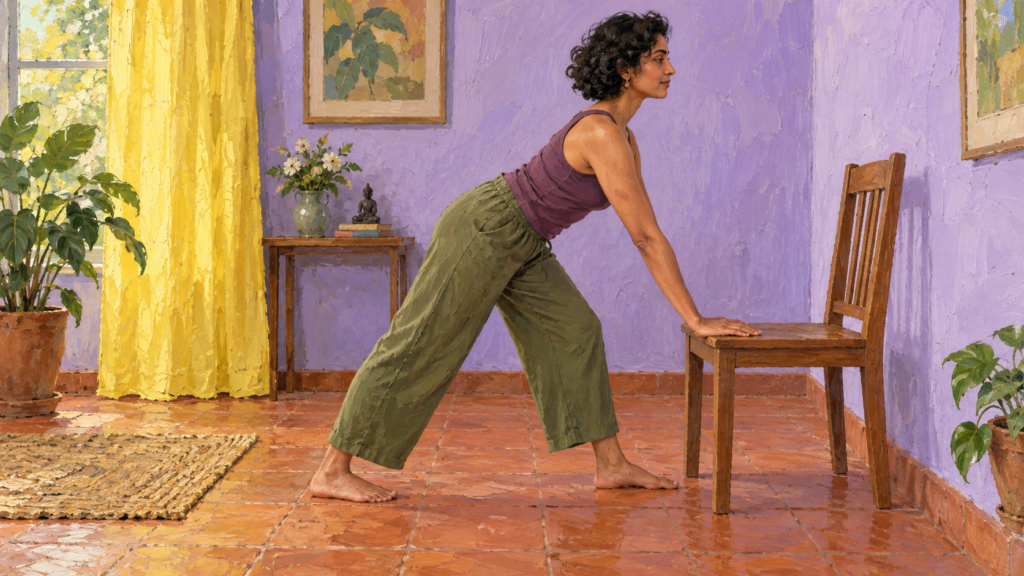
Pyramid can use two blocks, one for each hand, or both hands on a stable chair or wall. These arrangements let the hands share support while the torso faces the front leg. Reverse prayer behind the back is a separate shoulder demand, not a required part of the comparison.
A prop needs to be reachable without a sudden drop or twist. Choose a chair that cannot roll, slide or tip, and blocks stable on their chosen faces. Do not press a hand into the front knee to force it straight or use an arm to pull the torso farther down.
A longer front leg is not a locked knee
Both poses often show a long front leg. That does not require pushing the knee backward into its end range. A small bend may remain, and a higher hand support can keep the reach modest.
Nor does reaching lower prove that you have chosen the better pose. A deep Pyramid fold and a high supported Triangle ask different things of the body. Comparing only hand height misses the direction of the torso, the base and the support.
Stop for pain, pinching or sharp pulling instead of repeatedly changing the knee bend to investigate a symptom. A smaller shape can be an option, but symptoms are not a flexibility challenge to solve by trying harder.
Hip cues are guides, not a rigid silhouette
Triangle is sometimes taught as though the hips, ribs and head should fit between two narrow panes of glass. Physical therapist and yoga therapist Jennifer Chang questions treating that picture as an anatomical rule. Beth Spindler’s Yoga International discussion also describes different ways of practising Triangle rather than one compulsory shape.
The useful distinction here is sideways versus forward-facing orientation, not a demand to flatten the whole body into one plane. Similarly, a teacher’s instruction to face the pelvis forward in Pyramid is not permission to wrench it around over fixed feet.
Keep the gaze comfortable. Looking down or ahead in Triangle is a valid choice instead of turning toward the top hand. In Pyramid, avoid lifting the chin to make the chest look higher. Ask for help if the neck position becomes the main effort.
Choose a task, not a winner
- For a sideways standing reach: discuss a suitably supported Triangle, with the top hand on the hip if useful.
- For a forward-facing split-stance fold: discuss a modest Pyramid with hand support arranged first.
- If the stance or return is uncertain: learn the setup separately, use another suitable position or leave both out.
You do not need to do both in one session. Keep enough energy to return upright with control, and breathe normally rather than using a held breath to remain in the shape. Neither pose is automatically easier or safer for every person.
This is general education, not medical advice or treatment for a hip, knee or back problem. Ask your healthcare professional and qualified teacher about injury, recent surgery, pregnancy, balance concerns, blood pressure or eye conditions, and other limits affecting practice. Stop for pain, numbness, tingling, dizziness or unusual breathlessness.
Explore the yoga pose library for other choices. The aim is a suitable practice, not collecting every standing shape.
Sources and further reading
- Sarah Ezrin at Yoga Journal: 8 Ways to Practice Triangle Pose, for stance variation, hand support and gaze options. Toe hooks, binds and unsupported arm variations are not taught here.
- Yoga Journal: Pyramid Pose, for the forward-facing fold, soft-knee cue and block support. Fixed distances, deep folding and reverse prayer are not prescribed.
- Meagan McCrary at YogaUOnline: Intense Side Stretch (Pyramid) Pose, for the distinction from a side-body stretch and hand-support choices. Strong corrective cues and health claims are not adopted.
- Jennifer Chang at Yoga Journal: The “Two Panes of Glass” Cue, for questioning a universal pelvic silhouette. Its end-range testing instructions are not reproduced.
- Beth Spindler at Yoga International: 4 Ways to Transform Your Triangle Pose, for variation rather than one-size-fits-all alignment. Energetic and injury-prevention claims are not adopted.
- NCCIH: Yoga: Effectiveness and Safety, for qualified instruction and individual modifications.