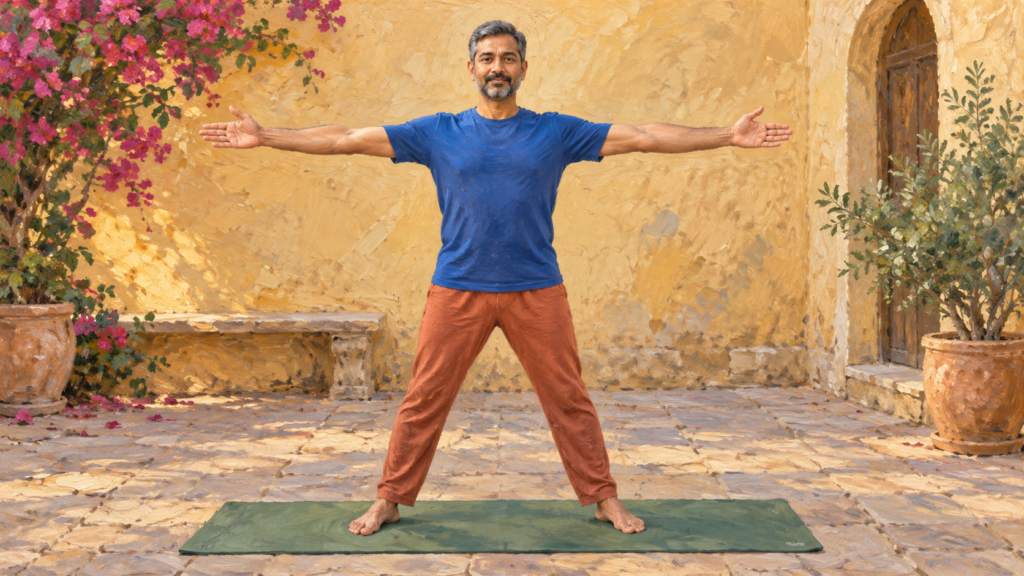
Five-Pointed Star Pose is an upright, wide-legged standing shape with the arms reaching out to the sides. The head, hands and feet make the five points. You may hear it called Utthita Tadasana, although pose names and arm choices vary between teachers.
Unlike Goddess Pose, it is not a squat. Unlike a wide-legged forward fold, the torso stays upright. It can be a pose in its own right or a place to pause before changing into another standing shape. A comfortable stance matters more than making a perfectly symmetrical star.
Start with a manageable width
Choose a firm, nonslip surface with enough clear space for the feet and arms. From comfortable upright standing, step one foot out to a width you can manage without sliding, stretching hard or losing balance. Step rather than jumping into position.
Some teaching descriptions place the feet approximately beneath the wrists when the arms extend. Treat that as an illustration, not a measurement rule. Arm length, leg length and comfortable hip movement differ. Yoga Basics specifically offers a narrower stance for beginners.
Both feet stay grounded. Keep the knees soft rather than pushing them backward to make the legs look straight. If the stance feels forced before you add the arms, bring the feet closer or choose another position.
Add the arms separately
When the stance feels steady, explore lifting the arms out to the sides. Stop at a comfortable height; shoulder level is a common version, not an obligation. Keep the neck comfortable and avoid raising the chin or pushing the ribs forward to make the chest look larger.
Hands on the hips or lower arms are ordinary options. You do not need to hold the arms up until they shake or ache. Lower them before adjusting the feet if managing both changes at once feels awkward.
Keep breathing ordinary and unforced. There is no need for a large inhalation, a breath hold or a fixed number of breaths to make the pose count.
Why do instructions about the feet differ?
Yoga Basics describes forward-facing, parallel feet. The Yoga and Mindfulness Teacher Preparation Program describes a slight outward turn in its setup and also gives a forward-facing cue in its helpful hints. These are teaching variations, not a reason to force a foot angle that is uncomfortable.
Ask your teacher to help choose an arrangement that suits your knees, hips and intended next movement. If you need to change the foot direction, reduce the stance and reposition rather than twisting sharply over a planted foot.
How is it different from Goddess or Triangle?
Goddess adds a deliberate knee bend and a squat. Triangle changes the foot arrangement and takes the torso sideways with a reach. Five-Pointed Star stays upright with the weight shared through both feet and without a deep knee bend.
Those differences matter when a class links the poses. You do not need to turn Star into a deeper squat or reach toward the floor. Pause to learn the next setup instead of copying only the arm shape.
Leave the pose as deliberately as you enter
Lower the arms. Bring the feet back toward a comfortable standing width in controlled steps, then pause. If the wide stance makes that return difficult, use less width next time rather than treating a larger step as progress.
You can keep the eyes open and look ahead. This guide does not add closed-eye practice, heel lifting or jumping as balance challenges. If you need substantial support to stand or step, get individual guidance about an appropriate supported or seated practice.
When a simple pose still needs care
Simple does not mean suitable for everyone. Yoga Basics lists knee, hip and shoulder injuries as cautions. The Yoga and Mindfulness Teacher Preparation Program also flags injury and surgery and cautions against long holds when the effort is too much.
Ask your healthcare professional and a qualified teacher about an injury, recent surgery, pregnancy, balance concerns or another relevant condition. A general standing-pose description is not a rehabilitation plan. A nearby wall does not automatically make a pose appropriate.
Stop for pain, pinching, tingling, numbness, dizziness or unusual breathlessness. Do not keep holding the pose to test a symptom. Seek healthcare advice for symptoms that persist, recur or concern you.
Some sources attach broad claims about circulation, pain relief, spinal realignment or energy to Star Pose. This guide does not treat those as established results from this particular posture. Its practical purpose is to understand a named standing shape and choose a manageable version.
For other pose choices, browse the yoga pose library. You can keep the stance modest, lower the arms and finish without adding another pose.
Sources and further reading
- Yoga Basics: Five-Pointed Star, for the basic shape, narrower-stance and lower-arm options and injury cautions. Broad health and energetic claims are not adopted here.
- Yoga and Mindfulness Teacher Preparation Program: Star Pose, for controlled stepping, soft knees, arm position and return. Its jumping cues are not taught here.
- Tummee: Five-Pointed Star Pose, for names and the distinction from nearby standing shapes.
- 7Pranayama: Utthita Tadasana, for the standing shape and caution against overextending the arms. Fixed widths, long holds and benefit claims are not prescribed here.
- Blissful Yogini: Five-Pointed Star tip sheet, by Rupali Embry, for the hands-on-hips option. Its statement that the pose is safe for everyone, closed-eye and heel-lift challenges, and treatment claims are not adopted.
- NCCIH: Yoga: Effectiveness and Safety, for qualified instruction and individual modifications.