A yoga practice without kneeling needs more than a blanket under the knees. If the aim is to avoid placing the knees on the floor, the poses, rests and changes between positions all need to respect that choice.
You can organise a practice around a chair, standing positions or an appropriate floor position. None is automatically right for every knee. The useful first step is to say exactly what you are leaving out and check the whole route, not only the finished pose.
Separate knee contact from knee bending
Not kneeling means avoiding a kneeling base, such as hands and knees, a back-knee-down lunge or sitting back toward the heels. It does not mean that the knees never bend or carry load.
Chair Pose has no knee-to-floor contact, but it still involves bending the knees and supporting the body on the feet. Sitting on a chair also bends the knees. A reclining pose can avoid kneeling while involving a deep knee bend or a leg crossed over the other thigh.
If you have a medical restriction, ask which movements and loads it covers. “No kneeling” may be one part of the advice, not clearance for squats, lunges or every chair exercise. This guide is not treatment for knee pain or a rehabilitation plan.
Choose the practice level before the pose list
Start with the place where you can remain comfortably and leave with control.
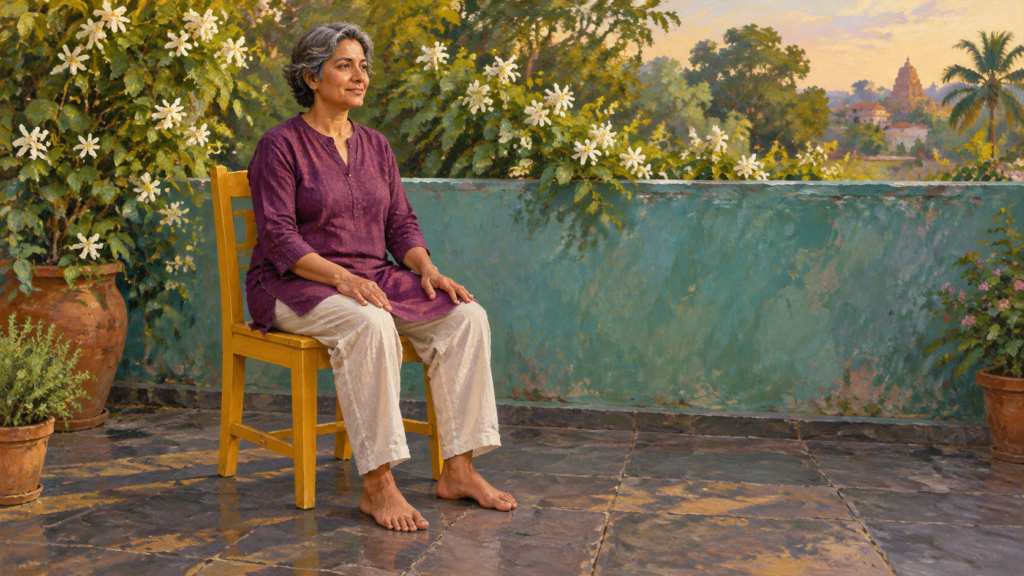
- Chair-based: a practical option when you want to avoid kneeling and floor transfers. The seat should support you without needing to balance on its edge.
- Standing: an option if standing itself suits you. Keep stable support within reach if needed and choose the stance separately from any arm movement.
- Floor-based: an option only when you already have a comfortable, dependable way down and up that does not require the kneeling you are avoiding.
You do not need all three in one session. Staying at one level can remove unnecessary position changes. A seated practice is a complete choice, not a waiting room for returning to the mat.
Use a chair to change the base, not to force the movement
Choose a sturdy chair without wheels on a firm, non-slip surface. Keep the feet supported. If the chair is too high, an appropriate firm foot support may help, but do not balance the feet on a loose stack.
Chair-based teaching resources include upright sitting, small spinal movements, arm movements, side bends and rest. Ohio State’s patient handout and Ann Pizer’s chair-yoga guide both show seated Cat-Cow rather than requiring hands and knees.
For a small seated spinal movement, the hands can rest on the thighs while the torso gently changes shape. Keep the head movement modest; do not throw the head back or push the chest forward to chase a large arch. Stay upright if rounding or arching is uncomfortable or restricted.
Adding a twist, forward fold or crossed-leg stretch is a separate decision. The chair does not make those movements compulsory or universally suitable. Ohio State explicitly warns against its trunk twist when spinal precautions or other medical limits rule out rotation.
Standing options still need individual choices
A comfortable upright stance can be a place to begin and pause. You might explore an appropriate arm reach or small side movement while keeping the feet steady. Lower arms or hands at the waist are valid choices if overhead reaching adds strain.
Do not replace every kneeling pose with a standing version at the same intensity. A back-knee-down lunge and a standing lunge have different support demands. Lifting the knee off the floor removes contact, but it also changes balance and leg effort.
A stable chair can offer hand contact during a teacher-selected standing movement. Keep it positioned so it cannot slide or tip; do not pull it toward you. If standing is tiring or uncertain, remain seated rather than treating the absence of knee contact as the only criterion.
Floor poses require a separate access plan
A back-lying or side-lying rest may avoid a kneeling position once you are there. Getting there can still include kneeling, especially in a class that moves through hands and knees between poses.
Do not use a deep squat, a sudden drop or a roll to the floor as an improvised workaround. If you do not already have a suitable non-kneeling transfer, ask a physiotherapist or other appropriate professional to assess a route. Until then, choose a practice level you can manage.
If floor access is already workable, choose the resting position on its own merits. A supported rest, a knees-bent back-lying position or side-lying may involve different support and joint positions. None is a promise that your knees or another condition will be comfortable.
Check these easily missed kneeling moments
- The starting position: a class may begin in a heel-sitting seat before the first named pose.
- The warm-up: Cat-Cow and Bird Dog commonly use hands and knees, even if the later sequence is standing.
- The lunge: lowering the back knee is still kneeling, even if it lasts only a moment.
- The rest: Child’s Pose is a kneeling shape, not a universal break. A block or blanket does not turn it into a no-kneeling option.
- The return: moving from a floor rest through all fours can reintroduce the very position you excluded.
Padding can change contact pressure for someone who chooses to kneel. It does not fulfil a plan to avoid kneeling, and it does not override pain or a clinician’s restriction.
Agree on substitutions before class
Tell the teacher: “I am avoiding kneeling, including during transitions. Can I stay seated or standing for those parts, and rest on the chair?” If you have additional limits on bending, twisting or weight-bearing, explain those too.
Ask what purpose the next movement serves rather than trying to recreate its exact outline. Seated spinal movement may answer the movement choice behind a hands-and-knees warm-up. Quiet sitting may answer the need for a pause. Neither has to reproduce every action of the original pose.
Group suitable movements by position and leave time to reset. You can stay where you are while others change level. Following the class rhythm is less important than having a route you can use comfortably.
Let symptoms change the plan
Ask your healthcare professional about pain, swelling, injury, recent surgery, pregnancy, balance difficulties or other relevant health conditions. A qualified teacher can help arrange yoga within those limits but should not diagnose the cause of a symptom.
Stop for pain, pinching, instability, numbness, tingling, dizziness or unusual breathlessness. Seek appropriate advice for persistent, recurring or concerning symptoms. Do not repeatedly test a painful movement because the knee never touched the floor.
The goal is a practice that respects your chosen boundary from beginning to end. A chair, fewer movements and a clear pause can be more useful than a long pose list with hidden kneeling between the entries.
For other pose choices, browse the yoga pose library. Choose practices appropriate to your needs rather than treating the list as a required routine.
Sources and further reading
- Ohio State University Wexner Medical Center: Gentle Seated Yoga, for firm-chair support, seated movement examples, stopping for pain and spinal-precaution limits. Its prescribed breaths and stronger movements are not reproduced.
- Verywell Fit: Chair Yoga Poses, by Ann Pizer, for chair-based Cat-Cow and supported feet. Its health-benefit claims and full sequence are not adopted.
- Yoga International: A Fully Seated Chair Yoga Practice, by Amber Karnes, for practising without leaving the chair. Its knee-pressure, deeper-twist and forced-breath cues are not used here.
- YouAligned: Modifying Common Yoga Poses, for recognising that Child’s Pose is not restful for everyone. Its kneeling modifications do not meet this article’s no-kneeling boundary.
- Yoga Basics: Seated Yoga Poses, for the breadth of shapes grouped under a seated label, not a guarantee of low knee demand.
- NCCIH: Yoga, effectiveness and safety, for qualified instruction and individual modifications. This guide makes no claim that a no-kneeling practice treats a condition.