A seated yoga practice can mean much more than sitting cross-legged. It may include an upright pause, a forward hinge, a side bend, a turn or a balance. The legs might reach forward, open apart or bend beside the body. Each choice changes the starting position before any movement begins.
Instead of collecting as many seated poses as possible, plan the movement you want to explore and then find a base that lets you do it comfortably. You do not have to earn a floor practice by learning Lotus, pressing the knees down or keeping the legs straight.
Two decisions: the seat and the movement
Choosing a seat for meditation is mainly about finding a position you can remain in comfortably. Choosing a seated movement practice adds another question: can you move and return without losing support or straining?
An upright position that works for a short pause may not work for a forward bend. A cross-legged seat that feels easy with the hands in the lap may feel less steady when an arm reaches overhead. Recheck the base when the task changes rather than assuming one seat must serve the whole session.
This guide helps organise those choices. It is not a sequence to complete or a replacement for learning individual poses with a qualified teacher.
What the leg arrangement changes
Leg position is part of the task, not decoration beneath the torso. Common starting arrangements include:
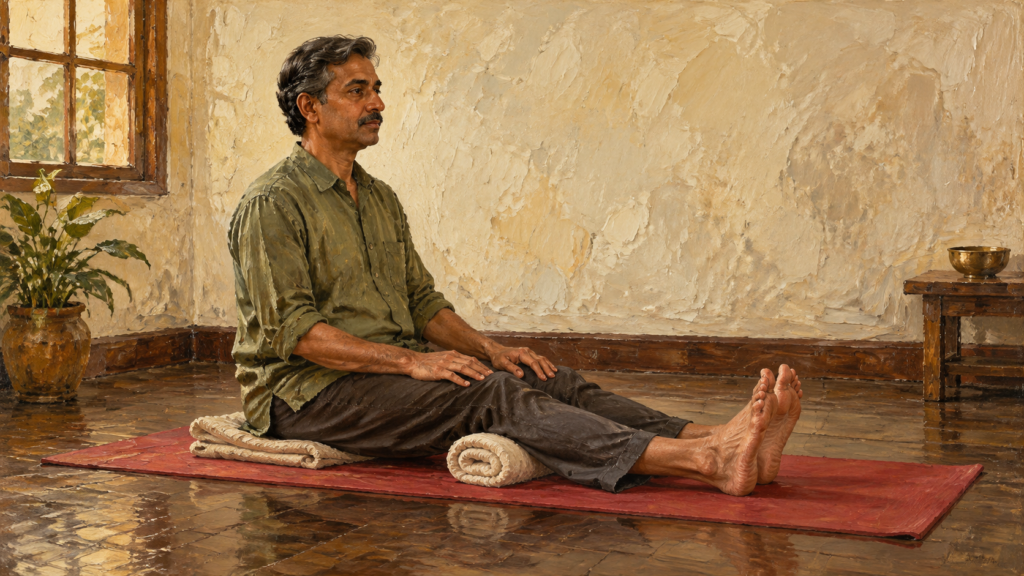
- Legs forward: Staff Pose begins with both legs in front. A folded blanket beneath the seat and a bend in the knees may make the starting position more manageable. It is not necessarily a passive rest.
- Legs crossed or feet together: Easy Pose and Butterfly use different hip and knee arrangements. Being comfortable in one does not establish that the other will suit you.
- Legs apart: a wide-legged seat adds a width choice. More space between the feet is not automatically better, even before adding a forward lean.
- One or both knees deeply bent: kneeling and asymmetrical seats introduce another set of demands. They are optional, not required preparations for every seated practice.
NC State’s seated-pose teaching page shows how varied this category is, including Staff, Boat, forward bends and twists. A shared category does not make those poses equivalent in effort or accessibility.
Build around one question
A useful short practice can have a clear question rather than a long pose list. For example: can I explore a modest forward hinge without reaching for my feet? Or can I turn a little without pulling on the knee or chair?
These questions separate the movement from the performance of a named shape. You can keep the range small, take a pause and decide whether to repeat. There is no requirement to combine folding, twisting and side bending in every session.
If your purpose is simply a quiet seated pause, you do not need to add a stretch. If your purpose is movement, you do not need to hold the starting seat for several minutes first.
When the plan includes a forward bend
Before leaning, check whether the starting seat itself is manageable. If you already need a strong grip on the feet or constant arm support to stay upright, reaching farther may not be the useful next step.
Jivana Heyman’s accessible forward-bend guidance includes bending and supporting the knees, using a strap and practising suitable chair variations. The practical point is that the setup can change. It is not necessary to pull harder to preserve a straight-legged photograph.
A strap extends reach; it should not become a handle for hauling the torso down. Nor does the forehead need to touch a knee. Keep the return part of the plan: choose a range you can leave without jerking or using momentum.
Back symptoms, osteoporosis, recent surgery or other restrictions need individual healthcare advice about appropriate bending. A general instruction to hinge from the hips does not establish that a particular fold is suitable.
When the plan includes a turn or side bend
A turn changes where the chest faces. A side bend changes the relationship between the ribs and pelvis to one side. They are different movements even when the same seated base is used.
Decide what the hands are for. They can rest or provide light, stable contact. Pulling on a thigh, knee or chair to increase a turn is another task. Heyman’s accessible-twist guidance describes using the chair to stabilise without pulling deeper with the arms.
Similarly, reaching an arm overhead is optional in a side bend. If the reach crowds the shoulder or makes you hold your breath, leave it out. Keep the head in a comfortable position rather than using a large head turn to make the movement look bigger.
Unwind before rearranging the legs. Moving the torso and dragging a bent leg into a new position at the same time can make the transition harder to manage.
A chair can change the base without changing the purpose
If floor access or a leg arrangement is the obstacle, discuss a chair option with your teacher. Seated movement does not have to happen on a mat. A chair may let you explore a suitable turn or small hinge without first solving cross-legged sitting.
NHS seated-exercise guidance recommends a solid, stable chair without wheels and a position with the feet flat on the floor. Check that the chair suits both your body and the movement, with enough room for the arms. A chair that slides, rolls or tips is not useful support.
For a quiet pause, using the backrest may be appropriate. For a particular movement, the setup may differ. Do not treat sitting away from the backrest as a universal test of good practice. The point is to arrange the support for the actual task.
Props solve specific problems, not every problem
A folded blanket beneath the seat changes its height. Support beneath a leg can meet a gap. A strap changes reach. These are different jobs, so choose the prop for the problem rather than adding equipment until a pose looks deeper.
Use a stable arrangement that does not slip or wobble. Check support before moving, and keep anything you will need within easy reach. A taller seat is not automatically a better seat, and reducing support over time is not a required goal.
If the same area remains uncomfortable, change the position or leave it out. A prop is not permission to persist through pain.
Leave room to change the plan
Stop for pain, pinching, tingling, numbness, dizziness or restricted breathing. Do not wait for a timer or the end of a teacher’s count. You may change position, keep the eyes open or stop the practice.
Ask a healthcare professional about suitable movement if you have an injury, recent surgery, pregnancy-related concerns or another relevant condition. Seek advice for symptoms that persist or recur rather than repeatedly testing them in a different seated shape.
Before starting, consider how you will get down, rearrange the legs and get back up. A seated practice is useful only if its transitions are manageable too. Choose a small amount of appropriate movement, an ordinary breath and an easy way to finish, rather than treating floor sitting as an endurance test.
For other pose choices, browse the yoga pose library. Choose practices appropriate to your needs rather than treating the list as a required routine.
Sources and further reading
- NC State Yoga I and II: Seated Poses, for the range of seated categories and raised-seat option in Staff. No knee-forcing or advanced-pose instructions are adopted here.
- Yoga International: Making Meditation Accessible, by Jivana Heyman, for floor support and chair/backrest options. Its physiological and spiritual claims are not used as medical evidence.
- Yoga International: Making Forward Bends Accessible, by Jivana Heyman, for supported knees, reach options and alternative bases, not treatment or nervous-system claims.
- Yoga International: Making Twisting Poses Accessible, by Jivana Heyman, for light stabilising contact rather than forced leverage.
- NHS: Sitting exercises, for stable chair selection and supported feet.
- NCCIH: Yoga: Effectiveness and Safety, for qualified instruction and individual modifications. Research on yoga programmes is not proof that one seated pose treats a condition.