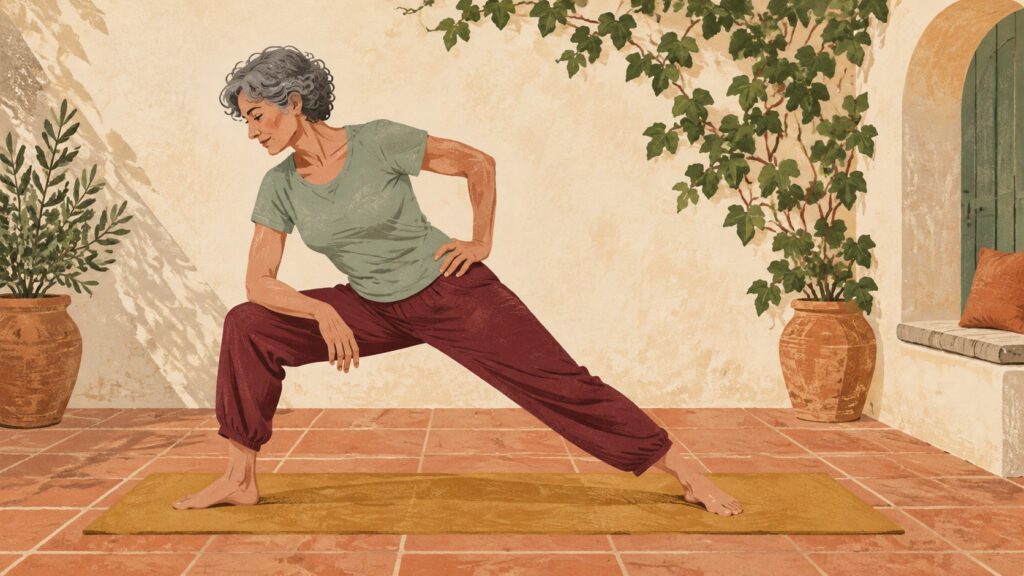
Triangle and Extended Side Angle share a wide standing base and a sideways reach, but the front leg does a different job. Triangle uses a longer front leg, with room for a small knee bend. Extended Side Angle keeps a more obvious bend in that knee while the torso reaches over the thigh.
That difference changes where a lower arm can rest, how the legs support you and which part of the shape may become demanding. Neither pose is automatically easier, and neither is a required step toward the other. Use this comparison to choose a task, not to rank the poses.
The front knee is the clearest clue
In Triangle, or Trikonasana, the front leg lengthens as the torso reaches sideways. Lengthening does not mean pushing the knee backward into its end range. A soft bend can remain.
In Extended Side Angle, or Utthita Parsvakonasana, the front knee stays bent while the back leg extends away. You do not have to lower the front thigh until it is parallel to the floor. A higher position changes the amount of bending without erasing the pose.
Our separate Triangle guide and Extended Side Angle guide describe individual setups. Here, the useful question is what changes when you choose one rather than the other.
Compare the support, not just the outline
- Front leg: Triangle explores a longer-leg position; Extended Side Angle asks you to sustain a knee bend. Either can feel demanding.
- Lower arm: Triangle can use a suitable block or other stable support. Extended Side Angle also offers forearm contact on the bent thigh, so the hand does not have to reach down.
- Upper arm: Triangle often shows an upward reach and Extended Side Angle an overhead diagonal. Both can keep the top hand on the hip. The arm alone does not identify the pose.
- Torso: Both involve a sideways reach with some turning of the chest. Neither requires forcing the hips and shoulders into a flat, two-dimensional arrangement.
- Stance: A distance that suits one shape may not suit the other. Reset the feet while upright rather than treating the wide stance as fixed.
When forearm-to-thigh contact is useful
If reaching toward the floor becomes the main struggle, a shallow Extended Side Angle with the lower forearm resting on the front thigh may be a useful option to discuss with your teacher. Yoga Journal includes this variation alongside block-supported and chair versions.
The contact belongs on the thigh, not as pressure into the kneecap. Keep enough space that the lower shoulder is not pushed toward the ear. If you have to collapse sideways or brace hard to stay there, come upright and reconsider the setup.
This is not a way to remove all work from the legs. You still sustain a bent-knee standing position. If that bend is unsuitable, having somewhere for the forearm to rest does not make the pose suitable.
When a longer front leg changes the choice
Triangle avoids the sustained deeper front-knee bend of a lunge-shaped Side Angle. It introduces a different demand, however: reaching sideways over a longer leg while maintaining a steady base. Do not choose it as an automatic remedy for knee discomfort.
A high hand support and a modest reach can help you explore the shape without chasing the shin or floor. In her Yoga International guide, Jessica Stickler explains that the hand can meet support and should not press into the knee. She also questions the familiar instruction to fit the hips between two panes of glass.
If lengthening the leg produces sharp pulling, pain or pressure behind the knee, come out. Keeping a small bend is an option, but persistent symptoms are not an alignment puzzle to solve by repeatedly testing the position.
Arm position does not decide which pose is better
A photograph may suggest that Triangle means an arm pointing at the ceiling and Side Angle means an arm stretched past the ear. Those are common variations, not obligations.
Keep the top hand on the hip if that makes the leg and torso task clearer. A comfortable forward or downward gaze is also valid; looking upward is not proof of a more complete pose. Yoga Journal explicitly offers gaze changes in Side Angle, and Stickler stresses a comfortable neck in Triangle.
Changing the upper arm, the knee bend and the hand height all at once makes it harder to notice which change caused strain. Keep the optional reach out of the comparison at first.
A practical way to make your choice
Begin by deciding what you want to explore. A supported bent-knee side reach and a supported longer-leg side reach are different tasks. Choose only a version you already know how to enter and leave comfortably.
Notice whether the legs stay steady, the hand or forearm support is easy to reach, and normal breathing remains possible. Also notice the exit. A shape that looks tidy but requires a sudden push, hop or grab to leave is not a useful choice for that attempt.
You do not have to perform both poses in one session to compare them. You may choose neither, work on a smaller standing movement or ask a teacher to assess support placement. Discomfort in one is not a reason to immediately try the other.
Keep the safety decision separate
This is general education, not medical advice. Ask your healthcare professional about suitable activity if you have knee, hip, back or neck problems, a balance concern, recent surgery, pregnancy or another relevant condition. A qualified teacher can help adapt movement within that advice.
Stop for pain, sharp pulling, pinching, numbness, tingling, dizziness or difficult breathing. A prop is not medical clearance. Neither pose is a treatment, and this comparison does not establish that one prevents injury or produces better health results.
Use the yoga pose library to explore other choices. The useful result is a suitable practice, not a particular silhouette.
Sources and further reading
- Yoga Journal: Extended Side Angle Pose, for the bent-knee shape, forearm-on-thigh, block and chair variations, and gaze options. Deep binds, fixed stance measurements and health-benefit claims are not adopted here.
- Yoga International: Triangle Pose Tips, by Jessica Stickler, for support placement away from the knee, a comfortable neck and the limits of two-dimensional hip cues.
- NCCIH: Yoga: What You Need To Know, for general safety, qualified instruction and individual modifications.