Revolved Head-to-Knee Pose, or Parivrtta Janu Sirsasana, combines a seated side bend with a turn of the chest. One leg extends out to the side while the other knee bends. Despite the name, it is not a request to pull the head toward the knee.
This introduction uses a modest side reach without holding the foot. The deeper version, with an overhead foot grip and a large turn, is a separate learning task to explore with a qualified teacher.
A side bend, not a deeper forward fold
In Head-to-Knee Pose, the torso faces the extended leg for a forward hinge. Here, the chest turns away from that leg and the torso inclines sideways toward it. Trying to keep the chest pointed at the shin changes the movement back toward a forward fold.
The base also resembles a wide-angle seat with one knee bent. The legs do not need to spread as far as possible. Choose the width that lets you sit without forcing the hips or knees.
Build a comfortable seat first
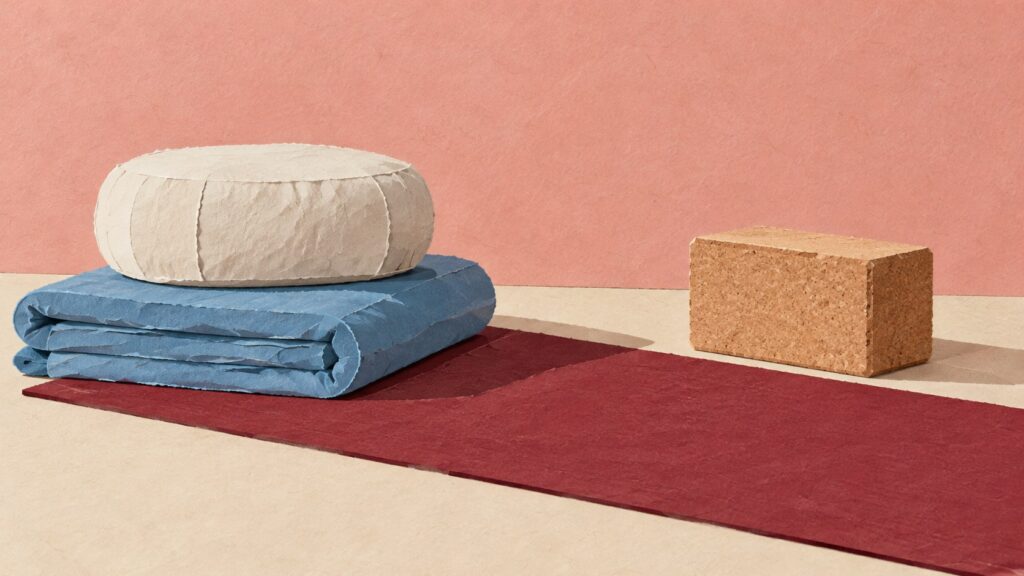
Sit on a firm, level surface. Use a broad folded blanket under the hips if it makes sitting upright easier. Extend the right leg diagonally out to the side, then bend the left knee and let the left thigh open comfortably. Bring the left sole toward the inner right thigh without dragging the heel into the groin.
If the bent thigh hangs uncomfortably, support it with a folded blanket or cushion. Do not push the knee down. Let the extended right knee stay softly bent if that is more comfortable. The basic seat must work before you add a turn or lean.
Leave room on the right side for your hand to touch the floor. If reaching the floor pulls you sideways before you are ready, place a stable block within easy reach or keep the hand resting lightly on the right thigh.
Separate the turn from the side reach
- Sit upright with both hands available for support. Let the chest turn a little toward the bent left knee, away from the extended right leg. Do not force the pelvis or pull on the knee to increase the turn.
- Keep the right hand supported on the floor, a stable block or the right thigh. Leave the left hand at the hip for the first attempt.
- Make a small side lean toward the extended right leg. Keep the chest comfortably open rather than dropping it toward the floor.
- If the shoulder is comfortable, lift the left arm and reach gently overhead. Stop below an overhead position if that is enough. The hand does not have to approach the foot.
- Let the head follow a comfortable line. Look forward or slightly down rather than twisting the neck to look at the ceiling.
- After a few easy breaths, use the lower hand to help return upright. Lower the top arm, release the turn and carefully extend the bent leg before changing sides.
Keep the movement small enough that you can leave it without pulling on the foot, rocking the pelvis or holding your breath. You may prefer the turn alone or a small side lean with the top hand at the hip.
Keep the bent leg comfortable
A raised bent knee is not a mistake that needs to be pressed flat. Change the support beneath the thigh, narrow the angle between the legs or come out. If the knee hurts, do not try to fix it by pulling the ankle closer.
Likewise, an extended knee need not be rigidly straight. Keep a soft bend and reduce the lean if the back of the leg feels pulled. Stronger sensation near a sitting bone or behind a knee is not a reason to stay longer.
Why the foot hold can wait
Holding the extended foot with the top hand adds shoulder reach and can tempt you to pull the torso down. Yoga International’s teaching guidance offers a simple overhead side reach without catching the foot, and recommends backing off when the rotation or easy breath is lost.
A strap can lengthen the reach in some versions, but it does not remove the demands of the turn and side bend. Learn that arrangement with a teacher rather than tightening a strap to reproduce a deep photograph. There is no need to rest the head on the knee or turn the face fully upward.
Make one change at a time
- If the chest rolls down: return higher and reduce the lean. Keep the top hand at the hip while you explore a smaller turn.
- If the lower shoulder feels crowded: bring the support closer or higher, without building an unstable stack.
- If the top shoulder strains: lower that arm. An overhead arm is optional.
- If one side feels different: choose a different range and support height. Do not force the second side to match the first.
This is not a self-assessment for scoliosis or a method for deciding which side of the spine needs more stretching. Conditions involving the spine need individual guidance, not a longer hold selected from a general article.
When to choose another movement
Current knee, hip, hamstring, shoulder, neck or back injuries, recent surgery, osteoporosis, pregnancy and other relevant health conditions call for individual advice before combining a seated turn and side bend. Stop for pain, tingling, numbness, dizziness or restricted breathing. Props do not make every version appropriate for everyone.
If floor sitting does not work for you, choose a different practice with your teacher rather than forcing this seat. This is general education, not medical advice or a claim to improve digestion, stimulate organs or produce a particular nervous-system response. Our beginner pose guide can help you compare other shapes.
Sources and further reading
- Yoga International: Revolved Head to Knee Pose, for the distinction between rotation and side bending.
- Yoga International: Pose Breakdown, Parivrtta Janu Sirsasana, with Beth Spindler, for the raised seat and simple side-reach option without a foot hold.
- NCCIH: Yoga: What You Need To Know, for general safety and individual modifications.