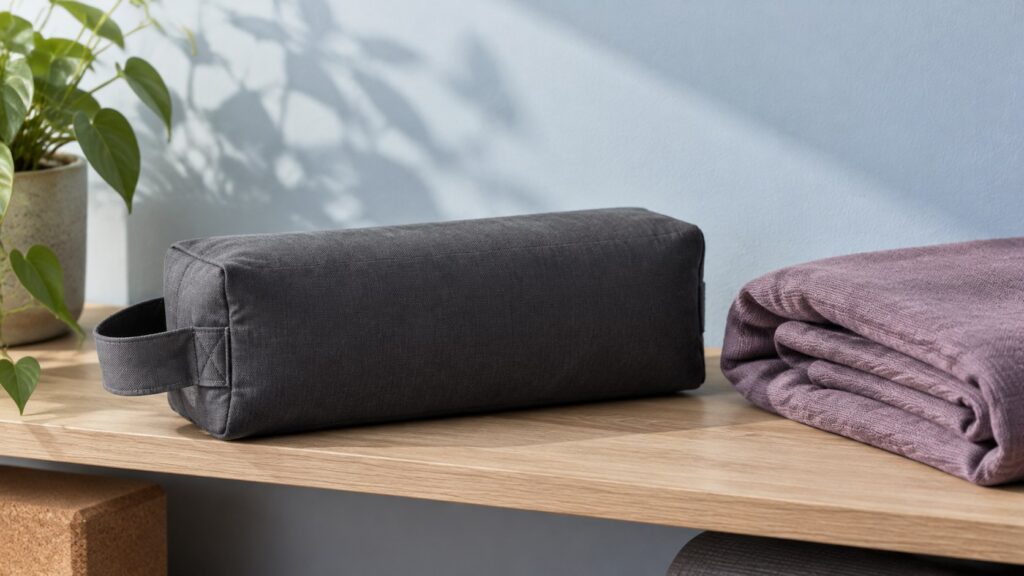
A yoga sandbag is a small weighted fabric prop used in some yoga practices. Unlike a bolster, which provides height and support, a sandbag adds weight. That difference matters: a soft-looking bag can still place a substantial load on the body.
This guide explains construction, filling, care, and the questions to settle before using one. It is not a body-placement routine. A photograph or general article cannot establish the right weight, position, or duration for an individual person.
What makes a yoga sandbag different?
Yoga sandbags are commonly compact rectangular bags with a carry handle. Some arrive filled; others are empty shells that the owner fills according to the manufacturer’s directions. Designs may include an inner liner, an outer cover, a zipper, or more than one closure.
The format is different from a large strength-training sandbag made for lifting, carrying, or throwing. Do not assume two products are interchangeable because their names contain the same word.
Hugger Mugger describes sandbags as established props in Iyengar yoga. Yoga International and YogaUOnline also discuss them in restorative and other supported practices. Those uses explain the context, but their existence does not make every illustrated placement appropriate for a beginner.
Weight is the main distinction
A blanket can cushion a surface, a block can raise a support, and a bolster can hold part of the body higher. A sandbag is chosen primarily because it supplies external weight. It may drape rather than holding a fixed shape, depending on the fill and construction.
That does not make it a better prop than an unweighted support. Our yoga props for beginners guide introduces the different roles of common supports. Ask what the practice actually needs. If the purpose is to bring a surface closer, a sandbag may not address the problem at all.
A familiar pose also changes when external weight is added. Being comfortable without the prop does not establish that adding a heavy bag is suitable. Discuss the proposed variation with a qualified instructor rather than treating the bag as an automatic upgrade.
How heavy is a yoga sandbag?
There is no single universal weight. Manufacturer examples show why product labels matter: Hugger Mugger describes a filled bag with ten pounds of sand, while Yogistar describes a roughly four-kilogram format. Those are product examples, not recommended doses for every practitioner.
Read whether the stated number means the filled weight, the capacity, or something else. An empty cover can look almost identical in a product photograph to a filled bag.
Do not choose weight by comparing yourself with another student. A larger capacity does not mean you should fill it completely. First establish the intended use and appropriate load with instruction; then check that the actual product can meet that requirement.
If filling is permitted, a scale is more informative than guessing from appearance. Record the finished weight so a partially filled bag is not later mistaken for a different one.
Filled or unfilled?
A prefilled bag avoids the task of sourcing and adding fill. It is useful to know exactly what it contains and whether it can be adjusted, opened, or washed. A sealed design should not be cut open simply because a different model has a zipper.
An unfilled bag offers flexibility only within its design limits. Before obtaining fill, read the manufacturer’s allowed material, capacity, closure instructions, and care guidance. If those details are missing, resolve them before assembly.
Also think about transport. A compact bag is not necessarily a light bag. Consider whether you can lift, set down, and store the filled item comfortably without dragging it across other equipment.
There is no need to own a sandbag to begin yoga. If a specific class uses one, ask whether an unweighted variation is available while you learn what the prop is meant to do.
Inspect the liner, cover, and handle
The outer fabric is only one part of the construction. The inner containment system is important because loose sand should not escape into the practice area.
- Liner: check whether there is a separate inner bag and what protects against leakage.
- Closures: look for full closure without trapped grains or excessive strain.
- Seams: inspect for gaps, thinning fabric, and loose stitching.
- Handle: check its attachment before moving a filled bag.
- Cover: identify whether it is removable and how it may be cleaned.
Love My Mat, for example, describes a ripstop inner liner and a removable washable outer cover. Halfmoon’s filling instructions describe two zippered closures. Neither construction should be assumed for every yoga sandbag.
Filling an empty bag
Follow the directions for the exact model. Halfmoon’s instructions specify dry, sterilized play-box sand, a funnel, and a scale. They also emphasize keeping sand out of the zippers, leaving space rather than overfilling, and closing both zippers.
These are useful principles for understanding the task, not permission to use the same fill in a different bag. A product designed for another material may have different requirements.
- Read the allowed fill and capacity before opening the package.
- Inspect the empty liner and closure so a defect is not hidden by the fill.
- Work in a clean area where spilled material can be contained.
- Add the approved dry fill gradually, checking weight rather than relying on visual fullness.
- Leave the space required by the maker so the bag can drape and close properly.
- Clear the closure of grains, close it fully, and check for leakage before putting the prop into service.
Do not force a zipper shut against a tightly packed bag. If you cannot obtain clear model-specific instructions, keep the bag unfilled until you can.
Why a placement photograph is not enough
Published yoga articles show sandbags in many positions. They do not all give the same precautions, and some make broad claims about relaxation, joints, or pain. Treat a demonstration as a description of a particular setup, not personal clearance.
YogaUOnline specifically warns that added weight can stress joints or tight tissues, advises against placing sandbags directly on knees, and says to remove the bag if a joint feels stressed or pulled. That is a reason to take placement seriously, not to experiment with every other location.
This guide does not teach weighted head, neck, chest, abdomen, overhead, or hanging-leg setups. Do not copy such arrangements from a picture. Get individualized guidance and use an unweighted alternative when the suitability is unclear.
Questions for an instructor
A useful explanation should be more specific than this will help you go deeper. Ask what the weight is intended to change and why it is appropriate for you.
- What is the purpose of the prop in this variation?
- What filled weight and placement are intended?
- What other supports are necessary before weight is added?
- How will the bag be removed before I change position?
- What is the unweighted alternative if I prefer it?
If someone else places the prop, agree on the setup first. Ask them to remove it when you request; you do not need to remain in discomfort to complete an exercise.
NCCIH recommends qualified instruction for yoga and notes that people with health conditions, older adults, and pregnant people may need modifications discussed with their health professional and instructor. A weighted variation deserves that same individual consideration.
Do not treat discomfort as progress
The purpose of a prop is not to force a shape. If added weight creates strain, pain, or a feeling that a joint is being pulled, stop the variation and have the bag removed before moving out of the position.
Do not add more weight because you cannot feel a dramatic effect. A stronger sensation is not proof of a better practice. Likewise, feeling calm under a bag does not establish that it is treating a medical condition.
Research about yoga in general should not be relabeled as evidence for a specific sandbag placement. This article makes no claim that a yoga sandbag cures anxiety, corrects a joint problem, or relieves a particular person’s pain.
Cleaning and drying
Separate the cover from the filled inner bag only if the product is designed for that. The care label controls; a washable outer cover does not mean the entire filled item belongs in a washing machine.
Love My Mat specifies cold washing and hang drying for its removable cover and says not to let the inner pillow get wet. Halfmoon’s instructions emphasize keeping its sandbag dry. These details show why one generic cleaning method is unsuitable.
Let cleaned components dry as directed before reassembly. Check seams and closures at the same time. A fresh-looking cover does not fix a leaking liner underneath.
Do not add oils or other substances unless the manufacturer permits them. There is no need to scent a weighted prop for it to serve its basic purpose.
Storage and shared use
Set the bag down rather than dropping it. Halfmoon warns that dropping a filled sandbag can split a seam. Keep it in a dry storage location where it is not a trip hazard or likely to fall from an unstable pile.
Before shared use, check that the cover is clean, the fill is contained, and the weight is known. If several bags look alike but contain different amounts, label them clearly so appearance does not decide which one is used.
Remove a leaking bag from use. Do not conceal escaped grains under a blanket or assume a thicker outer cover has solved an inner containment problem.
Frequently asked questions
Is a yoga sandbag the same as a bolster?
No. A bolster supplies support and height; a sandbag adds weight. They are not automatic substitutes.
Does every bag arrive filled?
No. Check the listing and packaging. Some are empty shells intended for approved fill.
Can I use any type of sand?
No. Follow the manufacturer’s specified material and capacity for the exact bag.
Must a beginner use one?
No. Yoga can be practised without external weights. Ask for an unweighted variation.
Can I wash the whole bag?
Only if its care instructions explicitly allow that. A removable washable cover does not establish that the filled liner can be washed.
The bottom line
A yoga sandbag is a weighted tool, not a shortcut to a deeper pose. Know its construction and actual weight, follow its filling and care instructions, and settle personal suitability and removal before using it on the body.
Sources and further reading
- Halfmoon: Filling sandbags
- Hugger Mugger: Yoga sandbags
- Yoga International: Sandbags in practice
- Yogistar: Balanced sandbag
- Love My Mat: Sandbag details and care
- YogaUOnline: Sandbag use and cautions
- NCCIH: Yoga effectiveness and safety
About the author: Ranjana Sinha
Ranjana Sinha is a yoga teacher with an MSc in Yoga and an M.PEd in physical education. She previously worked as an assistant professor of physical education and yoga and has taught at Kaivalyadhama Institute. Read more about Ranjana.
This article is general education, not medical advice. Speak with a health professional about your individual needs.