You can do some forms of yoga without a mat, but that does not make every floor suitable for every pose. The useful question is not simply whether a mat is essential. It is whether your planned practice, the surface, and your individual needs fit together.
A seated practice may avoid floor work altogether. A familiar standing movement may need little equipment. A flowing sequence with hands, knees, or other parts of the body on the ground makes different demands on grip and comfort.
If you have forgotten your mat, you do not need to reproduce your usual session at any cost. Change the practice, use suitable equipment provided by the venue, or wait. Missing one floor sequence is better than forcing an unreliable setup.
What changes when you remove the mat?
A mat provides a separate practice surface between you and the floor. Depending on its construction, it changes cushioning, texture, and traction. Removing it changes those contacts; it does not merely remove a visual boundary.
Think about where your weight will go. Standing with both feet on a floor differs from kneeling, placing weight through the hands, or lying down. A surface that feels acceptable for one position may be uncomfortable or unstable for another.
A mat is not a guarantee against slipping or injury either. The floor, the underside of the mat, the top surface, moisture, and your movement all matter. Judge the whole setup rather than assuming that either a mat or bare floor is automatically safer.
Choose the practice before choosing a substitute
Start with what you want to do. If the purpose is a short pause with comfortable breathing and attention, a stable seat may be enough. If the purpose is a demanding posture sequence, you may need the equipment and guidance appropriate to that sequence.
Yoga includes more than physical postures. NCCIH describes postures, breathing practices, and meditation as parts of the way yoga is commonly practised. You do not have to turn every session into floor exercise for it to be worthwhile.
This is not a reason to improvise forceful breathing or long breath holds. A quiet pause can use ordinary, unforced breathing. If you want to learn a specific breathing method, seek appropriate instruction instead of treating the absence of a mat as a cue to try something advanced.
Check the actual surface
Look at the place where you intend to practise. Is it clean and dry? Is it level? Is there enough clear space for the movements and transitions? Could furniture, doors, other people, or pets enter the working area?
Notice both comfort and stability. A hard floor may be uncomfortable under a knee or another contact point even when your feet do not slip. A soft surface may feel pleasant to sit on without providing the steady base you expect for standing movement.
Begin with a cautious check before any demanding movement. If your feet, hands, or support shift, pause and change the plan. Do not make a more difficult pose the test of whether the surface is suitable.
Wood or tile is not a complete answer
The name of the flooring material does not tell you how it will behave. Surface finish, moisture, residue, and the movement you attempt can change the experience. Avoid advice that declares every wooden floor suitable or every tiled floor unsuitable.
Keep the area dry and free of obvious residue. Do not assume that socks will improve grip. Footwear and any grip accessory should suit the practice and the actual surface, and a teacher’s or venue’s instructions still matter.
If you cannot maintain stable contact or the pressure feels uncomfortable, move to a suitable setup or select a different activity. There is no need to prove that you can perform the same sequence on a harder floor.
Can you practise on carpet?
It depends on the carpet and the practice. A fixed carpet is different from a loose rug. Thickness, softness, and how the surface responds under pressure can affect how it feels to stand or move.
Do not assume that adding more softness solves every problem. If the surface shifts or makes your footing unpredictable, more challenging standing positions are not the next step. Choose a stable alternative or ask a qualified teacher to help you adapt.
For floor positions, notice pressure and friction rather than expecting carpet to behave like a mat. Stop if the contact is uncomfortable. There is no universal carpet thickness that this guide can prescribe as suitable for everyone.
A towel is not an automatic replacement
A towel can move, bunch, or provide much less cushioning than the mat you usually use. A household bath towel is not automatically designed as a stable exercise surface.
Product instructions differ even among yoga-specific towels. Manduka permits its Yogitoes towel to be placed over a mat or directly on the floor. Yoga Ether describes its Etherloom as a topper that still needs a mat underneath. Neither instruction should be generalised to every textile.
Even where direct-floor use is permitted, check whether the whole setup meets your needs. Permission to use a product that way does not establish equal cushioning or guaranteed grip. Our separate towel-versus-mat guide covers that accessory decision in more detail.
Do not build an unstable stack
If the floor is uncomfortable, piling up loose blankets or towels can introduce movement between layers. A softer stack is not necessarily a more suitable practice surface.
Use props for their intended purpose and follow the guidance for the particular movement. If you need support because of pain, an injury, or a medical condition, ask a health professional and a qualified teacher which positions and supports are appropriate.
It may be better to skip a kneeling or floor position than to assemble a substitute that keeps shifting. Adapting the session is a real option, not a failure to complete yoga correctly.
A chair-based practice may be a better choice
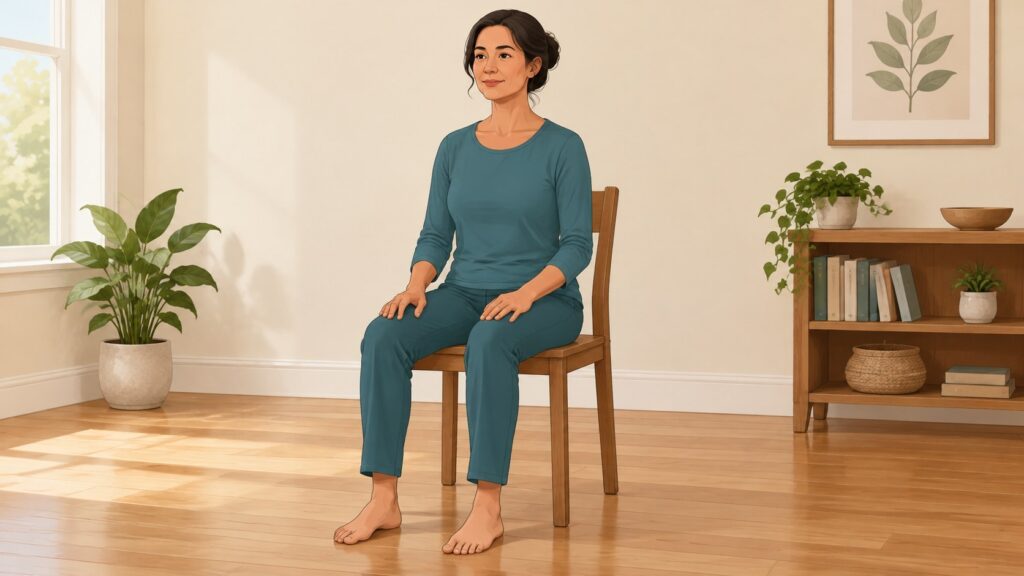
Chair yoga can include seated movement and, in some classes, standing movement using a chair for support. Harvard Health describes it as an option for people who find standing, balancing, or getting down to the floor difficult.
The chair needs checking too. The NHS recommends a solid, stable chair without wheels for its seated exercise guidance, with feet flat on the floor. Harvard advises against a chair that tips, wobbles, rolls, or moves easily.
Choose movements that suit you rather than assuming all chair yoga is appropriate for everyone. Start slowly and do not push into pain or strain. Our chair yoga guide is a separate introduction, not a requirement to copy a whole routine when you have forgotten your mat.
What if you are travelling?
Check what the destination provides before relying on an improvised surface. A studio or accommodation may have equipment, but availability and cleanliness should be confirmed rather than assumed.
If no suitable mat is available, choose a session that does not require floor contact. Quiet sitting or an appropriately adapted seated practice may fit the space better than moving furniture to squeeze in a familiar flow.
Do not treat a bed as interchangeable with a firm practice surface. Its softness and movement change the setup. A practice specifically adapted for a bed is a different question from transferring every standing or floor pose onto a mattress.
Outdoor practice needs its own checks
A patch of grass or sand is not automatically suitable because it looks inviting. Check for uneven ground, debris, moisture, obstacles, and whether you can maintain steady footing.
A mat does not remove every problem with the ground underneath it. Without one, you also need to consider direct contact with the surface. Choose a location and practice you can assess rather than assuming that an outdoor setting makes the decision simple.
If conditions do not suit the session, change location or change the session. You do not need to turn an unfamiliar surface into a balance challenge.
When to get individual guidance
NCCIH notes that yoga injuries can occur and advises beginners to avoid extreme practices. It also says people with health conditions may need to modify or avoid particular poses.
Tell your teacher about relevant limitations. If you are pregnant, recovering from injury or surgery, have balance concerns, or have a condition that affects what movement is appropriate, ask your health professional and teacher for an individual plan.
Pain is not a sign that you should toughen the surface or push further. Stop a movement that causes pain or strain. Changing equipment does not replace assessment of persistent symptoms or a medical problem.
A simple decision checklist
- Define the session. Separate quiet sitting, seated movement, standing practice, and floor work.
- Check the environment. Look for a clean, dry, clear, level place.
- Check contact and comfort. Consider the positions and transitions you actually plan to use.
- Read substitute-product instructions. Do not assume that a towel or rug replaces a mat.
- Change the practice when needed. Use an appropriate seated option or wait for suitable equipment.
- Respect individual limits. Seek guidance rather than pushing through pain or unreliable footing.
Frequently asked questions
Is yoga without a mat still yoga?
Yes. Yoga is broader than floor postures. Some seated practices do not require a mat, but the setup still needs to suit the activity and the person.
Can I do my usual flow on any floor?
No. Check grip, comfort, space, and the demands of each position. Adapt or postpone the sequence if the surface is unsuitable.
Can a bath towel replace a yoga mat?
Not automatically. It may move or bunch and does not necessarily provide suitable cushioning. Follow the intended use of any practice product.
Is carpet always better than a hard floor?
No. Softness and stability are different questions. Check the actual surface and the movements you plan to do.
What is an alternative when I forget my mat?
Ask about suitable loan equipment, choose an appropriately adapted seated practice, or wait. You do not have to reproduce every floor pose without the usual support.
The bottom line
Yoga without a mat is a question of matching practice to conditions. Do not ask an unsuitable floor, loose towel, or soft stack to behave like equipment it is not. Keep the session within your abilities, choose a stable and comfortable setup, and adapt the practice when the surface changes.