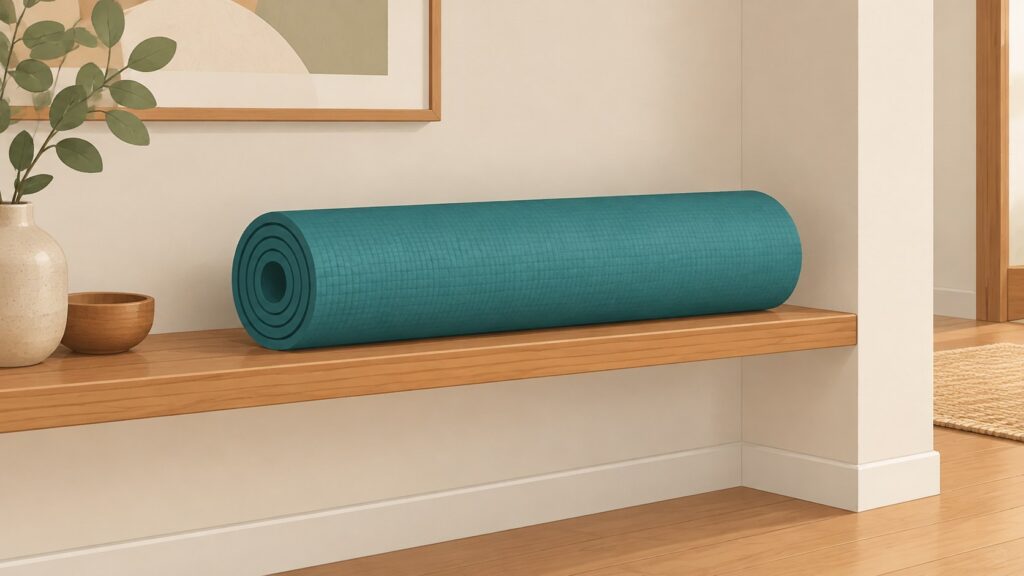
Good yoga mat storage begins before you put the mat away. Check the care instructions for the actual model, allow it to dry as directed, and choose a place that avoids the heat, sunlight, or pressure the manufacturer warns against.
You do not necessarily need a special rack. A suitable shelf, bag, or other ordinary space may work if the mat fits without being forced and the location suits its care requirements. The most attractive storage idea is not automatically the best one for the material.
This guide focuses on drying, rolling, choosing a storage place, and avoiding common mistakes. It is not a product ranking or a universal cleaning recipe.
Start with the model, not a generic rule
Yoga mats use different materials and constructions. A natural-rubber mat, a layered mat, and a mat designed to fold may need different care. Look up the instructions for the name on your mat or its packaging rather than relying on a rule for all yoga mats.
For example, Manduka’s eKO guidance says to store the mat rolled with its practice surface facing outward in a cool, dry place away from direct sunlight. Liforme also directs owners to roll its mats with the coloured practice side outward and advises against folding.
Those are useful examples of specific instructions. They do not prove that every mat from every brand must be rolled the same way. If the model is unclear, ask the manufacturer before trying a method intended for a different construction.
Drying and storage are separate jobs
A storage space is not always a drying space. Rolling a mat and putting it into a bag may make it easier to carry, but it does not establish that the surface is ready to remain enclosed.
Manduka’s eKO instructions say to let the mat air dry before rolling and avoid storing it damp. Liforme says to let the mat dry flat after practice before longer storage. It also explains that rolling after class for the journey home is different from leaving it rolled: unroll it to dry afterward.
Follow the drying method for your model. Do not assume that hanging, laying flat, or another method is suitable simply because it works for a different mat. There is no single drying time that fits every material, room, and amount of moisture.
Which side should face outward?
Check the manufacturer’s direction. Both the Manduka eKO and Liforme examples specify the practice side outward. Liforme explains that its layered construction is designed to be rolled that way to help the mat lie flat when unrolled.
That is a more reliable basis than a general claim that the practice side must always be protected inside. A method intended to separate the two surfaces should not override the instructions for the actual mat.
Roll without forcing a very tight bundle. If you need to compress the mat heavily to fit the storage space or bag, reconsider the fit. Avoid improvising heat, weights, or aggressive reverse bending to change its shape.
Can you fold a yoga mat?
Only if the model is intended to be folded or the manufacturer says that method is appropriate. A travel mat designed for folding is not evidence that a thicker layered mat will tolerate the same treatment.
Liforme specifically advises against folding its mats because visible creases may result. That warning is model guidance, not a statement that every crease in every mat has the same consequence.
If you travel often, check the permitted packing method before buying or packing a mat. Do not discover at the suitcase stage that the only way it fits is a method the maker advises against.
Choose a cool, dry indoor location
The manufacturers reviewed here repeatedly emphasise storage away from direct sunlight. Manduka’s eKO guidance also warns against excessive heat, hot cars, and heat sources. Jade’s natural-rubber guidance is particularly cautious about UV exposure.
Choose a location that stays suitable during the time the mat will be there, not only when you put it away. A corner that is shaded in the evening may receive direct sun later. A closed car is a transport location, not a dependable long-term storage plan.
If the room is damp or the storage area is near a source of heat, find another place where possible. Do not use sunlight or a heater to hurry drying unless the instructions for the exact product permit it.
Bag, shelf, basket, or rack?
Think first about fit and access. Can you put the mat away without crushing it? Can you remove it without pulling other objects down? Is there room for the rolled diameter and any strap or cover?
A bag can be useful for carrying and keeping items together, but only put the mat away for longer storage after completing the care and drying steps. Check the bag’s own care instructions too.
A shelf or basket may be an ordinary option if it is stable, dry, and does not squeeze the mat into an unsuitable shape. Keep heavy objects from pressing on it. These are practical storage checks, not a claim that one furniture type has been tested for every mat.
If you choose a rack, follow its actual assembly, mounting, and load instructions. This guide does not prescribe wall fixings or assume that every wall or freestanding unit can safely support the same weight.
Keep the route through the room clear
Storage should not create a new obstacle. Avoid leaving a rolled mat where it can move into a walkway or where someone has to step over it to reach a door.
In a shared home, agree on a place rather than taking over someone else’s storage space. If several people use mats, make it easy to identify and return the correct one.
The goal is a repeatable routine: practise, complete the appropriate care, let the mat dry, and return it to a place where it can stay without causing a problem. A simple arrangement you can use is better than an elaborate display that is difficult to maintain.
What about storing the mat flat?
Flat drying and flat storage are not necessarily the same recommendation. Liforme describes drying flat but then rolling for storage. Jade’s European natural-rubber guidance recommends storing rolled rather than lying open.
Check the distinction in your own instructions. Do not assume that because a mat is laid flat during one stage of care it should remain that way between uses.
If you are considering leaving it under furniture, make sure that this does not expose it to pressure, dirt, heat, or a folding method that conflicts with the care guidance. The available space is not the only factor.
Store a shared mat with a clear procedure
If several people use the equipment, agree on who completes cleaning and drying and where each stage happens. Otherwise, a mat may be put into storage because someone assumes another person has already checked it.
Use the venue’s procedure and the model’s instructions rather than adding a homemade spray or a stronger product because the mat is shared. Storage advice does not establish a disinfection method.
Keep a wet towel or damp accessory separate while it needs drying. Follow the instructions for each item, and avoid treating a storage bag as the place where every damp object can remain until the next class.
Odour is a reason to check, not cover up
Some mats have a material smell. Jade notes that natural-rubber odour can vary and advises airing its mats in a ventilated area, not outside or in direct sun.
Do not assume every smell has the same cause. Check whether the mat was put away damp, whether cleaning instructions were followed, and whether the bag or nearby accessories need care.
Adding perfume, oils, or an unapproved spray can create another problem. Jade warns that some products can damage its natural rubber or affect the surface. If you are unsure about a persistent change, contact the maker rather than masking it.
Check the mat when you take it out
Before practising, look for visible damage, unusual changes, or a surface that is not suitable for the activity. Make sure the mat lies as expected and that the floor setup is appropriate.
If corners remain curled or the surface has changed, consult the care guidance rather than trying an aggressive fix. Liforme and Manduka’s outward-rolling instructions show why the storage direction can matter for particular models.
Do not continue using a mat that feels unsafe just because it is expensive or new. Storage care helps you look after equipment; it does not make damaged or unsuitable equipment safe by definition.
A practical storage checklist
- Identify the model. Find its current care instructions.
- Complete appropriate cleaning. Do not substitute a general recipe for the maker’s guidance.
- Dry as directed. Distinguish a short trip home from longer storage.
- Use the recommended roll or fold. Check which side faces outward where specified.
- Choose a suitable place. Consider heat, sunlight, moisture, pressure, and access.
- Check before the next practice. Address a change rather than ignoring it.
You do not need a new storage product to follow these steps if an ordinary suitable space already exists. Buy an accessory only when it solves a real fit, transport, or organisation need.
Frequently asked questions
Should I roll my mat immediately after practice?
Follow the model’s instructions. Some makers distinguish temporary rolling for transport from longer storage and advise unrolling to dry once home.
Which side should face outward?
Use the maker’s direction. Manduka eKO and Liforme specify the practice side outward, but do not assume that every mat has identical requirements.
Can I leave a mat in a car?
Do not treat a car as a dependable storage place. Manduka’s eKO guidance specifically warns against hot cars and heat sources.
Is a wall rack necessary?
No. A suitable ordinary space may work. If you use a rack, follow its actual mounting and load instructions.
Can I fold any mat to save space?
No. Check whether the model is intended for folding. Some makers advise against it because creases can result.
The bottom line
Yoga mat storage is mostly about matching the routine to the actual mat. Dry it as directed, use the recommended roll or fold, and choose a location that avoids unsuitable light, heat, moisture, and pressure. Keep the arrangement simple enough to repeat, and let the manufacturer’s instructions outrank a generic storage trend.