Saucha is commonly translated as cleanliness or purity. It is one of the five niyamas, the personal observances listed in Patanjali’s Yoga Sutra. The term includes a philosophical context that is wider than cleaning a yoga mat or keeping a room tidy.
For a modern reader, an ordinary starting point can be care: making a practice space usable, looking after equipment, and approaching study with attention. That does not mean a spotless home proves spiritual progress, or that a body, food, or feeling should be judged as morally dirty.
This guide explains the classical references, acknowledges difficult wording in translation, and offers modest contemporary applications. It does not prescribe cleansing procedures, restrictive diets, or medical treatments.
What does saucha mean?
Cleanliness and purity are common English renderings. You may also see the spellings shaucha or sauca. The English words need context because a practical cleaning task, a ritual practice, and a philosophical account of purification are not identical.
Yoga Sutra 2.32 lists saucha among the niyamas, alongside santosha, tapas, svadhyaya, and ishvara pranidhana. Reading the list makes clear that the subject is part of a wider discipline rather than simply a housekeeping tip.
Contemporary explanations often discuss both outer care and an inner orientation toward clarity. Those explanations can be useful, but a metaphor about a clear mind should not be mistaken for a medical claim about removing toxins or treating a condition.
Where does it sit in the eight limbs?
The niyamas are part of the framework commonly called the eight limbs of yoga. They are discussed alongside the yamas and other aspects of practice, not as a replacement for the rest of the teaching.
Our guide to the eight limbs of yoga provides that wider setting. It helps distinguish a personal observance from a posture technique, a health intervention, or a rule about how every household must look.
A beginner does not need to master the whole framework before reading about one term. It is still worth remembering that an English definition is an entry point into a text and its interpretations, not a complete account of every tradition.
Why Yoga Sutra 2.40 needs careful reading
Some translations of Yoga Sutra 2.40 use strong language about the body. The Centre for Yoga Studies renders it as “From cleanliness, disdain for own body, non-association with others.” Its collected commentary places that wording in a context of reduced desire for bodily contact.
Integral Yoga Magazine also acknowledges the association with disgust for the physical body before discussing everyday cleanliness and simplicity. It would be misleading to pretend that every classical passage uses the language of modern body acceptance.
It would also be irresponsible to turn a difficult verse into an instruction to hate, neglect, or punish your body. A contemporary application should make its interpretive choices clear. Ask a knowledgeable teacher about the text, translation, and commentary rather than treating a single English word as a command for personal conduct.
What does Yoga Sutra 2.41 describe?
The following verse describes results connected with purity, including clarity, one-pointedness, mastery of the senses, and readiness for self-vision. English translations differ in the way they express these qualities.
These statements belong to a philosophical and spiritual account of practice. They are not clinical evidence that cleaning a room will produce concentration, eliminate distress, or create a particular state of consciousness.
A practical reading can still ask whether a small act of care makes a space more usable. That is a different, more limited question than promising the spiritual results described in a verse. Keeping those levels separate makes the explanation more honest.
Begin with a usable practice space
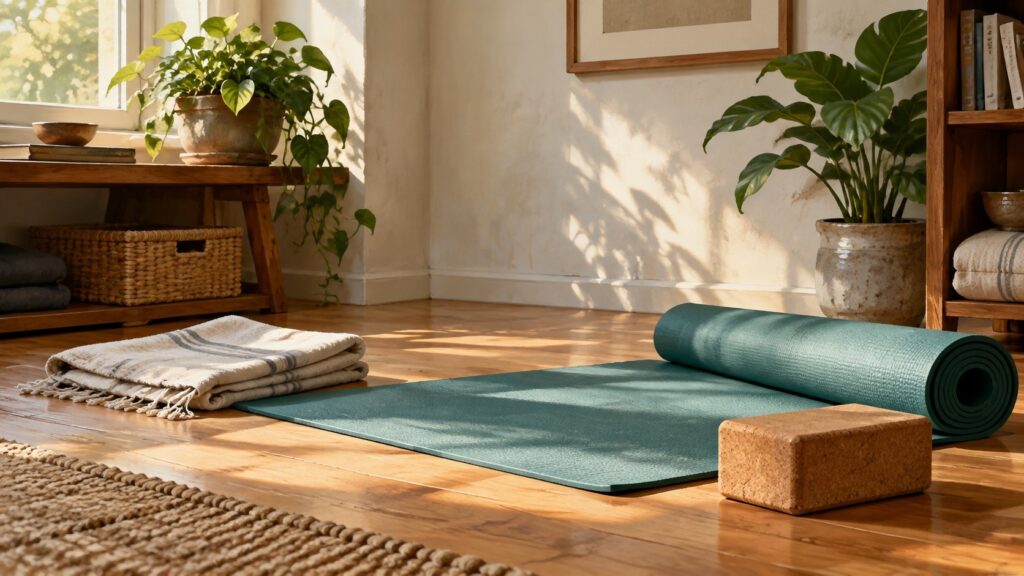
Choose a place where you can move without avoidable obstacles. Put away an object you might trip over, arrange the equipment you need, and leave enough space for the practice you have chosen.
This does not require a dedicated room or a particular style of decor. A shared space, a small clear area, or an ordinary corner can be enough for an appropriate activity. Adapt the setup to your circumstances rather than trying to reproduce a photograph.
If you share the space, respect other people’s belongings and needs. Ask before moving something important or changing how the room is used. Care for a shared environment includes agreements, not simply making it look the way you prefer.
Look after equipment according to its instructions
Mat and prop care is a concrete modern example of attention to the environment of practice. Follow the instructions for the actual material and model instead of assuming one cleaning method fits everything.
A surface looking clean does not establish every hygiene claim, and a strong smell is not evidence that a product works better. Use a cleaning product only as directed. Avoid improvised combinations or routines chosen because the word purification sounds more powerful.
If equipment is shared, follow the venue’s care procedure. If it is damaged, slippery, or otherwise unsuitable, address that practical problem rather than treating it as an opportunity to prove acceptance. Philosophy does not remove the need for safe equipment.
Choose a small reset rather than perfection
Swami Divyananda’s Integral Yoga Magazine essay discusses simplicity and care for surroundings through her own experience. Sarah Ezrin’s Yoga International article also explores ordinary cleaning as a setting for attention. These are contemporary accounts, not proof that every person needs the same level of order.
One practical application is to choose a task with a clear endpoint: return the props, clear the path, or put a book back where you can find it. Finish that task and move on.
The aim is not to inspect every corner repeatedly or reach an impossible standard. A living space can be used, imperfect, and cared for at the same time. Do not let a modest reset expand into a requirement that everything must be spotless before you deserve to practise or rest.
Cleanliness is not a ranking of people
Resources, disability, illness, work, caregiving, and housing conditions can affect what someone can maintain. A room’s appearance does not reveal the whole of that person’s effort, character, or spiritual life.
Do not use saucha to shame someone for needing help, having limited space, or managing a difficult period. The useful response to an unsafe or unmanageable environment may be practical assistance rather than a lecture about purity.
The same care applies to your own circumstances. Choose what is workable, ask for support where needed, and avoid comparing your daily reality with someone else’s carefully arranged image.
Be cautious with language about inner purity
Teachers sometimes use purification as a metaphor for examining habits or making room for clearer attention. A metaphor can invite reflection, but it can also become harmful if ordinary emotions are treated as contamination.
Anger, sadness, fear, and intrusive or unwanted thoughts are not evidence that you are dirty. You do not need to force gratitude or suppress a feeling in order to make yourself acceptable.
A contemporary reflection might ask, “What happened, and what response would be useful?” That is different from declaring an emotion impure. If thoughts or feelings cause significant distress, seek appropriate support rather than trying to cleanse them away through a philosophical exercise.
Saucha is not a detox plan
The word purity can be used to market cleanses, restrictive food rules, or procedures that promise to remove unspecified toxins. Those claims do not become valid because a yoga term appears beside them.
This article does not recommend fasting, purging, internal washing, or other cleansing procedures. Do not improvise a bodily practice from a brief description or use it to replace care recommended for a health condition.
It also does not divide people or foods into morally pure and impure categories. Decisions about nutrition, illness, or a procedure need appropriate individual guidance and evidence, not a general interpretation of a philosophical word.
When cleaning stops feeling optional
A reflection on saucha should not become pressure to repeat washing or checking until everything feels perfectly right. If a routine is causing distress, taking over your time, or making it hard to continue ordinary activities, seek professional support.
You do not need to solve that difficulty by becoming more disciplined in yoga. It is reasonable to pause an exercise that intensifies it and discuss what is happening with an appropriate professional.
This guide cannot assess an individual situation. Its practical suggestions are optional, low-stakes ways to explore care for a space, not treatment advice or a standard you must meet.
A brief contemporary exercise
- Choose one useful task. Keep it small and relevant to the practice you are about to do.
- Check the method. Use appropriate care instructions if a product or piece of equipment is involved.
- Notice your attention. You can attend to the task without trying to create a special experience.
- Stop at the endpoint. Usable is enough; perfection is not required.
- Continue with your day. The task is one act of care, not a judgment of your worth.
This exercise is a modern application. It is not a quotation from the Yoga Sutra or a substitute for studying the text with its commentary.
Frequently asked questions
What is the simplest meaning of saucha?
Cleanliness or purity. It is one of the five niyamas listed in Yoga Sutra 2.32.
Is it only about washing or tidying?
No. Classical and contemporary explanations also discuss philosophical and spiritual purification. Keep those meanings distinct from ordinary cleaning and medical claims.
Must my room be spotless before yoga?
No. A practical starting point is a usable, appropriate space. Perfection is not a requirement.
Does it mean I should dislike my body?
Some translations of Yoga Sutra 2.40 contain difficult language about the body. This guide does not turn that wording into an instruction for hatred, neglect, or punishment.
Is a detox routine part of this guide?
No. No cleansing procedure, restrictive diet, or medical treatment is prescribed here.
The bottom line
Saucha deserves more care than a slogan about being clean. Read the text and its interpretations honestly, then keep modern applications practical and limited. Care for a usable space and appropriate equipment can be a starting point. Body shame, moral judgments, compulsive standards, and unsupported detox promises are not useful substitutes for understanding.
Sources and further reading
- Centre for Yoga Studies: Yoga Sutra 2.32.
- Centre for Yoga Studies: Yoga Sutra 2.40 and commentary.
- Centre for Yoga Studies: Yoga Sutra 2.41.
- James Haughton Woods translation of the Yoga Sutra.
- Swami Divyananda: a contemporary personal account of simplicity and saucha.
- Sarah Ezrin: a contemporary interpretation of saucha and everyday care.