Confidence does not require perfect poses or a fearless personality; it can begin with noticing what you need, choosing a manageable next step, and keeping a promise to yourself. This beginner’s guide explains how yoga may offer a calm, practical setting for that kind of self-trust, with options to adapt or pause at any time.
This article is for general information and is not medical advice or a substitute for care from a qualified health professional. If you have a health condition, injury, pain, balance concern, are pregnant, or are unsure whether a movement is suitable, ask your doctor or another qualified clinician before starting. Stop if a movement feels painful, dizzying, or otherwise concerning, and seek professional guidance.
Why confidence can start small
Confidence can grow through small actions that you choose and complete. It is easy to picture confidence as a dramatic quality: speaking without hesitation, taking up space, or never doubting yourself. Everyday confidence can be quieter. It may mean trying a new movement, asking for an adjustment, or deciding that rest is the right choice today. Yoga does not promise a personality change; it can give you a repeated moment to practise attention and choice.
What yoga can and cannot do
Yoga may provide a practice setting for self-awareness, but it cannot guarantee confidence. A pose is not a test of character, and flexibility is not proof of worth. A beginner’s session can make room to notice breath, effort, comfort, and preferences without needing to impress anyone. Confidence develops differently for each person and is influenced by many parts of life. Treat yoga as one optional way to practise, not as a cure, requirement, or replacement for support you need elsewhere. For general information about yoga research and safety, see National Center for Complementary and Integrative Health.
Ask a clinician first when needed
A clinician can help you decide whether a movement practice fits your health needs. Before beginning, check with your doctor if you have an injury, persistent pain, a condition affecting movement or balance, recent surgery, pregnancy-related questions, or any concern about exercise. Share what kind of yoga you plan to try and ask about movements or positions to avoid. This is especially useful if you are returning after a long break or following professional treatment; this article cannot assess your personal situation.
Make the goal personal
Choose a goal that describes an action you control rather than a result you cannot guarantee. Instead of aiming to become confident by a deadline, try setting a small practice goal: spend five minutes noticing your breath, learn one comfortable posture, or practise saying no to a movement that does not suit you. These aims leave room for changing energy and circumstances. You can count pausing, adapting, or asking for help as thoughtful choices, rather than treating them as failures. Simple goal setting keeps the practice yours.
Choose a beginner-friendly setting
A quiet, supportive setting can make it easier to focus on your own experience. Try a class clearly labelled for beginners, a trusted instructor who welcomes questions, or a short home practice in a clear space. Ask about class pace, props, and whether options are offered. If you attend a class, you do not have to explain personal details to the group. You can simply say you are new and would appreciate a beginner variation.
What to bring and wear
Comfortable clothing and a stable, uncluttered space are enough for a simple start. A mat can help with grip, though a folded blanket or firm chair may be useful depending on the movement and setting. Keep water nearby if appropriate, and avoid clothing that restricts breathing or movement. Do not buy special equipment to prove commitment. If a home floor is slippery or a chair feels unstable, change the setup before you begin or choose a safer alternative.
Set an intention without pressure
A brief intention can remind you what you want to practise during this session. Keep it simple and kind: “I will listen to my body,” or “I can take one step at a time.” You do not need to feel positive before you begin. An intention is not a demand to perform; it is a gentle cue you can return to when attention wanders. If a phrase feels forced, skip it and simply notice the room around you.
Begin with a comfortable pause
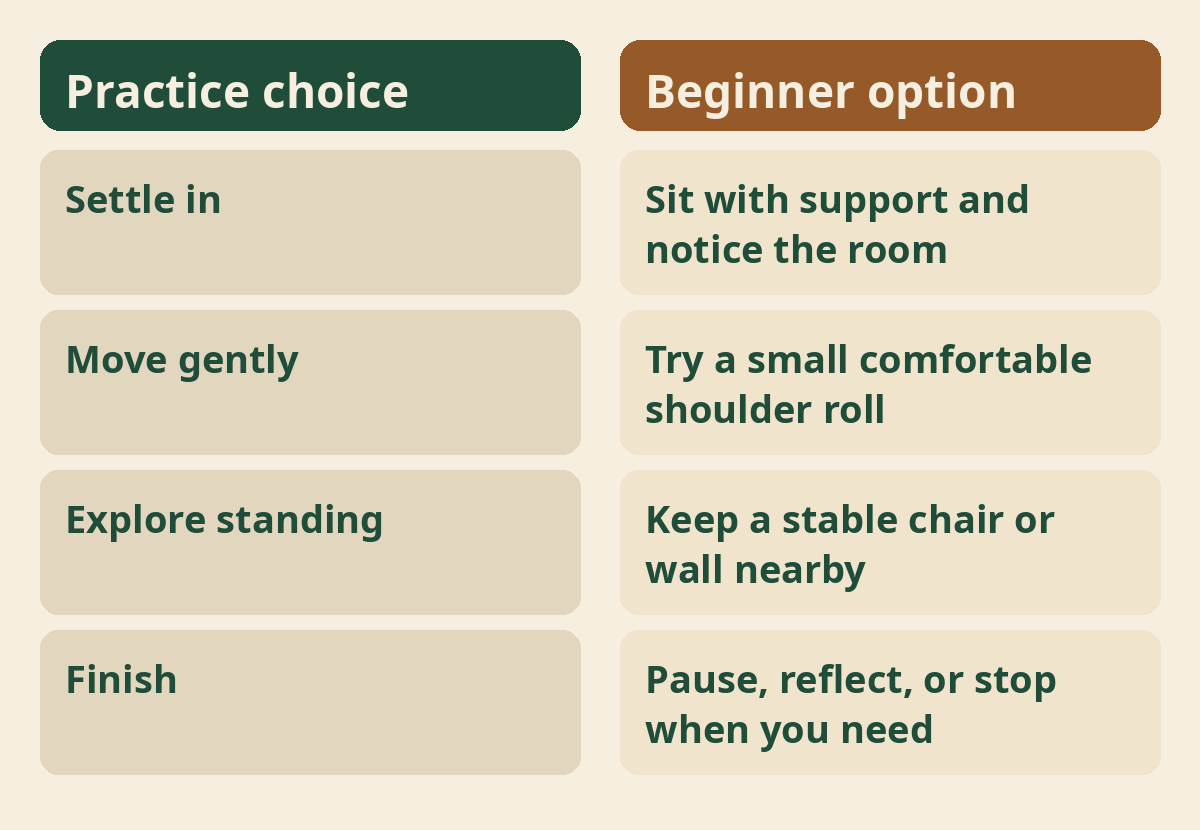
Starting in a steady position gives you time to notice how you feel before moving. Sit in a chair with both feet supported, or lie down only if that feels comfortable and getting up is safe for you. Let your hands rest, look around, and identify any immediate need to change your position. There is no need to close your eyes or alter your breathing. A calm beginning can include ordinary breaths and an open gaze. A short grounding pause can help you arrive.
Notice breath without controlling it
Observing ordinary breathing can anchor attention without making breath a performance. Notice where the breath is easiest to sense, such as at the nostrils or the movement of the ribs. Do not force a deep inhale or hold your breath. If focusing on breath feels uncomfortable, shift attention to your feet on the floor, a nearby sound, or an object in the room. Your practice should allow choice, including choosing a different focus.
Try a seated mountain posture
Seated mountain offers a simple way to explore an upright posture with support. Sit toward the front of a stable chair, feet comfortably grounded, and let your spine lengthen without stiffening. Rest your hands on your thighs. Notice the support beneath you and the space above your head. There is no single correct shape to copy. Adjust the chair or use back support if needed, and keep the posture easy enough to breathe normally. See mountain pose for beginners.
Add a gentle shoulder movement
A small shoulder movement can help you explore motion at a pace you choose. If it is comfortable, draw the shoulders gently up and let them settle, then try a small backward or forward roll. Keep the range modest and stop if there is pain, pinching, or strain. You can do only one movement or none. The useful skill here is noticing your preference, not making the movement large or matching someone else’s range.
Explore a supported standing posture
Standing near a stable support can make a brief balance practice more adjustable. Stand beside a wall or heavy chair that will not slide, with feet at a comfortable distance apart. Keep one hand near the support and feel how your weight meets the floor. There is no need to close your eyes, lift a foot, or hold still. Sit down instead if standing is tiring or feels unsteady, and seek guidance if balance is a concern.
Practise a small weight shift
A gentle weight shift can make balance practice gradual and optional. With both feet on the floor and support within reach, shift a little toward one foot, then return to the middle. Repeat only if it feels comfortable. Keep the movement small enough that you can remain steady, and do not turn it into a challenge. If it feels uncertain, keep both feet still and notice the contact between your soles and the floor.
Use a standing side reach only if comfortable
A modest side reach can be explored without pulling or forcing the torso. Stand or sit with support as needed, let one arm rest by your side, and reach the other hand slightly upward only if that feels natural. Keep both feet grounded and avoid leaning far. Return to neutral before changing sides. Skip the movement if it causes discomfort, dizziness, breath-holding, or worry; there is no need to complete a sequence.
Try a supported forward hinge
A small hinge from the hips is optional and should feel easy to return from. From a seated position, place your hands on your thighs and tip the torso forward a little while keeping the movement comfortable. You may keep your head lifted and your back in its natural shape. Return upright slowly. Skip this if bending is not appropriate for you, if it produces symptoms, or if a clinician has advised against it.
Close with a steady posture
Ending in a position that feels settled can help you notice your experience without grading it. Sit or stand with support and take a moment to notice what is present: warmth, effort, boredom, calm, or no clear change at all. None of these responses earns a better score. If you need to move, stretch, drink water, or stop, do so. Finishing by respecting your needs is a valid ending, even when the session was brief.
Adapt a pose to your day
Adapting a pose is a way to make a thoughtful choice, not a lesser version of practice. Use a chair, wall, folded blanket, or smaller range when it helps you feel stable and comfortable. An instructor can offer options, but you remain free to decline them too. Your needs may change from one day to another. A pose that suits you today may not suit you next week, and that is ordinary information rather than failure.
Rest is part of practice
Resting or stopping is a valid choice whenever you need it. There is no requirement to complete every movement or stay for a full class. Pause, sit, or leave a posture if you feel strain, pain, dizziness, breathlessness that concerns you, or anxiety. If symptoms are severe, new, or do not settle, seek appropriate medical advice. Respecting a limit can reinforce that your choices matter more than a routine or instructor’s sequence.
Let progress be more than flexibility
Progress can include greater comfort with making choices, even when your range of motion stays the same. You might notice that you ask a question sooner, use a prop without embarrassment, or end a session when you have had enough. These are personal observations, not proof that yoga has changed your life. Avoid comparing your body with photographs or other students. The most useful measure is whether the practice fits your own aims and remains appropriate for you.
Use kind, believable self-talk
Self-talk is more useful when it is respectful and believable than when it demands instant positivity. If “I am completely confident” does not feel true, try a smaller sentence: “I am learning,” “I can ask for help,” or “I can pause.” You can say these silently, write them down, or use no phrase at all. The purpose is not to erase doubt but to avoid turning a difficult moment into a harsh judgment about yourself.
Keep attention on your own practice
Returning attention to your own needs can reduce the pressure to perform for a room. A class may include people with different experience, bodies, and movement preferences. You do not need to match their depth, pace, or posture. Look toward the instructor or a neutral point if watching others leads to comparison. Consider a quieter class or home practice if the setting feels distracting. Choosing an environment that suits you is part of taking responsibility for your practice.
Handle beginner nerves with a plan
A simple plan can make attending a first class feel more manageable. Check the location and arrival time, wear familiar clothing, and think of one question you could ask the teacher. You might choose a place near the door or tell the instructor privately that you are new. You can also leave if the class feels unsuitable. Preparation does not guarantee that nerves disappear; it gives you options while they are present.
Build a short routine you can repeat
A brief routine is easier to adjust and repeat than a demanding schedule. Start with five to ten minutes once or twice a week if that fits your health guidance and daily life. Use a clear beginning, one or two comfortable movements, and a pause to finish. A shorter practice is not wasted. If you want longer sessions or have health concerns, ask a qualified teacher or clinician for appropriate guidance.
Choose consistency without punishment
A flexible rhythm can support practice without making missed days a reason for self-criticism. Pick a time that already has a natural pause, such as after waking or before an evening activity, but treat the timing as an invitation. If a day becomes busy, restart when it works. Avoid doubling the next session to make up for a missed one. Your practice belongs in your life; your life does not need to be arranged around a streak.
Record observations, not grades
A short note can help you see what made a practice feel comfortable or difficult. After a session, write down the date, what you tried, what you adapted, and one choice you felt good about. You do not need to score your body, mood, or confidence. Notes can help you remember useful adjustments for a future session. Keep the record private if that feels right, and stop tracking if it becomes another source of pressure.
Notice skills that transfer beyond the mat
The choices you practise in yoga can remind you of choices available in everyday situations. You might take a pause before agreeing to something, speak up when you need clarification, or prepare for a difficult conversation. Yoga alone does not cause these outcomes, and you do not need to force a connection. If a moment on the mat gives you a useful reminder, carry it with you; otherwise, let the practice simply be movement and attention.
Practise boundaries in class
You can set clear boundaries about touch, adjustments, and movements. Instructors may offer hands-on adjustments or invite students into a posture, but you can decline without giving a reason. You can say, “No adjustment, thank you,” or ask for a verbal cue instead. If a teacher ignores your choice, you can leave and consider another class. A respectful environment treats consent and questions as ordinary parts of learning.
Ask questions before or during class
Asking a practical question can help you participate with clearer information. Useful questions include: “Is this class suitable for a beginner?”, “What is an alternative if kneeling is uncomfortable?”, and “Can I rest whenever I need to?” You can ask before class, speak to the teacher privately, or choose not to ask if the setting does not feel safe. A reliable teacher should welcome reasonable questions and avoid pressuring you to ignore discomfort.
Treat a difficult session as information
One uncomfortable or disappointing session does not define your ability or future practice. Perhaps the room was too warm, the pace too fast, or the movements did not suit you. Consider what could be changed next time, such as choosing a different class, shortening the practice, or taking a break. If the difficulty involves pain or a health concern, pause and seek professional advice rather than trying to push through. You are allowed to decide that yoga is not for you.
Know when to seek support
A qualified professional can help when your questions go beyond a general beginner guide. For movement suitability, ask your clinician; for safe technique and beginner options, look for a qualified yoga teacher who explains choices clearly. If low confidence is causing ongoing distress or interfering with daily life, a mental health professional may offer appropriate support. Yoga is not a substitute for mental health care, and asking for support is a capable, practical step.
Use this sample ten-minute outline
A short outline can provide structure while leaving room to skip or change any part. Spend one minute settling in, two minutes noticing ordinary breath, two minutes in a comfortable seated posture, two minutes exploring a gentle shoulder movement, two minutes in supported standing or sitting, and one minute closing. These timings are suggestions, not instructions to push through. Use a chair for the whole practice if appropriate, or stop sooner whenever you need to.
Review your practice with curiosity
A curious review can help you decide whether to repeat, adapt, or leave a practice behind. Ask yourself: What felt comfortable? What would I change? Did I feel able to pause or ask a question? You do not have to report a positive outcome. If the session was not useful, that is enough reason to try a different approach or stop. Confidence is not measured by how much discomfort you tolerate or how often you practise.
Remember that confidence has many sources
Yoga is only one possible part of a broader life that can support self-trust. Relationships, learning, meaningful work, rest, counselling, medical care, and community can all matter in different ways. You do not need to earn confidence by mastering poses. Let your practice be modest and yours. If it helps you make one considerate choice for yourself, that may be enough for today; if it does not help, you are free to choose another path.
Where to read next
For a calm, beginner-friendly start, Ranjana Sinha’s Begin Where You Are is written for people who want simple steps. Our guide to starting a home yoga practice adds a gentle routine you can follow at home.
Frequently asked questions
Can yoga make me confident?
Yoga may offer a setting to practise attention and choice, but it cannot guarantee confidence or replace other support.
Which yoga poses are best for confidence?
Begin with comfortable, supported movements that fit your abilities, and ask a qualified teacher or clinician about personal concerns.
How often should a beginner practise?
Start with a brief, manageable routine that fits your schedule and any health guidance, then adjust based on how it feels.
What if I feel nervous in a yoga class?
Choose a beginner-friendly class, ask about options, and remember you can pause or leave if the setting does not suit you.
Should I practise yoga if I have pain or a health condition?
Ask your doctor or another qualified clinician before beginning, and follow their advice about suitable activity.
The bottom line
Yoga for confidence is not about forcing a pose or proving that you are fearless. It can be a small practice in noticing, choosing, adapting, and stopping when needed. Start gently, ask a clinician about personal health concerns, and keep only the parts that feel appropriate for you. Your worth does not depend on how far you stretch, how often you practise, or whether you finish a sequence.