Tree and Eagle are often grouped as standing balance poses. That does not make them two difficulty levels of the same shape. Tree turns the free knee outward, while Eagle crosses one thigh over the other and usually includes more bending of the standing knee.
The arm choices differ too, but you can separate them from the leg task. This guide compares the arrangements rather than teaching a transition or asking you to master a full wrap. Learn any unfamiliar version with a qualified teacher.
Look at the free leg first
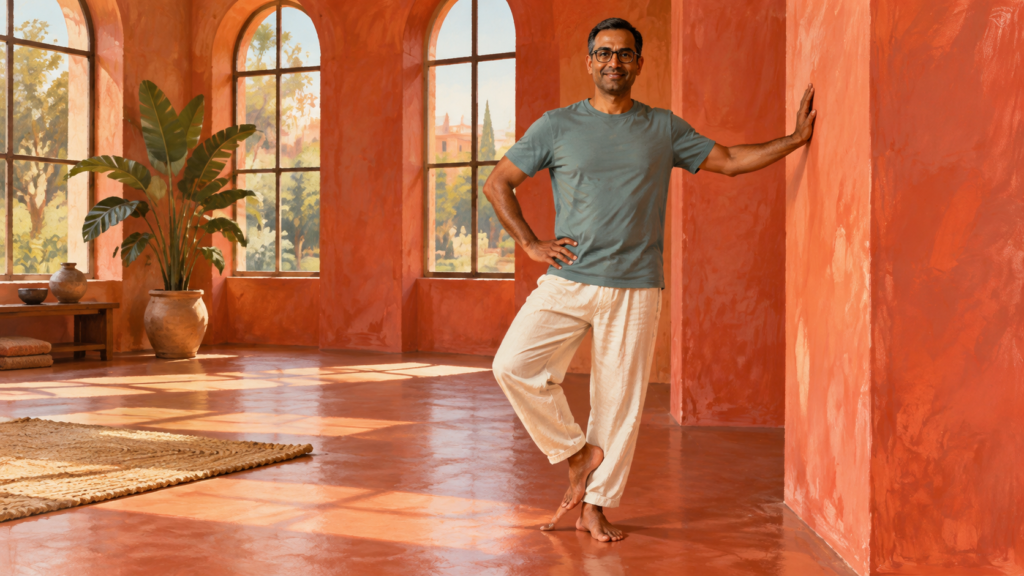
In Tree, or Vrksasana, the free thigh turns outward at the hip. The foot may rest low against the standing ankle with its toes on the floor, or higher against the inner leg in another suitable version. The knee does not have to point directly sideways.
In Eagle, or Garudasana, the free thigh crosses over the standing thigh. Some demonstrations add a foot hook behind the calf, but that hook is not necessary. Teaching references also show the free foot resting on a block or the toes reaching the floor.
Outward placement and a crossed-thigh placement are different tasks. Do not pull a foot or push a knee into position to make either match a photograph. If the leg arrangement is uncomfortable, come back to a steady two-foot position and ask for another choice.
Compare the standing knee, not the height of the foot
Tree commonly keeps the torso upright over a relatively long standing leg. The knee need not be locked. Eagle commonly uses a bent-knee position that resembles part of Chair Pose, with the thighs crossing.
A deep bend is not the goal of Eagle, and a high foot is not the goal of Tree. These are separate variables. A low-foot Tree may still involve balancing; a shallow Eagle may still ask you to manage leg crossing and knee bending together.
Comfort in one arrangement does not establish readiness for the other. Neither is a universal remedy for knee or hip discomfort, and neither needs to become a step toward a more complicated balance.
The arms do not have to join the challenge
Tree often shows hands together at the chest or arms overhead. Eagle often shows crossed arms with the elbows bent and the hands meeting. Those pictures can make the upper-body arrangement seem compulsory.
In Andrew McGonigle’s Eagle variations, a simple self-hug is an alternative to bringing the palms together. His Tree variations include hands on the hips. You can also keep a hand on appropriate support when learning a standing version, instead of giving up useful contact to copy an arm position.
If the shoulders or elbows are the part you want to explore, a teacher may separate the arm arrangement from standing balance. That is different from claiming that a seated or lying version reproduces every demand of the standing pose.
Low foot support means different things
A kickstand Tree can leave the free toes on the floor beside the standing foot. An Eagle variation may place the crossed-over foot on a stable block or keep the toes down. In each case, the support changes the amount of one-leg balancing without making the leg positions identical.
Arrange contact before crossing or lifting. A wall or stable chair should be within comfortable reach, not somewhere you must lunge toward after losing balance. A block should be stable on its chosen face, and a chair must not roll, slide or tip.
The NHS balance-exercise guide also recommends nearby stable support in its own exercises. That is a useful environmental principle, not evidence that every yoga balance becomes suitable when a wall is present.
Keep the return simple
Before choosing a version, know how you will put the free foot down and return to a comfortable two-foot stance. Leave enough room and energy for that return. Do not tighten a wrap or hold longer when fatigue makes unwrapping harder.
Keep the eyes open with a comfortable, steady gaze and breathe normally. Closing the eyes, lifting the arms and removing hand contact each add another change. You do not need to combine them.
A pause between attempts is useful. You can lower the foot and stop without immediately repeating the other side or replacing Tree with Eagle. Being able to stop is part of choosing a manageable task.
Make the choice specific
- Tree: ask about an outward-facing free knee, a suitable foot height and the hand support you need.
- Eagle: ask about a manageable standing-knee bend, thigh crossing and whether to leave out the foot hook and arm wrap.
- Neither: a supported two-foot movement or another appropriate practice may be a better choice today.
This is general education, not a fall-prevention programme or medical advice. Ask your healthcare professional and qualified teacher about joint injuries, recent surgery, pregnancy, dizziness, a history of falls or other balance concerns. Stop for pain, pinching, numbness, tingling, dizziness or unusual breathlessness. Persistent or recurring symptoms need advice, not more balance practice to test them.
For other options, browse the yoga pose library. A suitable supported choice matters more than how high a foot lifts or how tightly the limbs wrap.
Sources and further reading
- Andrew McGonigle at Yoga Journal: 5 Ways to Practice Tree Pose, for outward leg rotation, different supports and arm choices. Eye-closing challenges and universal foot-placement claims are not prescribed here.
- Andrew McGonigle at Yoga Journal: 4 Ways to Practice Eagle Pose, for thigh crossing, foot support, self-hug and non-standing variations. A full wrap is not treated as a required finish.
- Kat Heagberg at Yoga International: Eagle Pose, Step by Step, for separating the components and using foot support. Foot-hooking tricks, forward bows and energetic claims are not adopted.
- Brenda Hamlet at YogaClassPlan: Eagle Pose, for toes-down support, a steady gaze and a controlled return. Deep bends, arm balances and fixed holds are not taught here.
- NHS: Balance exercises, for stable nearby support and controlled movement in its own routine.
- NCCIH: Yoga: Effectiveness and Safety, for qualified instruction and individual modifications.