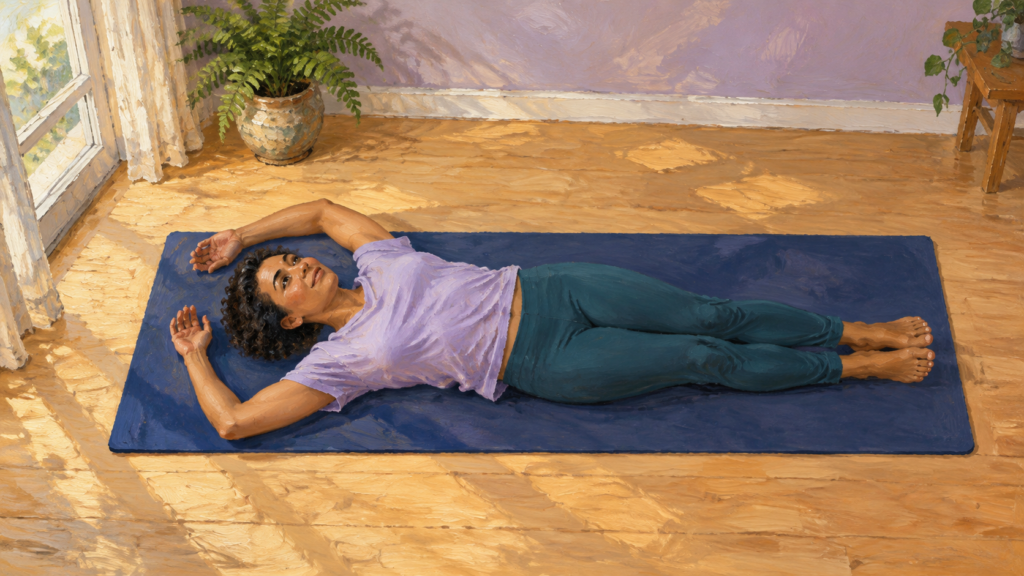
Bananasana, often called Banana Pose or a reclining side bend, makes a gentle crescent shape while you lie on your back. The feet and upper body move toward the same side while the back of the pelvis stays on the mat. Unlike a reclining twist, the aim is not to roll the knees one way and the chest another.
This guide explores a small, supported version. It does not prescribe a long Yin Yoga hold, promise pain relief or require crossed ankles and overhead arms. Learn an appropriate setup with a qualified teacher, especially if lying on your back or moving the shoulders is uncomfortable.
What makes this different from a reclining twist?
In Bananasana, the body curves sideways along the floor. Moving the feet and upper body a little to the right creates a crescent, with the left side forming the outside of the curve. The pelvis remains face up rather than rolling onto one hip.
A reclining twist involves rotation between the pelvis and upper body. These are different movements, even though both happen on the back. If you start turning onto your side to reach farther, reduce the crescent instead of treating the twist as extra progress.
Check the starting position first
Use a firm, comfortably padded surface with enough space for a small sideways movement. Before arranging the crescent, check whether lying face up with the legs extended is comfortable. If it is not, ask about another position rather than assuming the side bend will solve the problem.
Arrange any suitable head or arm support before settling. Consider how you will get down and back up. A reclining pose can still be inconvenient if the floor transfer is difficult.
If you have a back or shoulder injury, do not use this article to decide that the pose is suitable. Yoga 15 advises avoiding it with those injuries. Get individual guidance about alternatives.
A small way to explore the shape
- Begin centered. Lie on your back with the pelvis and shoulders resting comfortably. Keep the legs uncrossed and choose an easy arm position.
- Move the feet a little. Shift them toward one side without rolling the pelvis off the mat. You do not need to slide them as far as they can go.
- Add a small upper-body shift. Move the upper body toward the same side, leaving the pelvis supported. Stop before the movement becomes a pull through the back or shoulder.
- Let the arms suit you. Keep them lower if an overhead position is uncomfortable. Do not use one hand to tug the other wrist.
- Keep breathing ordinary. Make the first exploration brief. There is no minimum stretch sensation or hold time to achieve.
- Return to center. Bring the feet back and lower or rearrange the arms slowly. Pause in a comfortable centered position before considering the other side.
If you cannot make the movement without strain, leave it out. A teacher can help assess whether another arrangement is appropriate; more effort is not the answer to every difficulty.
Do the ankles need to cross?
No. Several Yin Yoga descriptions offer crossed ankles as a way to intensify the position. Boundless Yoga also describes uncrossed legs as an option to lessen tension around the outer hip. Keeping the legs uncrossed is a useful place to begin.
The same applies to clasping the hands or elbows. These are variations, not the definition of the pose. Adding a grip should not become a way to pull yourself farther sideways.
What if overhead arms cause tingling?
Stop and change position rather than waiting out tingling or numbness. YinYoga.com describes bringing the hands down or using appropriate arm support. YogaEasy also warns against tingling in the arms.
Do not treat a bolster as permission to continue through symptoms. If lowering the arms does not settle the problem, leave the pose and seek advice. Repeated, persistent or concerning symptoms need healthcare guidance, not a deeper stretch.
Is a three-to-five-minute hold necessary?
No. Some Yin Yoga sources describe holds of several minutes, while Yoga 15 describes several breaths. Those are different teaching formats, not a universal target for a new practitioner.
This article does not prescribe the longer hold. You can return to center whenever you choose, including before any strong stretch develops. Do not stay because a timer is running or because the other side lasted longer.
When to choose something else
Stop for pain, pinching, tingling, numbness, dizziness or restricted breathing. Keep the movement small and do not force a large inhalation into the stretched side. A side bend is not a breathing-capacity test.
Ask your healthcare professional and teacher about your needs if you have an injury, recent surgery or a condition affecting comfortable movement. During pregnancy, get advice from your maternity team and a qualified prenatal teacher rather than using a general reclining-pose guide. NHS guidance advises avoiding activities that involve lying flat on the back for more than a few minutes in later pregnancy.
Bananasana is an optional movement, not a treatment for back pain, shoulder pain or a medical condition. Claims about meridians in some traditional descriptions are not evidence that this pose treats an organ or disease.
For other pose choices, browse the yoga pose library. Choose a position you can enter, breathe in and leave comfortably rather than trying to complete a catalogue.
Sources and further reading
- YinYoga.com: Bananasana, for the crescent shape, pelvis contact, arm options and exit. Its deeper-edge instructions, long holds and meridian claims are not prescribed here.
- YogaEasy: Bananasana, for setup, return to center and arm-tingling caution. Intensifying strap variations are not taught here.
- Yoga 15: Reclining Side Bend, for the pose description, shorter-hold format and back/shoulder injury caution. Its pain and breathing-benefit claims are not adopted.
- Boundless Yoga: Bananasana, by Chris Loebsack, for uncrossed-leg and arm options and returning to a centered rest.
- NHS: Exercise in pregnancy, for advice about lying flat on the back during pregnancy.
- NCCIH: Yoga: Effectiveness and Safety, for qualified instruction and individual modifications.