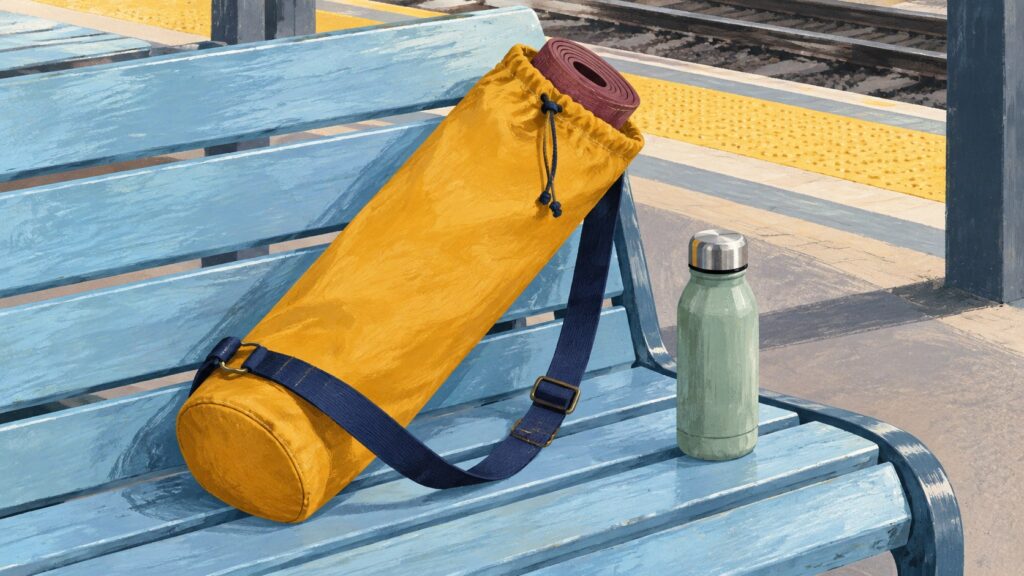
A yoga mat bag is a carrier for moving a mat and, in some designs, a few practice essentials. The useful question is not which bag looks most like yoga equipment. It is whether your actual mat goes in easily, the loaded bag is comfortable to carry, and the care instructions suit your routine.
This guide explains how to check fit, compare openings and straps, separate damp equipment, and look after the bag. It is not a brand ranking. A simple carrier can be enough, and you may not need a bag at all if your mat stays at home.
Start with the trip you actually make
List what you carry and how you travel before comparing bags. A short walk with one mat is different from public transport with clothes, blocks, a towel, and a water bottle. A bag that holds everything may also be a bag you do not enjoy carrying.
Put the usual items together. Remove things that only come along occasionally. Decide whether you want one combined bag or a small mat carrier alongside an everyday bag. Neither arrangement is automatically better.
For a home practice, consider whether moving the mat between rooms really needs a dedicated carrier. Our home yoga practice space guide covers the wider setup. Here the focus is transport, not choosing or storing the mat itself.
Measure the rolled mat, not just its label
A mat’s flat length and thickness do not fully describe the bundle that must pass through a bag opening. Roll your mat in its normal way, following its manufacturer’s instructions. Measure the roll’s length and diameter without squeezing it into an unusually tight cylinder.
For a mat rolled from a short edge toward the other short edge, the roll’s length corresponds to the mat’s width. This is easy to confuse with the much longer flat mat length. Tell the seller which measurement you mean.
Compare these measurements with usable internal bag dimensions and the opening, not only the exterior dimensions. A lining, end seam, zip opening, or separate compartment can reduce accessible space. If the listing gives only outer measurements, ask about compatibility with your mat model.
Keep units consistent. Do not compare a diameter with a circumference or assume that a bag described as standard fits every standard mat. There is no universal clearance rule that this guide can safely apply to every fabric and opening.
Why thickness alone is not a fit guarantee
Two mats with the same advertised thickness can behave differently when rolled. The practical test is the shape and bulk of your own roll. An extra-wide mat also needs a longer carrier even if it is thin.
Barefoot Yoga’s bag FAQ gives different compatibility examples for its regular and extra-large bags, including particular mats and practice rugs. Manduka lists recommended mat models for its Go Steady carrier. These examples show the value of model-specific information rather than proving a size rule for every brand.
If you carry a towel wrapped around the mat, measure that bundle too. Alternatively, choose a separate towel compartment. Do not discover after purchase that the bag fits the mat only when everything else is left behind.
Compare the opening before counting pockets
- Drawstring tube: loads through one end. Check that your rolled mat passes through without catching or needing force. Make sure the closure can secure the contents.
- Full-length zip bag: opens along the side, giving access to more of the compartment. Check that the zip clears the mat and lining without straining.
- Open tote: can make loading simple, but some of the mat may remain exposed. Check whether it shifts or protrudes during carrying.
- Carrying sling: secures the mat without enclosing it. It offers less coverage and generally does not replace a pocketed bag for loose items.
Barefoot Yoga describes its drawstring and zippered styles as different loading arrangements rather than naming one universal winner. A hands-on sewing review by Sewn By Tanya also shows how a side opening provides access to the mat. Your preference depends on where you pack and how easily your mat slides through the opening.
Try the bag with its normal load
An empty bag can feel comfortable while a loaded one does not. If a shop or return policy allows a clean fit test, load the normal equipment, adjust the strap, and walk a short distance. Keep tags and packaging intact until you know the purchase conditions.
Check whether the strap slips, the bag swings into your leg, or the load pulls awkwardly. See whether you can reach the closure and remove the bag without twisting it around your neck. A padded or adjustable strap is a feature to try, not a guarantee of comfort.
Do not keep carrying a load that causes pain, numbness, or tingling. Reduce the load or change the carrying arrangement. If a health condition affects what you can carry, ask your health professional rather than treating a product review as personal advice.
Online discussions can reveal questions worth testing, such as shoulder pressure from a heavy load, but one person’s experience does not establish that a particular bag will suit your body.
Give each pocket a job
Look at how the compartments work when the mat is inside. A pocket that looks roomy in a product photo may become shallow when the main compartment is full. Check access as well as advertised capacity.
A closed pocket can keep keys from becoming loose in the main compartment. A bottle needs a secure position and a sound closure. Keep hard or sharp items from pressing into the mat surface, and do not assume a separate pocket is leakproof.
Manduka’s Go Steady page describes separate compartments for a mat and other equipment. That is a useful design example, not a reason to fill every available space. Adding storage also adds the possibility of carrying more than you need.
Ventilation is not a drying service
Mesh, eyelets, and open sections can allow airflow. They do not establish that a damp mat is dry, and they do not remove the need to unpack after practice. Take the mat out and dry it according to its own instructions before long-term storage.
Keep used towels and damp clothes separate from a clean, dry mat. If you use a temporary wet-item pouch for the journey, empty it afterward rather than leaving wet equipment packed until the next session.
Manduka specifically warns against leaving damp items inside its bag and recommends letting the bag dry fully before reuse. That is more useful than assuming a breathable label means any wet load can remain enclosed indefinitely.
Water resistance and dye transfer are separate checks
A water-resistant outer fabric is not a promise that an entire bag is waterproof. Openings, seams, pockets, and zips still matter. Do not assume a yoga carrier will protect electronics during heavy rain or immersion unless the manufacturer explicitly supports that use.
Color transfer is another issue. Manduka’s carrier care page recommends a cold-water rinse before first use, thorough drying, and keeping damp bags and mats separate, especially with light-colored or porous mats.
Follow that advice for the listed product, not as a universal pre-washing rule for every bag. Check your own label first. A protective liner or towel may change fit, and it is not a substitute for keeping items dry.
Clean the bag according to its own instructions
A washable mat does not make its bag washable in the same way. Read the bag’s label for washing method, temperature, detergent restrictions, and drying. Remove contents and check pockets before cleaning.
JadeYoga recommends cold washing and hanging its organic cotton bags to dry to avoid shrinkage. Barefoot Yoga gives different directions for its fabric groups, including hand washing for cotton velvet. The Gaiam Cargo listing at Dick’s Sporting Goods specifies cold machine washing and flat drying.
These differences are the reason to avoid a single rule such as machine-wash all canvas or tumble-dry all synthetic bags. If the care label is missing, ask the maker before experimenting. Do not use mat-cleaning chemicals on a bag unless its instructions allow them.
Let the bag dry fully before repacking. Check that the lining and seams are dry too, not just the outside. If it has shrunk or no longer closes comfortably, reassess fit instead of forcing the zipper.
Inspect closures and straps before reuse
Look for separating seams, fraying straps, loose attachments, and a zip that catches repeatedly. Empty the bag before investigating a jam. Keep fabric and the mat edge clear of the teeth rather than pulling harder on the slider.
A carrying strap is not an exercise strap, restraint, or bodyweight support. Use it only for the purpose its maker describes. Do not improvise a loaded repair if you cannot tell whether the attachment is sound.
If a bag no longer holds equipment securely, stop carrying it until repaired or replaced appropriately. An unloaded inspection gives you a chance to notice damage before the next trip.
Frequently asked questions
Do I need a yoga mat bag?
No. It can help with transport and loose items, but a secure sling or no carrier may suit a mat that rarely leaves home.
Will a bag for a thick mat fit every thick mat?
No. Check rolled length, diameter, opening, and model compatibility. Thickness alone is not enough.
Can I leave a damp mat in a ventilated bag?
Unpack it and dry it as directed. Ventilation is not proof that the mat or bag has dried.
Can I wash the bag with my yoga clothes?
Only if its care instructions permit the same method and temperature. Check color separation and drying instructions too.
Is a larger bag always better?
No. More capacity can mean a bulkier load. Choose enough space for easy packing without carrying unnecessary equipment.
The bottom line
Choose a yoga mat bag around the mat and journey you already have. Measure the real roll, test the opening and loaded strap, check useful compartments, and read the exact care instructions. Easy packing and reliable everyday use matter more than a long feature list.
Sources and further reading
- Barefoot Yoga: Bag FAQ
- Manduka: Go Steady carrier and care
- JadeYoga: Care FAQ
- Gaiam Cargo listing: Construction and care
- Sewn By Tanya: Hands-on bag review
- Yoga Soul: Bag features guide
About the author: Ranjana Sinha
Ranjana Sinha is a yoga teacher with an MSc in Yoga and an M.PEd in physical education. She previously worked as an assistant professor of physical education and yoga and has taught at Kaivalyadhama Institute. Read more about Ranjana.
This article is general education, not medical advice. Speak with a health professional about your individual needs.