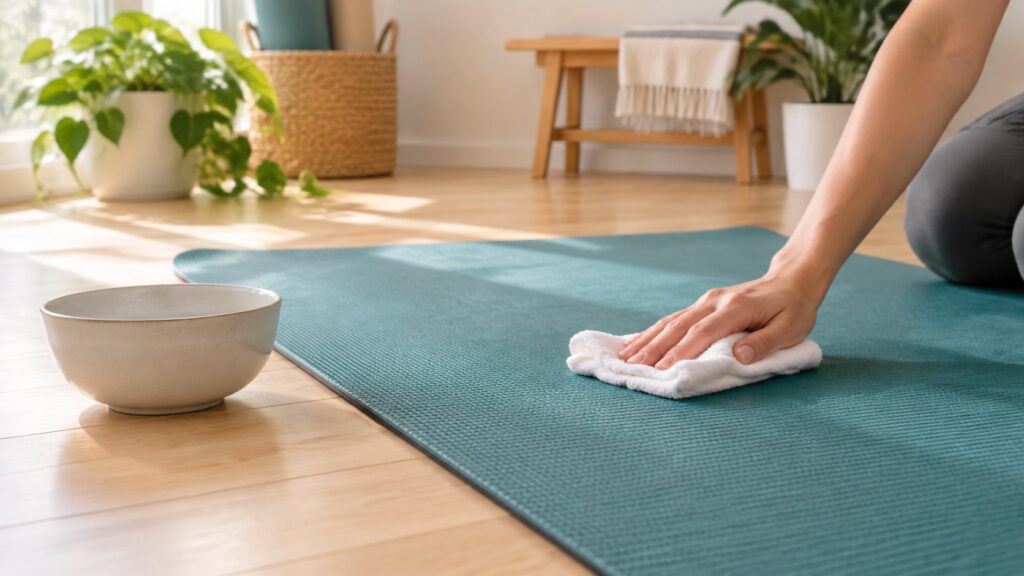
The best way to clean a yoga mat starts with its care label, not a universal homemade spray. Different surfaces tolerate different cleaners. A method that works for one mat can damage another, leave it slippery, or make it harder to dry.
For everyday care, find the maker’s instructions, use the approved cleaning method, remove residue as directed, and let both sides dry completely before rolling. You usually do not need a complicated routine. You do need to know whether your mat can tolerate soap, disinfectant, soaking, or machine washing.
If you are still choosing equipment, the beginner yoga mat guide covers size, cushioning and grip. This guide focuses on caring for the mat you already have.
Start with the exact mat, not just its color
Look for a brand and model on the label, receipt, order history, or product page. Check the care instructions for that particular model. A brand may sell several kinds of mats with different care requirements. The backing and top layer can also be different materials, so the surface you touch does not tell the whole story.
If you cannot identify the mat, avoid experimenting with strong cleaners or putting it in a washing machine. Ask the manufacturer or seller for instructions. A soft cloth lightly dampened with water is a cautious starting point for a small test area, not a promise that every unidentified mat can be safely wet-cleaned.
Manufacturer guidance matters more than a broad rule such as “all rubber mats need soap” or “all foam mats can be soaked.” For example, Manduka says not to use soap on its natural-rubber eKO mats, while other manufacturers give different instructions for their own products.
Cleaning and disinfecting are different jobs
Cleaning removes dirt and other material from a surface. Disinfecting uses a suitable chemical product to kill specified germs. A mat can look cleaner without having been disinfected, and a disinfectant is not a substitute for removing dirt when its label requires a clean surface first.
Cleveland Clinic distinguishes ordinary cleaning of a personal mat from the extra hygiene needs of shared mats. You do not need to treat every ordinary home practice as a contamination emergency. Shared studio equipment needs an appropriate cleaning and disinfection process, but the mat still has to be compatible with that process.
Do not assume that anything marketed as a yoga mat spray is a disinfectant. A scented refresher, homemade mixture, or essential-oil blend does not automatically have a verified germ-killing claim. Read what the product actually says it does.
A practical cleaning sequence
1. Set up somewhere the mat can dry
Choose a clean surface with room to open the mat and good airflow. Keep a soft cloth ready, along with a second clean cloth if your approved method requires a water-only wipe afterward. Move the mat away from heaters and direct, prolonged sunlight unless its instructions explicitly allow that exposure.
Check the underside as well as the top. Cleaning the practice surface while leaving dirt on the backing can transfer that dirt to the floor or to the top when you roll it. Follow the care instructions for both sides, especially if the mat has different materials on each.
2. Check the cleaner before applying it
Use a product and dilution permitted by the mat maker. If mild soap and water are allowed, use the recommended amount rather than adding extra soap for a stronger clean. More cleaner can mean more residue to remove. If the maker specifies water only or a particular type of cleaner, do not substitute a general household spray.
Where the instructions call for a patch test, test a small, unobtrusive area and let it dry before treating the whole surface. Check for a change in color, texture, tackiness, or grip. A patch test cannot prove that a prohibited chemical is safe, so it does not replace the care label.
3. Wipe gently, in manageable sections
Apply the cleaner in the way its instructions describe. Some methods call for spraying the mat; others call for putting cleaner on a damp cloth. Do not flood an absorbent surface just because a different mat’s care video shows a generous spray.
Use light pressure with a soft cloth. Work over the places where hands, feet, and skin contact the mat, then the rest of the surface. Avoid abrasive pads and forceful scrubbing that can damage the texture. For a stubborn mark, repeat an approved gentle method rather than immediately trying a stronger chemical.
4. Remove residue as directed
If the method requires rinsing or a clean-water wipe, do that step thoroughly without soaking a mat that must not be submerged. Residue can affect how the surface feels under your hands. Do not leave soap on the mat because it smells pleasant or because the surface looks dry.
Check your cloth as you work. Once it is dirty, rinse or replace it rather than spreading the same dirt around. Keep cleaning products away from children and pets, and follow the product’s handling instructions.
5. Dry fully before practice or storage
Air-dry the mat as the maker recommends, flat or supported over a suitable rack. Make sure both surfaces are dry before rolling it up or putting it in a bag. Avoid placing a wet mat over a dirty surface or a support that could leave marks.
Do not plan a thorough clean just before you need the mat. Drying time varies with the mat, the amount of water used, ventilation, and the room. Rather than relying on a fixed timer, check the mat itself. Use it only when it is dry and its grip feels suitable for safe practice.
Material questions that change the answer
On a small screen, swipe the table sideways to read all columns.
| Mat or surface | What to check before cleaning |
|---|---|
| Natural rubber | Whether soap is allowed; which cleaner the maker approves; restrictions on sun, heat, and soaking. |
| Polyurethane or an absorbent top layer | Whether liquids or disinfectants can be absorbed; permitted cleaning products and residue-removal steps. |
| Cork or a layered mat | Care for the top and backing; whether soaking could affect the layers; drying instructions. |
| PVC or TPE | Model-specific cleaning and heat restrictions. Do not assume a closed-cell mat can be submerged. |
| A washable textile mat or rug | Whether machine washing is explicitly allowed, plus temperature, spin, detergent, and drying rules. |
These are checks, not interchangeable recipes. Ruth White allows machine washing for certain named mats but gives wipe-clean instructions for others. Manduka prohibits machine washing for its mats other than its Shala Yoga Rug. That difference is why the exact model matters.
How often should you clean a yoga mat?
Use the manufacturer’s guidance and the way you use the mat. Visible dirt, sweat, outdoor use, and shared use create different needs. A brief approved wipe after a sweaty practice may be useful, while a deeper clean should follow the mat’s actual condition and care instructions.
You will see different schedules online. Cleveland Clinic says a personal mat can be cleaned when visibly dirty, while manufacturers may recommend wiping after each practice. These are different contexts and recommendations, not a reason to invent one compulsory schedule for every mat.
A simple routine is to inspect the mat after practice, deal with dirt or moisture using the approved method, let it dry, and store it properly. If you use a shared mat, ask the studio what its cleaning process is and whether it is appropriate for that equipment.
When disinfection is needed
For shared equipment, follow the facility’s hygiene process and the mat maker’s compatibility guidance. Use a disinfectant labelled for the intended use, and follow its directions, including any required cleaning first, contact time, residue removal, and drying.
Contact time means the surface must remain in the condition specified on the disinfectant label for the stated period. A quick spray followed by an immediate wipe is not necessarily disinfection. Do not borrow a contact time from an unrelated product.
Some absorbent mats are unsuitable for disinfectants. Manduka, for example, says not to use them on its GRP mats because liquid can be absorbed and cannot be thoroughly cleaned out. If equipment cannot be safely disinfected using the process you need, ask the maker or facility for a suitable alternative rather than improvising.
Common cleaning mistakes
- Using a universal vinegar recipe. Do not assume vinegar is approved for your surface or that a homemade mixture disinfects it.
- Adding essential oils directly. Oils can leave a slippery surface. “Natural” does not mean suitable for every mat.
- Soaking first and reading later. Several manufacturers prohibit submerging particular mats. Check before using a bathtub, hose, or shower.
- Using heat to hurry drying. Avoid radiators, dryers, and strong sun when the care instructions prohibit them.
- Rolling while damp. Give both sides time to dry instead of trapping moisture inside a bag or tight roll.
- Mixing cleaners. Do not combine cleaning chemicals. Follow one approved product’s instructions.
What if the mat still smells or feels slippery?
Check whether it is completely dry and whether cleaner remains on the surface. Follow the approved residue-removal method and allow it to air out as directed. Do not cover an unexplained smell with a stronger fragrance or keep adding different cleaning products.
If the surface is peeling, cracked, unusually sticky, or losing grip, cleaning may not fix the problem. Ask the manufacturer whether the condition is expected or whether the mat should be replaced. Stop using a mat that no longer gives you stable footing. A towel is not a reliable repair for a damaged surface.
Frequently asked questions
Can I put my yoga mat in the washing machine?
Only when the care instructions for that exact mat explicitly allow it. Some textile products and certain named mats are washable; many other mats are not.
Can I use dish soap on every yoga mat?
No. Some manufacturers allow a mild soap solution for particular mats, while others prohibit soap on specific materials or models. Check before using it.
Does a nice-smelling mat spray disinfect the mat?
Not necessarily. A cleaner or refresher is not automatically a disinfectant. Check the product’s labelled purpose and whether it is compatible with your mat.
Can I roll my mat as soon as the top feels dry?
Check the underside too. Store the mat only when both sides are completely dry, following the manufacturer’s instructions.
Should I clean a shared studio mat?
Follow the studio’s cleaning and disinfection process. Ask what products and steps are suitable for its mats rather than applying an unknown household cleaner.
The bottom line
Good mat care is specific rather than complicated. Identify the mat, follow its approved cleaning method, distinguish cleaning from disinfection, and allow complete drying. When instructions conflict, use the guidance for your exact model rather than a generic recipe.