People often ask me how to start yoga. They worry about being stiff, being busy, or not doing it right. I wrote my book, Begin Where You Are, for exactly these worries.
Here are 20 lines from the book that I keep coming back to when I talk with beginners. Under each one I explain what I meant, in plain words, and how you can use it in your first weeks of yoga. Page numbers are from the printed book.
1. Start from where your body is today
In my book I wrote:
"Stiffness is honest; it tells you exactly where the work is."
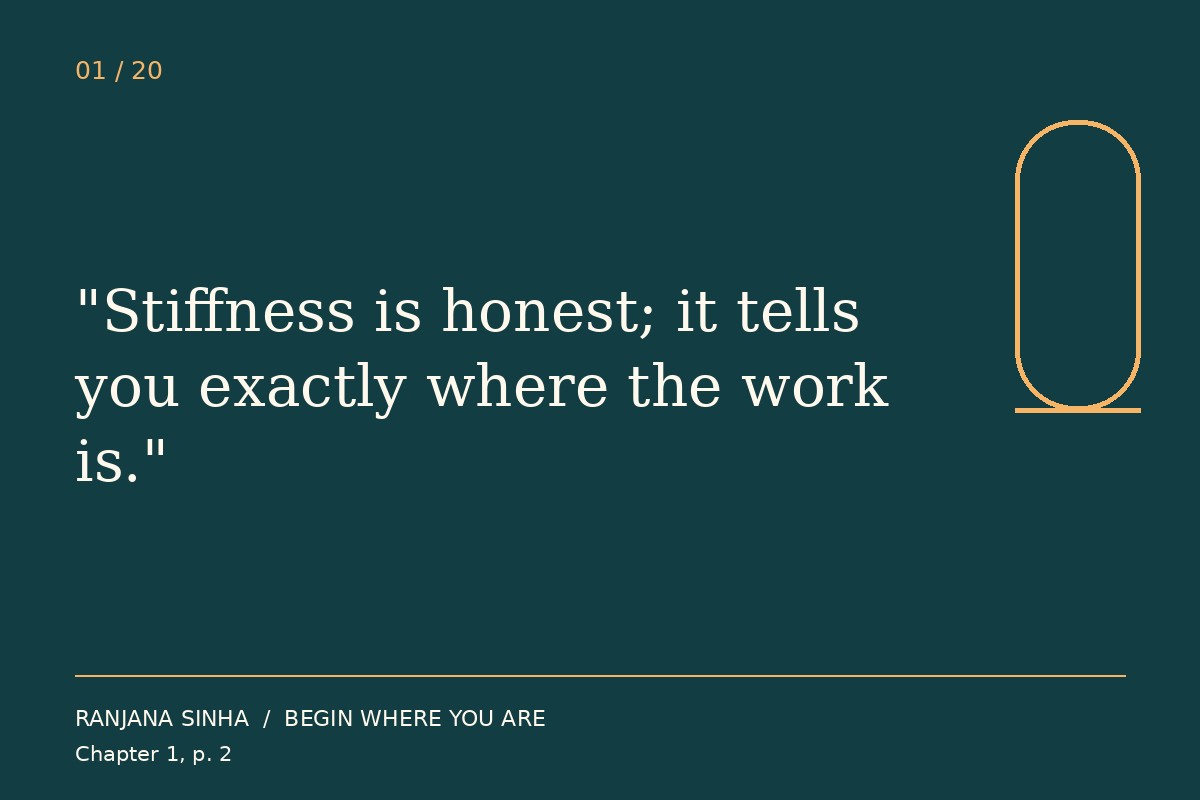
I wrote this for everyone who says, "I'm too stiff for yoga." Stiffness is not a flaw. It simply shows you where your body is today. If you are wondering how to start yoga, begin there, gently, and do not force your body to look like a photo.
2. Count the ordinary days
In my book I wrote:
"The days it feels like homework are not failures. They are the days the habit is actually being built."
Some days you will feel eager. Other days you will practice because you said you would. In my book I wanted you to know that both kinds of days count. A short practice on a dull day is how a habit really forms.
3. Pick a plan you can keep
In my book I wrote:
"An ambitious plan is a wonderful way to feel virtuous for four days and defeated for the rest of the year."
I have seen many beginners start with an hour a day and stop by the end of the week. Start smaller than you think you need to. Ten manageable minutes you actually do beat an hour you keep postponing.
4. Use poses as a way in
In my book I wrote:
"The poses are the doorway, not the house. But a doorway matters."
The poses are a good, practical place to start, and I teach them for that reason. But yoga is more than shapes. Breath and attention are part of it too. Let the poses be your doorway, then explore what is inside.
5. Bring your attention along
In my book I wrote:
"The difference is not in the limbs. It is in the attention."
Two people can make the same movement and have a very different experience. What changes it is noticing: your breath, your effort, how comfortable you are. Try to take part in each pose, instead of just getting through it.
6. You do not need to perform
In my book I wrote:
"Yoga is not a performance. There is no pose you owe anyone, no photograph you must be able to take."
Many new students worry they are not good enough. You do not have to prove anything. A simpler version, a supported pose or a rest all belong in yoga. Nobody is watching to give you a score.
7. Let your breath be enough
In my book I wrote:
"The breath is not the warm-up for the practice. It is the practice, wearing its simplest clothes."
If you are not sure how to start yoga, start with the breath. Slow, comfortable, unforced breathing is already practice. Please do not rush past it to get to something that looks more impressive.
8. Arrange your life to help you
In my book I wrote:
"Enthusiasm is weather. Arrangement is climate."
Motivation comes and goes like the weather. What you can control is the climate: a regular time, a clear corner, a mat that is easy to reach. These small arrangements carry you through the days when excitement has passed.
9. Tie your practice to something you already do
In my book I wrote:
"A habit that floats free in the day will be carried off by the day. A habit tied to something immovable stays put."
"I'll practice sometime today" usually turns into "not today." Attach your practice to something that already happens, such as after brushing your teeth or before your evening tea. The familiar cue does the remembering for you.
10. A missed day is not a failure
In my book I wrote:
"A broken streak is a fact, not a verdict."
If you miss a day, or a week, it only tells you what happened. It does not say anything about you. I do not want you to turn one missed session into a reason to quit. Pick a small next step and take it.
11. Come back without blaming yourself
In my book I wrote:
"There is no judge. There is a mat. Return to it."
When you have been away for a while, it is tempting to feel you owe an apology. You do not. Roll out the mat, do something small and kind, and begin again.
12. Let the practice outlast the plan
In my book I wrote:
"The plan ends; the practice does not."
My book includes a thirty-day plan. This line is for the day you finish it. You can repeat the routines you liked, try new ones, or join a class. The plan gets you started, and what comes next can fit your own life.
13. Learn from a teacher too
In my book I wrote:
"A teacher who can see you answers questions no book can hear."
A book can only give general guidance. It cannot watch you move or hear what you are unsure about. A teacher can see how you are doing and answer what you did not know to ask. That is why I encourage you to try a class once you have started.
14. Be patient with a busy mind
In my book I wrote:
"The mind is not the enemy of practice; it is the student."
A wandering mind does not mean you are doing it wrong. Every beginner has one. When you notice your thoughts have drifted, gently bring your attention back. That returning is part of learning.
15. You do not have to be flexible first
In my book I wrote:
"Stiffness is a starting point, not a disqualification."
Nobody has to become flexible before they are allowed to begin. Choose movements and supports that suit you now. This is encouragement to start where you are, not to push through pain.
16. Respect your doctor's guidance
In my book I wrote:
"Practicing within a doctor's circle is not limitation; it is precision."
The "circle" is the set of boundaries your doctor gives you about what is right for your body. Working inside it is a careful choice, not a lesser practice. If you have a health condition, please follow your own doctor's advice over any routine you see online, including mine.
17. Read the old texts as friendly company
In my book I wrote:
"They are not rules. They are letters from earlier students."
Here, "they" means the old yoga texts. I like to think of them as letters from people who asked questions much like yours. You can read them with curiosity, instead of treating each line like a test to pass.
18. Short sessions still build a lasting habit
In my book I wrote:
"The chain matters more than the length of any link in it."
The chain is your practice over time, and each link is one session. A short session on a busy day keeps the chain going. Read this together with the line about a broken streak: it is encouragement to keep returning, not pressure never to miss.
19. Look after your practice a little at a time
In my book I wrote:
"A practice is not a monument you build once; it is a path you sweep daily, and sweeping takes two minutes on the days the wind has been through."
A practice needs ordinary, regular care more than one big effort. On hard days, make the step smaller, even two minutes. Life gets messy, and that is not a reason to leave the path.
20. Begin with the life you have
In my book I wrote:
"Stand tall. Breathe slowly. Begin where you are; there is no other place to begin."
You do not need a quieter house, a more flexible body or a perfect Monday. Choose a small, comfortable beginning that is possible today. This is the idea behind the title of my book.
A small beginning is still a beginning
If you take only one thing from these lines, let it be this: yoga does not have to look impressive to be worth returning to. Start small, keep what is manageable, find a teacher when you want personal guidance, and begin again without blaming yourself for the last missed day.
If you would like to read more, Begin Where You Are is available on this site.
Source: Ranjana Sinha, Begin Where You Are. This article is general reading for beginners and not individual medical advice. If you have a health condition, check with your doctor before you start.